

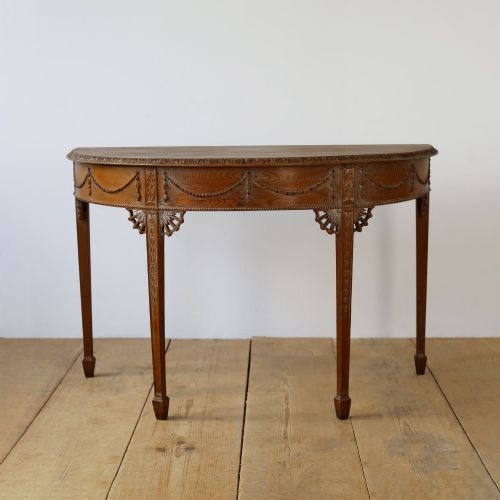
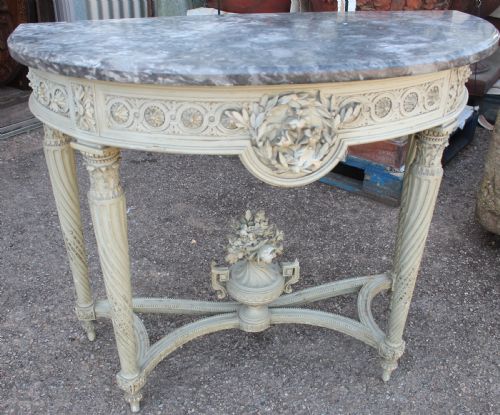
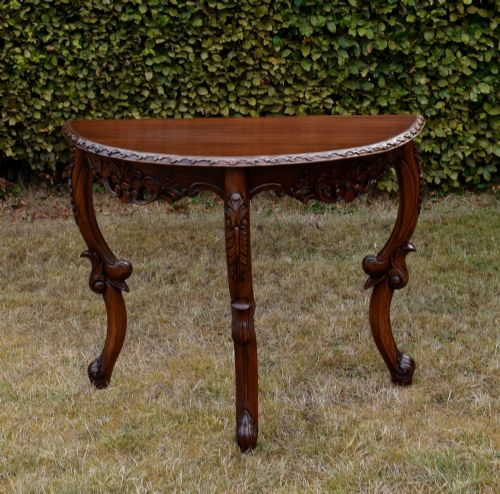


Crescent Wall Table
A crescent wall table fits tight against the plaster, offering a neat semi-circular surface for lamps and letters.
Crescent Wall Table
A crescent wall table, also known in the trade as a demi-lune console, provides a flat straight edge to stand against a wall while curving outward into the room. These pieces appear in forms ranging from the plain painted timber of Swedish workshops to grander inlaid designs in mahogany and satinwood.
Most examples found on this page date from the nineteenth and early twentieth centuries, spanning the Edwardian era back to Georgian and Regency inspirations. Buyers typically encounter console tables designed to stand in hallways, parlours or beneath matching wall mirrors.
Makers drew on Louis XVI Neoclassical, Grand Regency, and Gustavian styles to shape these semi-circular surfaces. The physical evidence shows console tables adopting forms from Chinese antique interpretations to Dutch provincial work.
How they were made
Cabinetmakers built these semi-circular frames using dense timbers like mahogany, rosewood, and satinwood, often applying intricate marquetry and fine wood inlays across the top surface. Pine and general painted wood served as the foundation for pieces finished with decorative pigments in the Swedish and Dutch traditions.
Many of these console tables incorporate contrasting veneers and delicate stringing to define the curved edge. Glass and marble also appear as surfacing elements, adding weight and a cool tactile contrast to the wooden structures.
Crescent Wall Table Retail Price Guide 2026
Typical asking prices for crescent wall table among the pieces listed under this phrase on Sellingantiques today, from the lower quarter to the upper quarter. They describe what is for sale here now, not the wider market.
Listings feature mahogany, satinwood, and painted wood surfaces spanning the eighteenth to the twentieth centuries.
What varies in quality
Quality rests in the precision of the timber matching and the subtlety of the marquetry across the curved top. Finer examples display harmonious grain selection and crisp inlay work that follows the strict geometry of the semi-circle.
Structural integrity in the leg joints and the stability of the wall-fixing mechanisms dictate the worth of a piece. Tables with matched components, such as a corresponding wall mirror, demonstrate a higher original commission standard.
Edward and Roberts
The Crescent Wall Table Glossary
- Demi-lune
- A half-moon shape used to describe tables designed to stand flush against a wall. This profile maximises floor space in narrow hallways.
- Marquetry
- The art of applying decorative veneer pieces in various woods to form geometric or pictorial patterns. It covers the flat surfaces of finer console tables.
- Satinwood
- A durable, yellowish timber prized for its smooth grain and natural sheen. Cabinetmakers utilised it extensively during the Edwardian period.
- Console table
- A table supported by wall brackets or legs, designed to sit against a vertical surface. The evidence shows these often take semi-circular forms.
Crescent Wall Table: Frequently Asked Questions
Where should I place a crescent wall table?
These tables suit narrow entrance halls and landings where a full-depth rectangular table obstructs movement. Their flat back sits securely against the plaster while the curved front softens the geometry of a hallway.
Pairs of these tables work well flanking a fireplace or positioned beneath a matching wall mirror in a formal sitting room. Their shallow depth keeps floor space open.
How do I identify a Edwardian table?
Edwardian tables often feature light satinwood surfaces, delicate floral marquetry, and slender tapered legs. The timber preparation reflects early twentieth-century mechanical improvements in veneer slicing.
Comparing the edge details and inlay patterns against nineteenth-century precedents helps confirm the Edwardian period. The lighter colour palettes distinguish them from darker Georgian walnut and mahogany.
Can these tables stand without wall support?
Many console tables require attachment to the wall for complete stability because of their half-moon geometry and slender legs. Historical designs often relied on a rear bracket or wall fixing to prevent tipping.
Modern placement should account for this structural requirement, particularly on polished floors. Checking the original leg configuration reveals whether a piece was built as a freestanding centre table or a wall-anchored console.
What is the difference between console and centre tables?
A console table is designed with one flat side to stand against a wall, whereas a centre table is finished on all sides to stand in the middle of a room. Some nineteenth-century examples blur these categories through adaptable framing.
Examining the back edge of the timber top clarifies the intended placement. Unfinished rear edges indicate a piece strictly made for wall positioning.