
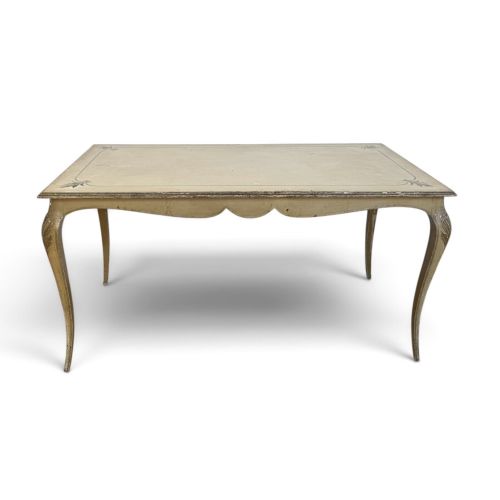
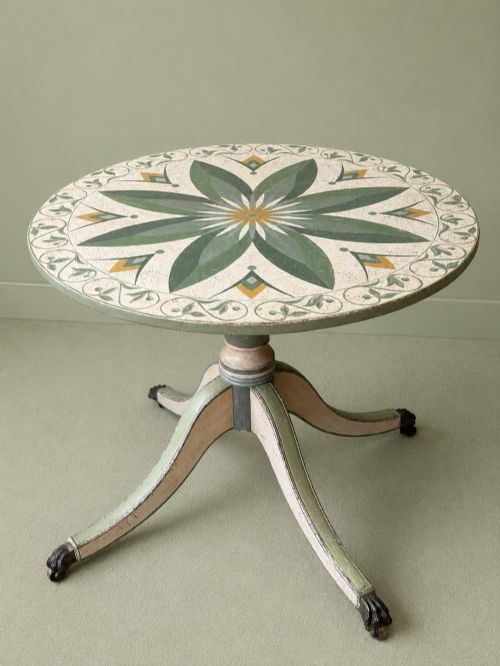
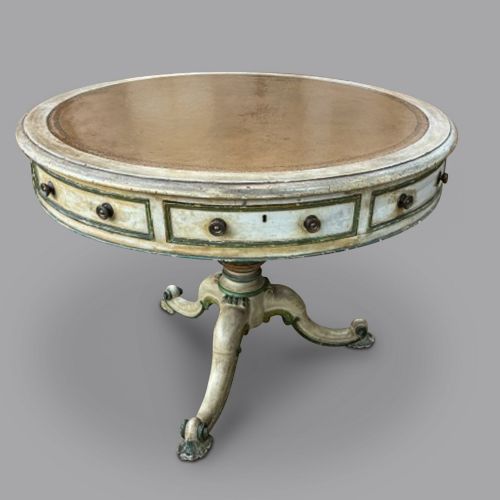
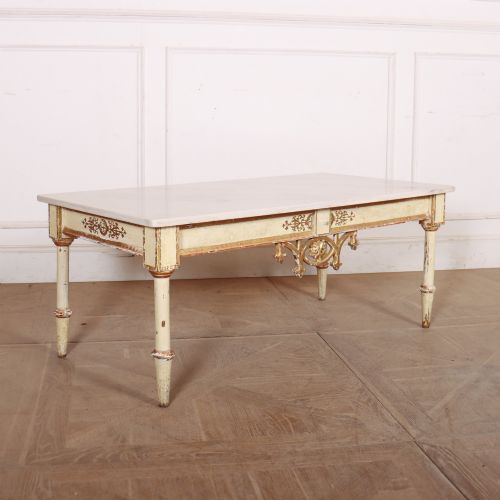


Cream Painted Centre Table
A cream painted centre table brings architectural presence and painted charm to a room, offering surface space with an aged finish.
Cream Painted Centre Table
When you search for a cream painted centre table, you examine circular or rectangular freestanding pieces designed to stand in the middle of a room rather than against a wall. These items emerge from the nineteenth century, the Victorian era, and the early twentieth century, spanning styles such as French Louis XV Revival, Italian Neoclassical, Regency, and English Country.
The most frequent versions encountered on this page are occasional tables, coffee tables, and dining or breakfast tables finished in muted painted wood or timber. Their forms include tilt-top mechanisms, drum bodies, and marble tops, often carrying traces of gold leaf or hand-decorated motifs.
Materials and construction
These tables rely on wood, timber, and pine as their structural foundation, shaped into pedestals, turned legs, and circular or rectangular tops. Artisans applied layers of paint over wood surfaces, sometimes accentuating carved details with gold leaf or creating decorative finishes such as Chinoiserie.
Specialised variants incorporate inset marble tops or tilt-top mechanisms requiring functional hinges and stabilising pedestals. The application of paint and surface decoration defines the exterior character across French, Italian, English, and Swedish workshops.
Some tilt-top tables were engineered to fold completely flat so busy Victorian households could reclaim their floor space for dancing when evening arrived.
Assessing quality and craftsmanship
The distinction between tiers rests upon the execution of the woodwork, the integration of materials like marble or cast metal, and the handling of the painted finish. Tables featuring hand-decorated surfaces, carved detailing, and well-balanced tilt-top mechanisms demonstrate greater artisanal investment than simpler utilitarian forms.
Provenance and stylistic coherence also shape the character of each piece, whether it follows strict Venetian or French Louis XV Revival lines or simpler English Country vernacular.
The Cream Painted Centre Table Glossary
- Centre table
- A freestanding table designed to be viewed from all sides and placed in the middle of a room rather than pushed against a wall. These surfaces function as focal points in large halls or reception spaces.
- Tilt-top table
- A table featuring a hinged mechanism that allows the wooden top to pivot vertically when not in use. This design saved floor space in historic interiors.
- Drum table
- A circular table with a deep, cylindrical frieze containing drawers, typically supported on a central pillar and tripod base. They originated as library and study furniture.
- Chinoiserie
- A European decorative style employing fantastical interpretations of Chinese artistic motifs. It frequently appears on early twentieth-century painted furniture.
- Louis XV Revival
- A nineteenth-century design movement resurrecting the flowing asymmetrical curves, cabriole legs, and naturalistic ornamentation of the French Rococo period.
Cream Painted Centre Table: Frequently Asked Questions
Where should I place a centre table?
These tables belong in the middle of a spacious room, an entrance hall, or a large landing where they can be approached from all sides. They serve as display surfaces for lamps, ceramics, or books.
Ensure there is adequate clearance around the perimeter for movement, as their freestanding nature requires spatial breathing room to display their proportions.
How do I care for a painted wood surface?
Dust the painted wood regularly with a soft, dry cloth to prevent dirt accumulation. Avoid harsh chemical cleaners that can degrade historic paint layers or gold leaf.
Use coasters and placemats to protect the painted or marble surface from moisture and heat damage during daily use.
What is the difference between an occasional table and a centre table?
An occasional table is typically smaller and designed to be moved around a room to serve a temporary function. A centre table is larger, heavier, and anchored visually as the primary furniture piece in a space.
Centre tables often feature more elaborate pedestals and surface decorations intended for permanent display.