
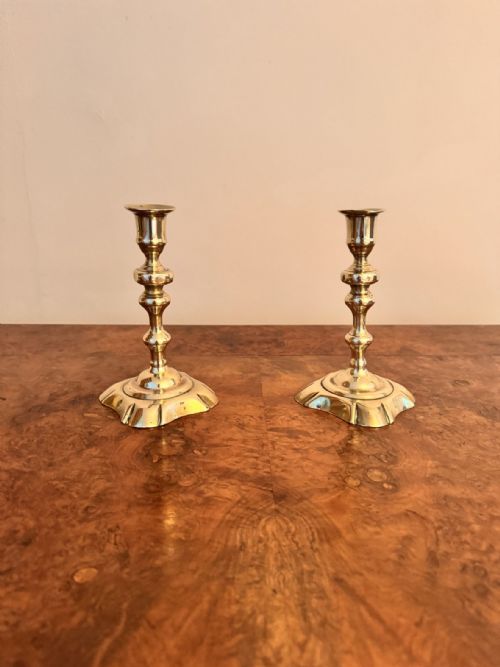
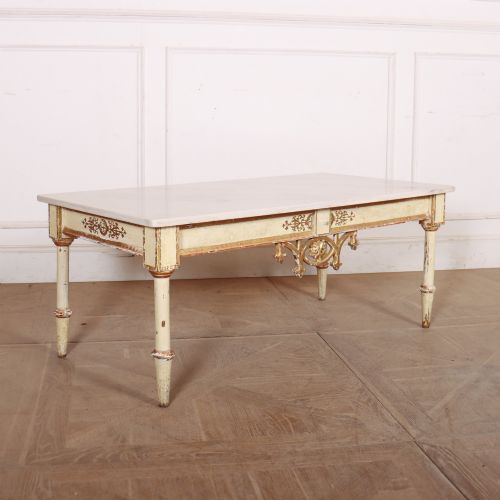


Eighteenth Century Style Table
These pieces built in an eighteenth century style table design bring classical proportion and rich timber into a room.
Eighteenth Century Style Table
When you search for an eighteenth century style table, you encounter furniture built across several later periods that borrows the proportion, ornament, and form of the Georgian and neoclassical eras. The selections on this page span from original eighteenth century examples to later nineteenth and early twentieth century interpretations.
The forms vary widely across the surviving pieces, including side tables, console tables, coffee tables, desks, and tea tables. These items reflect both British Georgian idioms and continental European tastes, such as Italian neoclassical and French rococo aesthetics.
Mahogany remains the dominant wood across the listings, often complemented by painted surfaces, gilt highlights, and satinwood. Buyers frequently meet pieces featuring characteristic details like serpentine fronts, tripod bases with pie crust edges, and demi-lune shapes.
How they were made
Cabinetmakers constructed these tables primarily from solid mahogany and wood veneer, employing traditional joinery to build sturdy frames and polished surfaces. Skilled hands shaped timber into complex forms such as serpentine curves and demi-lune silhouettes.
Surface decoration involved meticulous work, including hand painting on wood, the application of gilt, and delicate satinwood veneers. Brass hardware and mounts frequently finished the pieces, adding structural accents and decorative contrast.
The listings span from the eighteenth century through the nineteenth and twentieth centuries, featuring mahogany, painted wood, and marble.
What varies in quality
Quality rests upon the crispness of the carving and the depth of the timber selection, where tightly grained mahogany commands greater admiration than plainer woods. The execution of fine details, such as carved mouldings and fitted drawer interiors, distinguishes superior workshop production.
The integrity of surface treatments also sets pieces apart, particularly in hand-painted items and gilded ornamentation where the skill of the decorator determines the visual balance. Original brass fittings and the preservation of polished timber surfaces contribute significantly to the standing of an item.
The Eighteenth Century Style Table Glossary
- Demi-lune
- A half-moon shape characteristic of small side and tea tables designed to sit flat against a wall.
- Serpentine
- A curved line that undulates inward and outward, frequently seen on the fronts of sideboards and desks.
- Pie crust edge
- A raised, carved moulding along the perimeter of a tabletop, resembling the pastry crust of a pie.
- Tripod table
- A small occasional table supported by a central pillar resting on three spreading feet.
- Satinwood
- A durable, yellowish timber often used for veneering and detailed inlay work on finer furniture.
Eighteenth Century Style Table: Frequently Asked Questions
How do I spot an eighteenth century style table?
Examine the timber, the construction joints, and the decorative motifs such as carving or painted decoration to understand when a piece was built.
Compare the proportions and secondary woods against known period examples to differentiate between an original eighteenth century piece and a later revival item.
Where should I place a console table?
Console tables sit comfortably against a hallway wall or beneath a mirror in a principal reception room.
Their shallow depth allows them to occupy narrow spaces without obstructing movement while providing a surface for lamps or decorative objects.
What is a pembroke table?
A pembroke table is a small, versatile table featuring two hinged drop leaves on either side.
Cabinetmakers originally designed them for breakfast use or as writing surfaces that could expand when needed.
How do I care for mahogany furniture?
Keep wooden surfaces away from direct sunlight and steady heat sources to prevent the timber from drying and splitting.
Apply natural beeswax polish occasionally and buff gently with a soft cloth to maintain the lustre of the finish.