
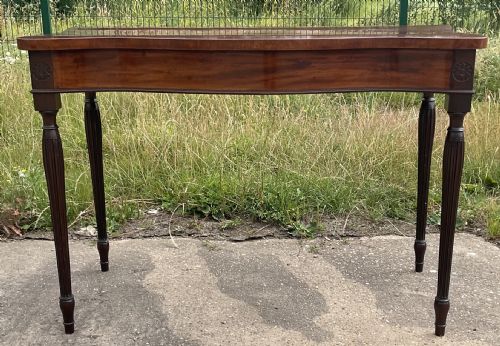

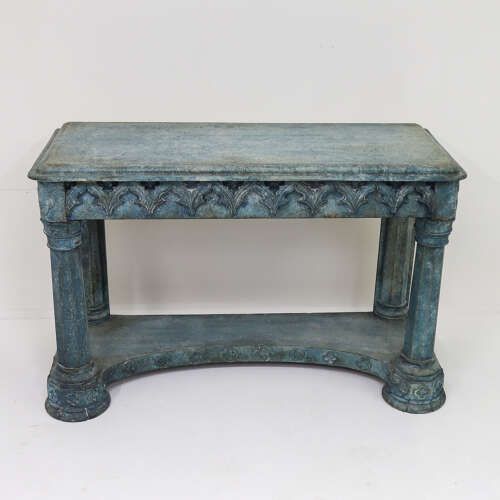


Carved Timber Entry Table
A carved timber entry table brings structure and architectural weight to a hallway, offering a solid surface matched to narrow spaces.
Carved Timber Entry Table
A carved timber entry table serves as a statement piece in a hallway, vestibule, or reception room. These items encompass console tables, pier tables, centre tables, and altar forms designed to stand against walls or anchor open spaces.
Buyers encountering this selection will find formats ranging from Georgian style serpentine and breakfront mahogany designs to narrow pitch pine freestanding tables and painted French cherry consoles.
Origins and influences span diverse aesthetic traditions including Anglo-Indian padouk pieces, Gothic taste painted consoles, Adam design demi-lune formats, and Chinese altar tables dating across the eighteenth and nineteenth centuries.
Materials and construction methods
Construction relies upon traditional hardwoods and softwoods such as mahogany, rosewood, padouk, pine, cherry, and mixed hardwoods. Master artisans shaped these woods using hand-carving techniques suited to intricate details like Corinthian capitals and classical revival motifs.
Surface treatments incorporate decorative painted wood finishes alongside exposed timber grains. Several examples integrate inset marble tops that provide a durable and cool surface contrasting with carved wooden bases.
Current listings feature timber entry tables spanning the eighteenth century, the Victorian era, and early twentieth-century revivals.
Assessing quality and craftsmanship
Quality reveals itself in the depth and crispness of the carved detailing, distinguishing mechanical execution from skilled hand-carving. The choice of primary timber, such as dense padouk or figured mahogany, directly dictates the refinement of the finished piece.
Proportion and scale separate standard regional pieces from high-status interpretations, particularly in specialised forms like serpentine fronts, demi-lune shapes, and breakfront layouts.
The Carved Timber Entry Table Glossary
- Console Table
- A table designed to stand against a wall, frequently fixed to the architectural structure or supported by front legs. These items are traditional choices for entryways and reception rooms.
- Pier Table
- A specialised console table specifically built to stand against the wall space between two windows. They often sit beneath a matching wall mirror.
- Demi-Lune
- A half-moon shape characteristic of tabletops and commodes designed during the eighteenth and nineteenth centuries. This curved profile saves valuable floor space in narrow hallways.
- Serpentine Front
- A table front featuring a convex centre flanked by concave curves, or vice versa. This undulating contour demands advanced woodworking skill.
- Breakfront
- A piece of furniture where the central section projects forward from the flanking sections. It adds visual depth and architectural presence to formal console tables.
Carved Timber Entry Table: Frequently Asked Questions
Where should I place a carved timber entry table?
These tables find their natural home in hallways, corridors, and entrance foyers where space is often at a premium. Their shallow depth allows them to sit flush against walls without obstructing thoroughfares.
They also work effectively in reception rooms beneath mirrors or artwork, providing a convenient surface for lamps and decorative objects.
How do I distinguish between console and centre tables?
Console tables are engineered specifically to stand flat against a wall, often featuring finished fronts and simplified backs. Centre tables are freestanding objects designed to be viewed from all four sides in the middle of a room.
While some narrow formats overlap in function, checking the finishing of the rear edge usually clarifies the original intended placement.
What is an Anglo-Indian entry table?
Anglo-Indian tables represent furniture produced in the Indian subcontinent during the British colonial period, typically combining British form with local craftsmanship and exotic timbers. They frequently feature dense woods like padouk and elaborate, deep-relief carving.
These pieces reflect a distinct cultural synthesis that separates them from standard domestic British production of the same era.
How do I care for antique timber and marble tops?
Maintain wooden surfaces by applying appropriate wax polishes sparingly and avoiding direct exposure to strong sunlight or fluctuating heat sources. Lift objects rather than dragging them across the timber to prevent surface scratching.
Marble tops require gentle cleaning with mild, non-acidic soap and water to protect the stone from etching by spills.