


Rococo Painted Hall Table
A rococo painted hall table brings curving asymmetrical lines and decorative charm to an entrance, offering both surface space and striking character.
Rococo Painted Hall Table
A rococo painted hall table is typically a console or centre table designed to stand against a wall or anchor a reception space. These pieces draw on French, Italian, Venetian and Spanish design traditions spanning from the eighteenth century through the nineteenth century and into the nineteen-twenties and thirties.
The forms on this page appear most frequently as console tables, alongside a smaller number of centre tables and side tables. Buyers encounter serpentine fronts, wall-mounted console formats, and decorative marble-topped variants originating from diverse continental workshops.
Materials and construction
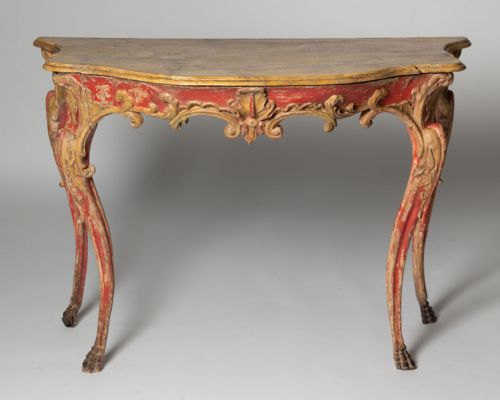
Makers utilised wood as the primary structural foundation, employing hand-carving techniques to shape complex curves and motifs. Surfaces received layers of paint, gesso, and gold leaf or parcel-gilt highlights to create the characteristic decorative finish.
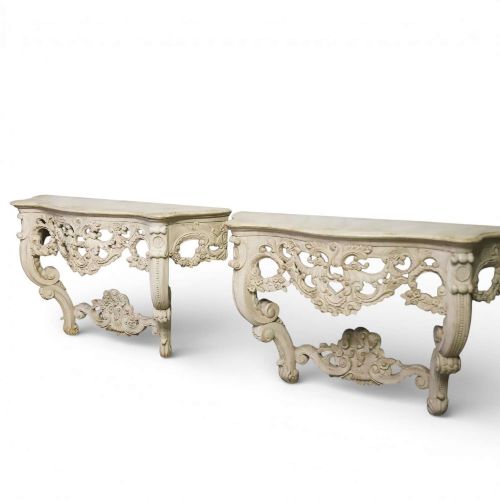
Many examples incorporate marble tops fitted to carved wooden bases, combining heavy stone slabs with ornate frames. Paint finishes range from antique white and distressed shabby chic treatments to detailed polychrome schemes.
Several tables wear their antique white paint with a charmingly battered shabby chic attitude.
Qualities of craftsmanship
The standard of carving distinguishes different examples, with hand-carved woodwork showing greater depth and fluidity than simpler shaped timber. The application of paint, gesso, and gilding also varies, affecting the visual richness of the surface.
The integration of materials such as fitted marble tops and the precision of serpentine joinery demonstrate the skill involved in the construction. Pieces executed with finer detailing and more complex contouring stand apart from plainer utilitarian tables.
The Rococo Painted Hall Table Glossary
- Console table
- A table designed to be fixed against a wall, often supported by ornate front legs or brackets. These pieces save floor space while providing a prominent display surface.
- Serpentine front
- A piece of furniture featuring a front edge that curves inward centrally and outward at the ends in a gentle 'S' shape. This undulating profile is typical of sophisticated rococo design.
- Parcel-gilt
- Woodwork decorated with partial application of gold leaf or gilt alongside painted surfaces. This technique highlights specific carved details rather than covering the entire object.
- Gesso
- A plaster-like mixture applied to wood surfaces to prepare them for painting or gilding. It provides a smooth base for intricate relief ornament.
- Centre table
- A freestanding table intended to be viewed from all sides, placed in the middle of a room rather than against a wall.
Rococo Painted Hall Table: Frequently Asked Questions
Where should I place a console table?
These tables suit hallways, entranceways, and reception rooms where wall space allows a shallow surface for display. They sit well beneath mirrors or artwork to create a balanced focal point.
Because many versions feature finished backs or wall-mounting brackets, placement depends on whether the piece is a freestanding centre table or a console meant to anchor against a wall.
How do I clean a painted and gilded surface?
Dust the carved woodwork gently with a soft, dry cloth to prevent the accumulation of dirt within the intricate relief details. Avoid using harsh chemical sprays or abrasive cleaners that can damage delicate paint and gold leaf.
Marble tops require mild soap and warm water, followed by immediate drying to protect the stone from staining. Care must be taken to keep moisture away from any exposed wooden joints.
What distinguishes rococo style from other periods?
Rococo design relies on asymmetrical curves, C-scrolls, and naturalistic motifs derived from shells and foliage. This aesthetic avoids strict symmetry in favour of flowing, organic movement across the wooden frame.
Revival pieces from later centuries reproduce these flamboyant eighteenth-century contours with varying degrees of sculptural depth.
Are marble tops original to these tables?
Many console and centre tables were constructed specifically to carry heavy marble slabs, acting as structural counterweights for the decorative base. The presence of stone tops appears frequently across nineteenth- and early twentieth-century examples.
Examining the fit between the marble and the wooden frame helps determine if the components share the same period of origin.