
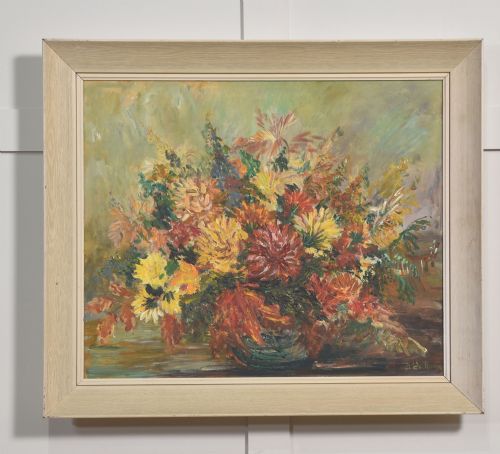
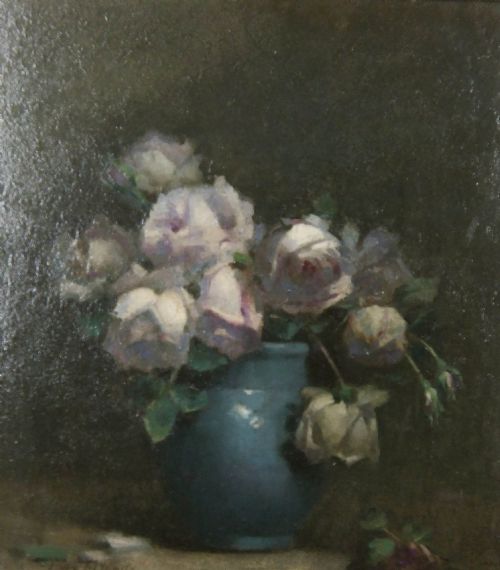


Cream Floral Canvas Painting
These cream floral canvas painting works are mid-century and earlier oil paintings featuring botanical subjects, offering buyers textured historic character and classic floral compositions.
Cream Floral Canvas Painting
When you search for cream floral canvas painting, you encounter a selection of oil paintings spanning the nineteenth century through to the 1960s. These works primarily depict still life arrangements of roses, anemones, and orchids, often set against domestic interiors or studio backdrops.
The most common formats on this page are oil paintings on canvas and wood, representing movements such as British Impressionism, Post-Impressionism, and Mid-Century Impressionism. Creators range from named artists like William Thomas Wood and Ernest Higgins Rigg to anonymous nineteenth-century panel painters.
How they were made
These works are executed using oil paint applied to canvas or wood supports, often framed in wood or finished with gold leaf. Artists built up their floral subjects through varied brushwork, employing techniques that range from pointillist dots to broader impressionistic strokes.
The physical construction typically involves stretched canvas mounted within period wooden frames, occasionally accompanied by painted panels that highlight the texture of the ground material and the depth of the oil medium.
Artistic movements represented include British Impressionism, Post-Impressionism, and Art Deco.
What varies in quality
The distinction between standard and superior examples rests in the handling of light, brushwork complexity, and the depth of the floral composition. Works featuring named artists or sophisticated luminist effects demonstrate a higher degree of artistic control over the canvas.
Material preservation also defines the tier of a piece, where the stability of the oil paint layers, the integrity of the canvas or wood support, and the originality of the frame contribute to the overall execution.
D. L. Williams·William Thomas Wood·Ernest Higgins Rigg·Owen Bowen
The Cream Floral Canvas Painting Glossary
- Oil paint
- A slow-drying paint made by combining pigments with a drying oil, typically linseed. This medium allows for rich blending and textured impasto surfaces on canvas.
- Luminist
- A nineteenth-century style focusing on the effects of light on canvas. It emphasises atmospheric quality and meticulous attention to illumination within still life scenes.
- Pointillist
- A technique involving small, distinct dots of colour applied in patterns to form an image. In these floral paintings, it builds luminous petal textures.
- Impressionism
- A style developed in the nineteenth century characterised by relatively small, thin, yet visible brush strokes. It prioritises accurate depiction of light and fleeting botanical moments.
- Chinoiserie
- A decorative style reflecting Chinese artistic traditions, sometimes influencing the background motifs or interior settings of these floral compositions.
Cream Floral Canvas Painting: Frequently Asked Questions
What periods do these paintings cover?
The works span from the nineteenth century through the 1910s, 1920s, 1930s, and into the 1960s. They capture shifting modernist approaches to botanical still life over more than a century.
Earlier pieces lean towards traditional nineteenth-century panel painting, while later examples embrace mid-century impressionist and art deco sensibilities.
What subjects are depicted in these paintings?
The primary subjects are floral arrangements, including roses, anemones, orchids, and peach blossom. These are frequently arranged in still life compositions within domestic interiors or artist studios.
Some works incorporate broader interior views and windowsills, placing the flowers within a specific architectural context.
What materials were used for these artworks?
The primary materials are oil paint on canvas and wood panels. Many pieces retain their original wood frames, and some feature gold leaf accents.
The combination of oil mediums and textured canvas supports creates the distinct tactile surface characteristic of these historic paintings.
How do I identify different painting styles?
Styles range from traditional nineteenth-century painting to British Impressionism, Post-Impressionism, and Luminist Pointillism. Look at the brushwork and the treatment of light to distinguish between them.
Pointillism uses distinct dots of colour for texture, whereas impressionist works rely on visible, fluid strokes to capture light on petals.