


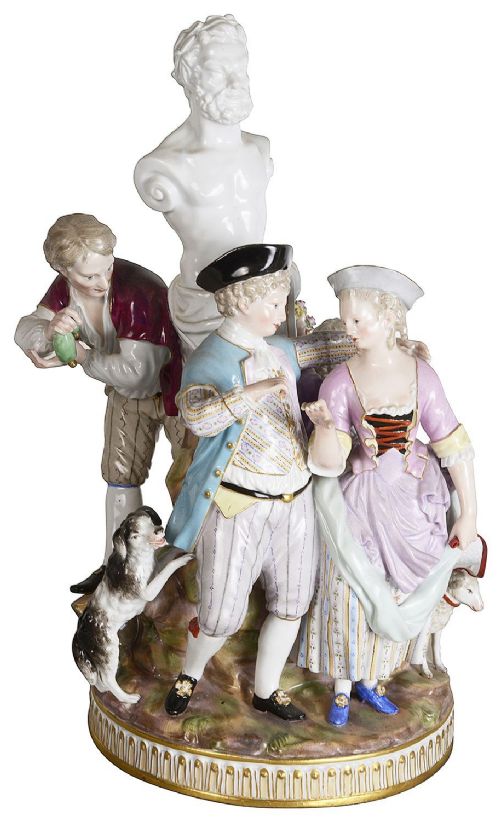


Courting Couple Figurines
Courting couple figurines are romantic porcelain and faience groups capturing pastoral charm, offering a delightful decorative focus for your mantelpiece or cabinet.
Courting Couple Figurines
Courting couple figurines are decorative porcelain and earthenware sculptural groups depicting romantic pairs in various social settings. These charming pieces frequently show amorous duos engaged in musical pursuits, quiet conversation, or graceful leisure.
The versions you are most likely to meet on this page span the eighteenth, nineteenth, and early twentieth centuries. They range from small single figures to large pairs created by notable European factories.
Many examples draw heavily on romantic and pastoral themes, reflecting historic artistic tastes for gallant scenes. You will find them modelled in varied forms including musical groups, harp ensembles, and classical compositions.
How they were made
These figures are fashioned from hard-paste porcelain, soft biscuit porcelain, and occasionally French faience. Manufacturers utilised intricate moulding and hand-modelling techniques to shape the delicate limbs, garments, and botanical bases.
Skilled artisans applied rich enamel colours, metallic gilding, and gold leaf accents to enhance the garments and decorative details. Many pieces combine glazed surfaces with unglazed bisque or Parian porcelain to create subtle textural contrasts.
Finer details such as lace effects, musical instruments, and floral embellishments were meticulously applied by hand before firing. The application of gold leaf and vibrant enamels completed the elaborate appearance typical of Rococo and Victorian aesthetics.
Several couples are caught mid-tune, accompanied by tiny porcelain harps and classical busts.
What varies in quality
The distinction between ordinary and exceptional pieces lies in the crispness of the modelling and the delicacy of the hand-painted details. Superior examples display finely rendered facial expressions, intricate lace work, and carefully defined fingers and garments.
The application of gilding and enamel colours also dictates the visual merit of each piece. Finer items feature rich, well-preserved gold leaf and nuanced, hand-applied polychrome decoration that remains vibrant across the porcelain surface.
The overall scale and ambition of the composition heavily influence the standing of the work. Large pairs and complex sculptural groups involving multiple figures or architectural elements generally represent more accomplished factory output.
Bourdois & Bloch Paris·Letu & Mauger Paris·Volkstedt·Meissen·Triebner Ens & Co·Ludwigsburg
The Courting Couple Figurines Glossary
- Biscuit porcelain
- Unglazed porcelain fired once to produce a matte, marble-like finish. This material is frequently utilised for Parian and romantic figures.
- Hard-paste porcelain
- A durable ceramic composition fired at high temperatures. It provides a solid body for detailed nineteenth-century figurines.
- Faience
- Tin-glazed earthenware produced in various European regions. It offers an opaque surface for colourful hand-painted decoration.
- Gilding
- The application of gold leaf or powdered gold onto the ceramic surface. This technique highlights raised decorative elements and garment trims.
Courting Couple Figurines: Frequently Asked Questions
What materials are these figurines made from?
These pieces are primarily constructed from hard-paste porcelain, bisque porcelain, and occasionally French faience.
Manufacturers often enhanced the ceramic bodies with enamel colours, gold leaf, and metallic gilding.
Which periods do these figures come from?
The selection spans from the eighteenth century through the nineteenth century and into the early twentieth century.
Victorian and later nineteenth-century interpretations of earlier Rococo styles appear frequently among the listings.
How were these decorative figures displayed?
Historically, such groups served as fashionable ornaments for drawing rooms, mantelpieces, and cabinet displays.
Pairs were often arranged symmetrically to complement interior decor schemes of the period.
How can I tell different styles apart?
Earlier eighteenth-century pieces often exhibit restrained classicism, while nineteenth-century revivals embrace more exuberant Rococo scrolls and theatrical postures.
Examining the paste, modelling style, and factory marks helps clarify the period of production.