
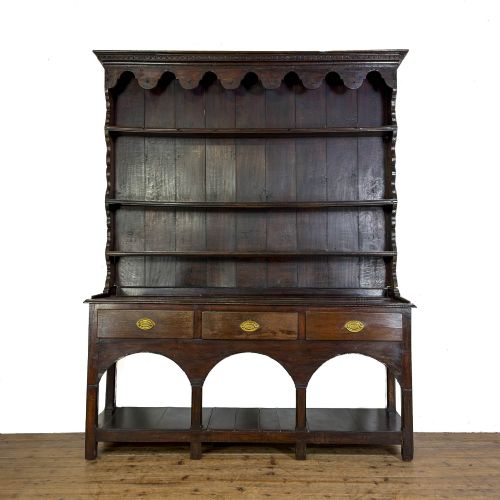


Country House Kitchen Hutch
A country house kitchen hutch brings honest utility and vernacular charm to a room, offering generous storage through fitted shelves and deep base cupboards.
Country House Kitchen Hutch
A country house kitchen hutch represents the intersection of robust domestic utility and regional vernacular woodworking. When you search this phrase, you encounter substantial furniture designed to store and display household provisions and crockery. These items predominantly take the form of kitchen dressers, dressers and hutches, and dressers with delph racks.
The pieces on this page span the 18th century, the Georgian era, the Victorian period, and into the early 20th century. Styles range from English Country and Georgian Vernacular to Scandinavian Country and 18th Century Welsh Vernacular. You are most likely to meet 19th-century oak and painted examples that reflect long-standing regional traditions.
Forms vary from monumental kitchen dressers with breakfront drawers to compact cottage alternatives. Many incorporate upper display racks, sometimes referred to as delph racks, sitting atop robust timber bases. Each iteration mirrors the specific domestic needs of the rural households that originally commissioned them.
How they were made
Construction relies heavily on native hardwoods like oak and elm, alongside more utilitarian softwood such as pine. Craftsmen selected these timbers for structural strength in the base cabinets and resilience in the display shelves. Burr walnut occasionally appears on refined surfaces to introduce subtle decorative grain patterns.
Joinery methods prioritize enduring utility, utilising pegged mortise and tenon joints alongside hand-cut dovetails for drawers. Many surfaces carry traditional paint finishes or retain the warm, natural patina of waxed oak. Iron, brass, and metal hardware such as hinges and pulls secure the doors and drawers while adding functional contrast.
Some dressers retain deep drawer bottoms notched by generations of spoons rattling against the timber during busy morning preparations.
What varies in quality
Quality rests primarily in the integrity of the timber selection and the sophistication of the regional joinery. Superior examples demonstrate thoughtful proportion, balanced breakfront configurations, and original surface treatments that have aged gracefully. Lesser pieces may display unsympathetic later alterations or replacement hardware that disrupts the historical continuity.
The distinction also lies in the ambition of the design, moving from utilitarian cottage work to monumental country house iterations featuring cabriole legs or complex architectural mouldings. Integrated delph racks that proportion harmoniously with the lower cabinet elevate the visual success of the entire composition.
The Country House Kitchen Hutch Glossary
- Breakfront
- A cabinet design where the central section projects forward from the flanking outer sections. This architectural arrangement creates depth and visual interest in large country house storage pieces.
- Delph Rack
- An open wooden shelving superstructure mounted on top of a dresser base for displaying plates and pottery. The term derives from Delftware, the popular tin-glazed earthenware traditionally stored upon them.
- Vernacular
- Furniture built by local tradesmen using regional traditions and native materials rather than adhering to metropolitan pattern books. These pieces prioritize localized function and straightforward construction.
- Patina
- The deep, lustrous surface sheen developed on wood through decades of handling, waxing, and exposure to light. It serves as a visual indicator of age and continuous domestic use.
- Dovetail
- A traditional joint formed by interlocking wedge-shaped fingers, prized for its exceptional tensile strength. Hand-cut versions are a hallmark of quality craftsmanship in drawer construction.
Country House Kitchen Hutch: Frequently Asked Questions
What is a country house kitchen hutch?
A country house kitchen hutch is a sturdy domestic storage piece combining lower cupboards or drawers with upper display shelving. These items served as the practical heart of rural kitchens, holding everyday provisions and tableware.
Today, they function as prominent storage and display focal points in modern interiors. Their enduring appeal stems from honest craftsmanship and versatile utility.
How do I date an oak dresser?
Dating relies on observing construction techniques, timber characteristics, and stylistic vernacular details. Hand-cut joinery, pegged joints, and native timbers like oak and elm typically point towards 18th-century or Georgian origins.
Later Victorian and 20th-century iterations often incorporate machine-sawn components or standardised hardware. Comparing the proportions and overall form to established regional styles helps narrow down the period of manufacture.
Were these hutches used only in kitchens?
While primarily designed for food preparation spaces and sculleries, larger country house examples frequently stood in dining rooms or entrance halls. Their upper racks allowed wealthy households to display prized ceramic collections.
Over generations, these pieces migrated through various rooms as domestic habits shifted. Their adaptable storage capacity makes them equally suitable for living spaces and modern kitchens.
How do I care for antique timber?
Maintaining antique timber requires stable indoor humidity and protection from direct sunlight and heat sources. Regular application of a traditional beeswax polish nourishes the wood and preserves the historical surface sheen.
Avoid modern silicone-based sprays, which can penetrate open grain and damage the existing finish. Gentle dusting with a soft, dry cloth is sufficient for routine maintenance.