

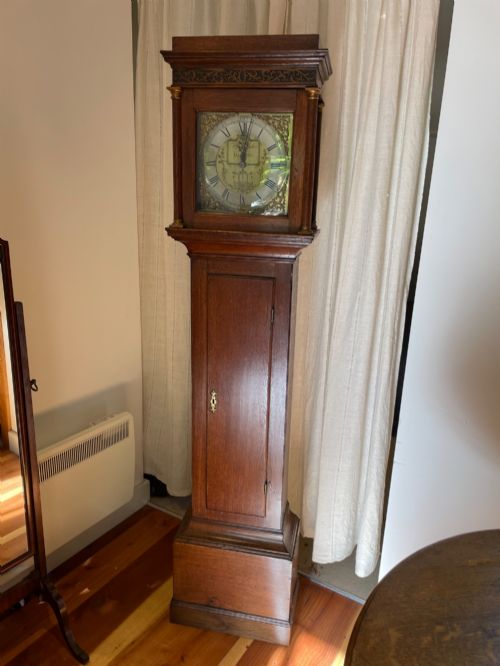
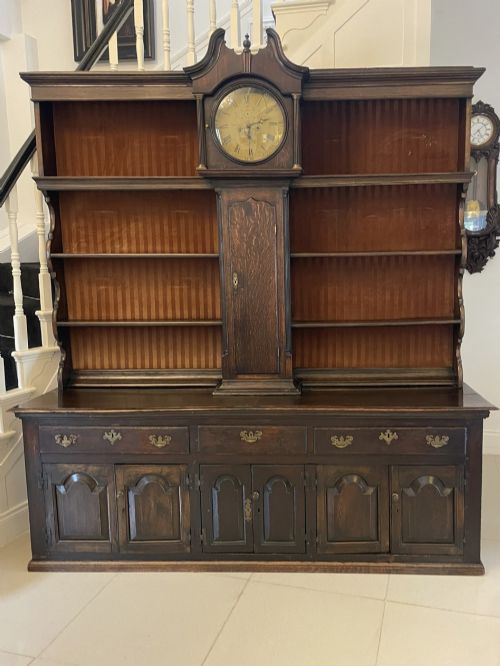


Country Georgian Grandfather Clock
These country georgian grandfather clock pieces bring honest provincial timekeeping into a room, offering simple architectural presence and regional character.
Country Georgian Grandfather Clock
You meet sturdy oak and pine housings, often fitted with thirty-hour movements by regional makers. Simpler rustic country versions and painted finishes sit alongside early georgian formats, representing the everyday domestic clock of the period.
How they were made
Cabinetmakers constructed the tall cases using solid regional timbers such as oak and pine, frequently finished with paint or left in the natural grain. These woods provided a durable housing for the heavy weight-driven mechanisms.
Dial work combined brass and iron components, often featuring single-hand indicators driven by thirty-hour movements signed by local clockmakers on the face.
Country Georgian Grandfather Clock Retail Price Guide 2026
Typical asking prices for country georgian grandfather clock among the pieces listed under this phrase on Sellingantiques today, from the lower quarter to the upper quarter. They describe what is for sale here now, not the wider market.
One persistent maker built a clock so small and modest in pine that it squeezed neatly into a cottage hallway.
What varies in quality
The standard of a country georgian grandfather clock rests in the integrity of the provincial casework and the legibility of the dial. Crisp lettering on the brass face and clean timber joints distinguish the more carefully executed regional pieces from utilitarian utility items.
Proportion and surface preservation determine the visual impact of the clock in an interior. Retained original paint or patinated oak surfaces carry greater architectural coherence than heavily altered examples.
Thomas May Of Witney·Richard Alexander·Samuel Buxton·William Harley·John Welsh·Ed Hemmins
The Country Georgian Grandfather Clock Glossary
- Longcase clock
- A tall pendulum clock enclosed in a wooden case that stands directly on the floor. This term is the formal alternative to grandfather clock.
- Thirty-hour movement
- A clock mechanism designed to run for just over a day before requiring manual winding via the hanging weights. These movements are typical of simpler country timepieces.
- Single hand
- A single dial pointer indicating the hour rather than hours and minutes. This feature appears on earlier eighteenth-century clocks before minute tracks became standard.
- Oak
- A hard, durable timber widely utilised for provincial furniture and clock cases during the Georgian period. It yields a pronounced grain and a rich warm tone over centuries.
Country Georgian Grandfather Clock: Frequently Asked Questions
What is a country georgian grandfather clock?
It is a tall weight-driven timepiece housed in a wooden case, made outside London during the eighteenth or nineteenth century.
These pieces utilise regional timbers like oak and pine, often displaying simple provincial styling rather than metropolitan elaboration.
How do thirty-hour movements work?
A thirty-hour movement requires winding once a day by pulling the chains or cords attached to the driving weights.
This simpler mechanism was standard for provincial country clocks, requiring fewer gears than an eight-day movement.
Where were these clocks made?
Regional horologists and cabinetmakers constructed them in towns and villages across Britain, from Oxfordshire to Norfolk.
Local makers frequently signed their names directly onto the brass or painted dial faces.
How do I live with a tall clock?
These clocks require a stable, plumb wall surface where the tall case can be secured safely to prevent tipping.
Regular setting of the pendulum and careful weekly winding keep the mechanical movement functioning properly in a domestic room.