



Cornish Maritime Art
Cornish maritime art captures harbours, fishing luggers and coastal light through paintings and dioramas rooted in nineteenth and twentieth century traditions.
Cornish Maritime Art
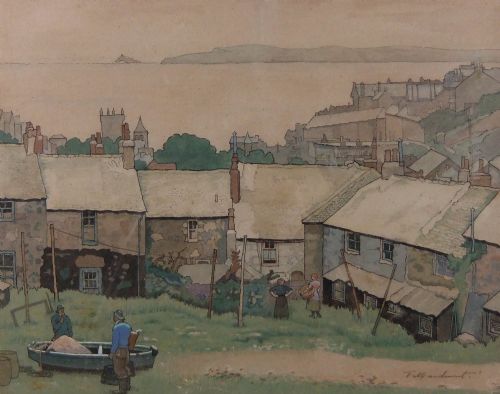
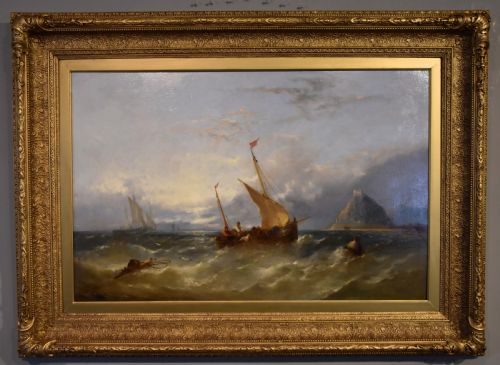
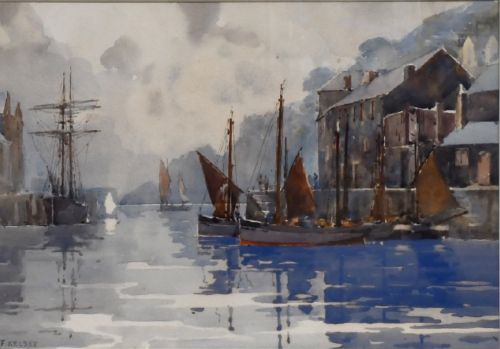
Cornish maritime art brings together paintings, watercolours and framed dioramas depicting coastal scenes, harbours and fishing vessels around Cornwall. The selections on this page focus heavily on local harbours such as St Ives, Mevagissey and Polperro, alongside open sea views.
Most pieces date from the Victorian period through to the mid-twentieth century, capturing the working life of fishermen and the distinct quality of West Country light. Buyers will encounter traditional watercolours and oil paintings created by artists associated with the Newlyn and St Ives schools.
The subjects range from tranquil low-tide harbour views to dramatic shipwrecks and trawling luggers battling coastal waters. Framed artworks dominate the selection, often preserved in period wood or gilt frames that complement the maritime subject matter.
Materials and technique
Artists working within this tradition relied primarily on oil on canvas and watercolour on paper, applying pigments to capture the movement of sea and sky. Canvas works offer rich texture and depth, particularly in depicting heavy seas and turbulent weather off the Cornish coast.
Watercolour paintings utilise fluid washes and fine brushwork on paper to render crisp harbour walls, sailing vessels and atmospheric coastal haze. Supporting materials include traditional wood frames, gilt wood surrounds and protective glass used specifically to house delicate paper works and dioramas.
One nineteenth century diorama faithfully preserves the rigid majesty of the Queen Anne within a compact glazed wooden frame.
Judging quality in coastal works
Quality rests upon the artist's ability to handle light and atmosphere, distinguishing evocative depictions of Cornish harbours from formulaic local views. Stronger works demonstrate confident brushwork, accurate rendering of marine architecture and a genuine understanding of maritime movement.
The condition of the medium also shapes overall merit, with well-preserved oil canvases showing stable pigment and watercolours retaining their original tone without excessive fading. Original period frames that match the age and character of the artwork add considerably to the integrity of the piece.
William Banks Fortescue·Thomas Maidment·William Henry Williamson·Frank Kelsey·George F Pennington·Edward Matthew Elliott·Charles Napier Hemy·Richard Harry Carter·Gyrth Russell·Charles Sim Mottram·William Pitt·Ernest F Hill·William Lambert Bell·Ralph Todd·William Lee Hankey·Hendrik Yan Wolter·S J Lamorna Birch·William Edward Webb
The Cornish Maritime Art Glossary
- Newlyn School
- An art colony based in West Cornwall that focused on plein air painting and realistic portrayals of local fisherfolk and coastal life. Artists in this circle captured authentic daily scenes with naturalistic light.
- Lugger
- A traditional two-masted fishing boat commonly utilised along the Devon and Cornwall coasts during the nineteenth and early twentieth centuries. These vessels feature prominently in regional marine paintings and watercolours.
- Maritime Diorama
- A three-dimensional model depicting a ship or coastal scene, often enclosed in a glazed wooden case. These decorative objects combine craftsmanship in miniature with traditional marine subjects.
- Woodblock Print
- A relief printing technique where an image is carved into a block of wood, inked and transferred to paper. Examples appear alongside original watercolours in early twentieth century portfolios.
Cornish Maritime Art: Frequently Asked Questions
What subjects appear most often?
Harbours, fishing luggers and coastal settlements form the core subjects across these paintings and watercolours. Views focusing on St Ives, Mevagissey and Polperro recur frequently.
Artists also recorded the daily labour of local fishermen, alongside dramatic scenes of shipwrecks and open sea views around the Cornish coast.
How should I display these watercolours?
Watercolours require protection from direct sunlight to prevent the pigments and paper from fading over time. Hanging them away from bright windows preserves their original tonal quality.
Maintaining stable indoor humidity also protects both the paper support and the traditional wood or gilt frames enclosing the artwork.
How do I identify Newlyn School paintings?
Newlyn School works typically depict realistic scenes of coastal life, local fisherfolk and harbour activities painted with a naturalistic palette. The artists worked extensively out of doors to capture authentic West Country light.
Signatures or stylistic associations with painters connected to the West Cornwall art colony often help confirm the origin.
What periods do these pieces span?
The selection spans from the Victorian era through the early and mid-twentieth century. Pieces date from the late nineteenth century up to the 1960s.
Victorian and Edwardian works sit alongside later mid-century interpretations of the same Cornish coastal landscape.