
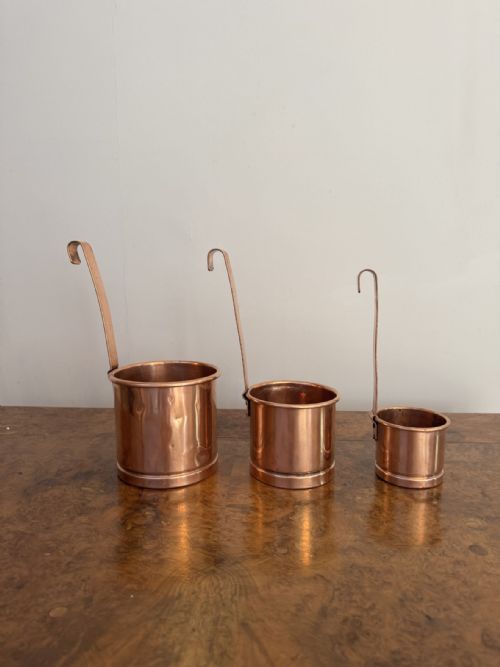


Copper Kitchenware Set
A copper kitchenware set brings warmth and utility to a room, offering grouped spans of metalwork shaped for historical domestic service.
Copper Kitchenware Set
A copper kitchenware set gathers together multiple culinary vessels, pans, or measures that share a uniform provenance and aesthetic. When browsing for a copper kitchenware set, buyers typically encounter grouped items originating from the Victorian and Georgian eras, alongside nineteenth-century French or Anglo-Indian examples.
The configurations vary from graduated sets of measuring jugs and tavern measures to larger arrays of saucepans and cooking pans. These groupings generally display coordinated forms, such as nested saucepan sets or linear series of graduated measuring vessels.
Originating primarily from domestic kitchens and taverns, these collections demonstrate how nineteenth-century cooks and hosts organised their daily work. The pieces on this page reflect this practical heritage, offering cohesive assemblages rather than isolated items.
Materials and construction
Makers constructed these items predominantly from sheet copper, often incorporating brass for handles, rivets, or rims, and occasionally employing cast iron or wood for structural support. Artisans hammered and joined the metal plates by hand, shaping the walls of pans and measures to endure heavy kitchen tasks.
The integration of brass and iron provided necessary rigidity to handles and seams, ensuring that functional vessels could withstand high heat and frequent handling. These material combinations define the manufacturing standard of the period, balancing thermal efficiency with physical durability.
Some measures travelled across empires, ending up as gleaming brass-rimmed veterans of colonial trade.
Assessing quality in grouped metalwork
Quality in these groupings rests upon the consistency of the set and the integrity of its manufacture. A superior assemblage maintains uniformity in material thickness, handle attachment, and proportions across every single piece.
Sets that retain their original graduation and matching hardware demonstrate a higher level of historical completeness. The distinction between ordinary domestic items and finer examples lies in the precision of the hand-beaten surfaces and the harmony of the matched components.
The Copper Kitchenware Set Glossary
- Graduated set
- A collection of vessels sized proportionally so that each smaller piece fits sequentially within or alongside the next. This arrangement allowed for precise scaling in historical food preparation and measuring.
- Tavern measure
- A standardised vessel utilised for dispensing liquids in public houses. These items often feature heavy brass rims and clear capacity indicators.
- Kitchenalia
- Utilitarian objects and equipment used in historical domestic kitchens. The term encompasses everything from cooking pans to measuring vessels.
- Seer measure
- A traditional unit of measurement originating from South Asia, often produced in copper and brass. These sets reflect regional trade and colonial exchange.
Copper Kitchenware Set: Frequently Asked Questions
How were these sets used historically?
These grouped copper vessels served essential functions in domestic kitchens, commercial cooking spaces, and public houses. Cooks and servers utilised them for food preparation, heating liquids, and measuring ingredients with standard precision.
The coordinated nature of a set allowed kitchen staff to maintain efficiency and accuracy during busy service hours. Over time, many such groupings transitioned from active duty to decorative display.
How do I date a copper set?
Dating relies upon examining the manufacturing techniques, handle styles, dovetail seams, and material composition. Victorian and Georgian items exhibit specific hand-working methods and rivet placements characteristic of their respective decades.
Comparing the stylistic markers across all pieces in a group provides a reliable timeframe. Makers often left subtle tool marks that reveal the period of production.
Are these sets safe for modern cooking?
While historic copper pans were designed for active culinary use, original antique pieces often require professional inspection and re-tinning before handling food today. Many collectors choose to display them as decorative objects rather than subjecting them to modern kitchen stoves.
The thin interior linings of nineteenth-century vessels wear down over decades of use and cleaning. Preserving the historic metal surface generally takes precedence over daily utility.
What defines French country style here?
French country copper items display distinct regional forms and heavier gauge metalwork tailored to continental culinary traditions. These pieces often feature specific handle profiles and surface patination unique to nineteenth-century French workshops.
Such sets bring a robust, utilitarian aesthetic that differs slightly in handle design and shaping from British Victorian equivalents. They represent the industrious domestic output of provincial French kitchens.