
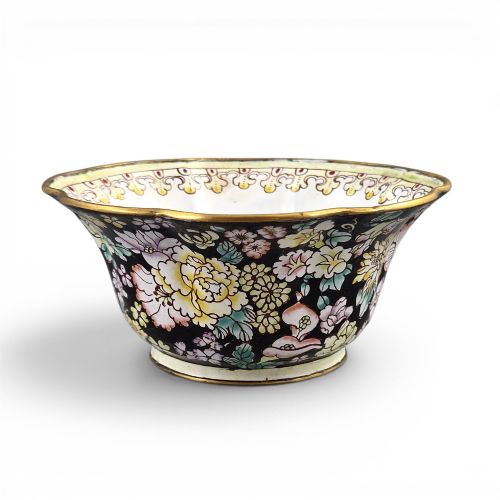


Copper Enamel Dish
A copper enamel dish brings vibrant colour and meticulous detail to any tabletop, uniting beaten metal with glassy fusion.
Copper Enamel Dish
When you search for a copper enamel dish, you encounter a fascinating cross-section of global craftsmanship spanning the eighteenth century through the early twentieth century. The selections available here heavily lean towards Japanese cloisonne pieces from the Meiji period, alongside Chinese Canton painted enamel vessels and English Bilston boxes.
The assortment ranges from small salt cellars and patch boxes to large chargers and decorative trays depicting dragons, phoenixes, and botanical scenes. European examples from the eighteenth century appear alongside Asian works, showing distinct regional approaches to fusing vitreous enamel onto metal bases.
How they were made
Artisans built these objects by shaping copper into bowls, trays, and boxes before applying powdered glass or enamel paints to the surface. Many Japanese pieces utilise brass wire to create compartmentalised cloisonne cells, which were then filled with coloured enamel pastes and fired in a kiln.
Chinese and European workshops often employed painted enamel techniques directly onto the copper substrate, sometimes incorporating gold leaf or brass mounts. Once fired, the surfaces were ground down and polished to a smooth, lustrous finish that protects the vitreous layer.
Keep an eye out for microscopic air bubbles trapped in the glaze; they prove a human hand fired the piece centuries ago.
What varies in quality
The standard of a copper enamel dish rests on the precision of the design and the complexity of the firing process. Pieces featuring exceptionally fine wirework, intricate pictorial subjects like Mount Fuji or samurai figures, and flawless enamel surfaces represent the upper echelon of the craft.
Scale and ambition also dictate the tier of an object, with large chargers requiring immense technical skill to fire evenly without cracking the vitreous glaze. Simpler geometric patterns or standard floral motifs occupy the more accessible levels of the category.
The Copper Enamel Dish Glossary
- Cloisonne Enamel
- A technique where thin metal wires are soldered to a metal base to form compartments filled with enamel paste. This method creates detailed, stained-glass-like patterns upon firing.
- Vitreous Enamel
- A material made by fusing powdered glass to a substrate by firing, usually between seven hundred and nine hundred degrees Celsius. The resulting compound is smooth, durable, and chemically resistant.
- Charger
- A large decorative plate or tray typically used for display rather than serving food. These substantial items often showcase the pinnacle of an artisan's pictorial skill.
- Cabochon
- A gem or piece of glass shaped and polished as a convex dome rather than faceted. They frequently appear as raised decorative elements on Arts and Crafts metalwork.
Copper Enamel Dish: Frequently Asked Questions
How do I clean a copper enamel dish?
Dust the surface gently with a soft, dry cloth to preserve the polished vitreous finish.
Avoid using water, abrasive cleaners, or chemical solvents, as these can harm the exposed copper edges and delicate enamel.
Can I use these dishes for food?
Most antique pieces function primarily as decorative objects rather than tableware.
Older enamels may contain historical compounds unsuited for modern culinary use, making display the safer option.
What is the difference between cloisonne and painted enamel?
Cloisonne uses metal wires to separate different coloured vitreous pastes into distinct cells.
Painted enamel applies pigments directly onto the metal ground in the manner of a canvas painting.
How do I date an antique enamel piece?
Examine the style of decoration, the mounting techniques, and the colour palette used by the maker.
Japanese Meiji period works and eighteenth-century European pieces each carry distinct stylistic markers of their eras.