

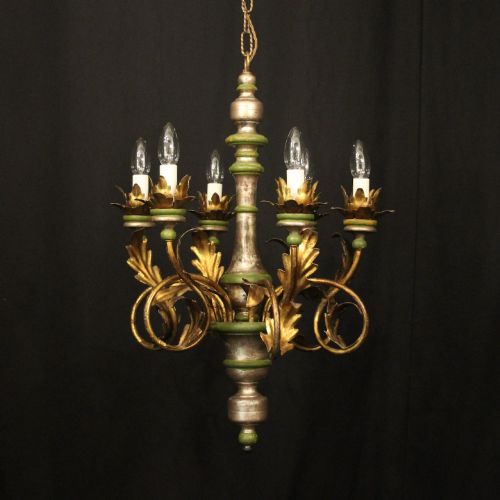


Continental Giltwood Lighting
Continental giltwood lighting brings carved warmth and aged gold to a room, offering grand illumination through historic Italian and Spanish forms.
Continental Giltwood Lighting
When you search for continental giltwood lighting, you are looking at carved wooden pieces finished in gold leaf, paint, and gesso designed to hold candles or bulbs. The listings on this page span table lamps, candlesticks, chandeliers, bed canopies, and ceiling lights originating from Italy, Spain, and wider continental Europe.
The objects you are most likely to meet on this page take the form of table lamps and candleholders dating from the eighteenth and nineteenth centuries. These pieces carry regional styles including Baroque, Neoclassical, Florentine, and Rococo, reflecting centuries of decorative craft.
Earlier examples often begin as altar-type candle-holders and pricket sticks before conversion to modern electric lamps, while later twentieth-century pieces continue the tradition of carved and gilded illumination. Each item displays the distinct hand of its maker through carved wood details and surface patination.
Materials and construction
Makers shaped these fixtures from solid wood, applying layers of gesso to smooth the surface before laying fine gold leaf or paint by hand. This traditional preparation creates the rich, reflective finish seen across eighteenth-century Italian bed crowns and nineteenth-century lamps.
Metal components such as brass and toleware appear alongside the primary wooden structures, particularly in lanterns and chandeliers. Fabric and metal elements combine with the gilded frames to support structural parts and diffusion.
Continental Giltwood Lighting Retail Price Guide 2026
Typical asking prices for continental giltwood lighting among the pieces listed under this phrase on Sellingantiques today, from the lower quarter to the upper quarter. They describe what is for sale here now, not the wider market.
Listings incorporate items spanning the eighteenth century, nineteenth century, and early twentieth-century decades up to 1930.
Assessing quality
The depth and clarity of the wood carving separate standard items from superior pieces. Crisp undercut foliage and expressive figures demonstrate a higher level of artisan skill than softened, shallow relief work.
The application and survival of the gold leaf and gesso ground dictate the visual weight of the object. An aged surface retaining its original burnished warmth holds greater aesthetic presence than a flat, modern re-gilding.
The Continental Giltwood Lighting Glossary
- Giltwood
- Wood that has been coated with thin sheets of gold leaf over a prepared gesso ground. This technique gives the surface a luminous and enduring metallic sheen.
- Gesso
- A plaster mixture applied to wood surfaces to create a smooth base for gilding or painting. It allows intricate carved details to remain sharp beneath the gold leaf.
- Pricket stick
- A type of candlestick featuring an upward-facing metal spike that secures a candle rather than sitting inside a socket. These often originate from ecclesiastical settings.
- Toleware
- Enamelled or painted sheet metal used in decorative objects and light fittings. It frequently complements gilded wooden elements in continental lanterns.
- Baroque style
- An ornate design aesthetic characterised by dynamic movement, exuberant curves, and dramatic proportion. This style dominates many eighteenth-century Italian and Spanish pieces.
Continental Giltwood Lighting: Frequently Asked Questions
Are these lamps converted from old candlesticks?
Many table lamps listed under this category began life as eighteenth-century pricket sticks or altar candle-holders before receiving modern electrical wiring.
Conversion is typically done with minimal alteration to preserve the integrity of the original carved wood and gilt finish.
How do I identify Italian Baroque lighting?
Italian Baroque pieces display theatrical proportions, bold acanthus carving, and heavy architectural forms designed to project grandeur.
They often incorporate altar-type candle-holder designs or large altar-prickets dating back to the eighteenth century.
Where did bed crowns go in a room?
Bed crowns, such as eighteenth-century Italian examples, mounted to the wall above the head of a bed to suspend fabric canopies.
They served both a decorative purpose and a practical one by framing the sleeping quarters with draped textiles.