
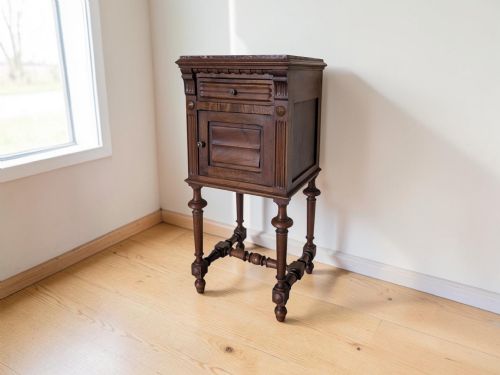
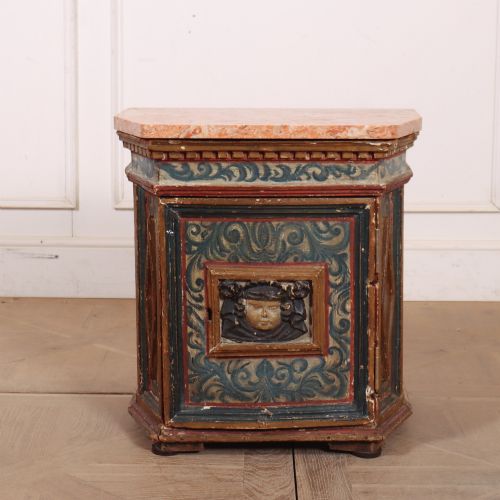
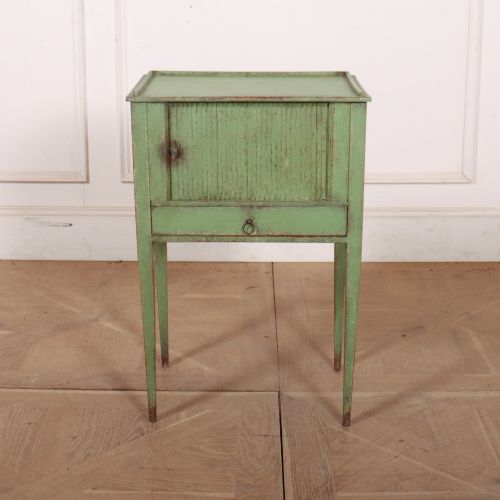
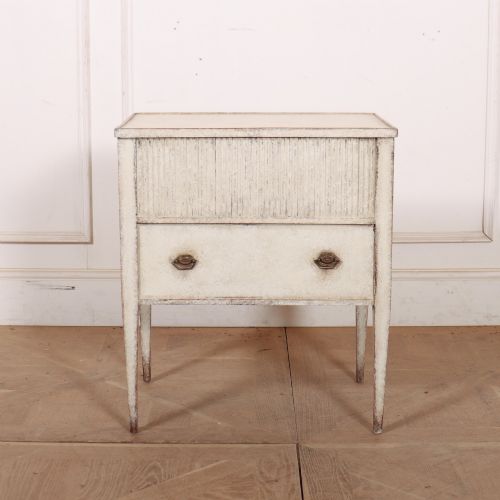


Continental Bedside Cabinet
A continental bedside cabinet brings compact European proportion and timber character to a bedroom.
Continental Bedside Cabinet
A continental bedside cabinet provides enclosed storage beside a bed, taking forms from the nineteenth century through the Art Deco period. Buyers seeking a continental bedside cabinet encounter pieces originating from diverse European regions, including Dutch, Italian, French, and Hungarian workshops.
The selection ranges from simple pine cupboards to grand marble-topped walnut and marquetry pieces. Painted finishes and regional provincial styles appear frequently alongside neoclassical and baroque designs.
How they were made
Cabinet makers utilised structural timbers such as oak, pine, and mahogany, often applying decorative surface veneers of walnut, burr walnut, kingwood, or burr elm. Marquetry inlay and painted decoration added visual depth to cabinet doors and drawer fronts.
Marble slabs served as durable and hygienic tops on many finer examples, while brass fittings provided handles and hinges.
Materials span walnut, burr walnut, pine, painted wood, oak, mahogany, and marble across 19th-century and 20th-century pieces.
What varies in quality
The distinction between standard and superior pieces rests on the choice of timber and the complexity of its preparation, such as figured walnut or matched burr veneers. Finer examples display meticulous marquetry inlay, well-fitted marble tops, and substantial brass hardware.
Construction methods determine longevity, with hand-cut dovetails and solid secondary woods marking out superior cabinet making from simpler utility pieces.
The Continental Bedside Cabinet Glossary
- Bombe
- A bulging, convex shape characteristic of certain continental case furniture. This swelling profile defines baroque and rococo commodes and cabinets.
- Marquetry
- The art of applying pieces of veneer to a structure to form decorative patterns. Craftsmen use varied timber species to create pictorial or geometric designs.
- Biedermeier
- A central European style dating from the nineteenth century focusing on utilitarian comfort and clean lines. This aesthetic favours native timbers over heavy ornamentation.
- Serpentine
- A furniture shape featuring a curved front with a convex centre flanked by concave sides. This flowing contour appears on the edges of tabletops and cabinet fronts.
Continental Bedside Cabinet: Frequently Asked Questions
What periods do these cabinets come from?
The available pieces span multiple centuries, ranging from eighteenth-century painted items to nineteenth-century Victorian examples and early twentieth-century Art Deco designs.
Cabinet making styles reflect the prevailing tastes of their originating regions, encompassing Dutch provincial work, Italian baroque, and neoclassical forms.
Are marble tops original to the cabinets?
Many continental cabinets incorporate fitted marble tops designed specifically for the piece, providing a durable surface for bedroom use.
These stone slabs appear across nineteenth-century and early twentieth-century examples, particularly those originating from French and Italian workshops.
How do I choose between painted and wood finish?
Painted wooden cabinets offer regional charm, often featuring distressed or original decorative finishes from Dutch and Hungarian traditions.
Natural timber versions display the grain of walnut, oak, mahogany, or pine, sometimes enhanced by marquetry inlay or polished veneer.
What storage configurations are common?
Most examples combine a top drawer with a lower cupboard enclosed by a single door.
Some variations include open shelving, side drawers, or marble surfaces paired with bedside tables attached to larger headboards.