
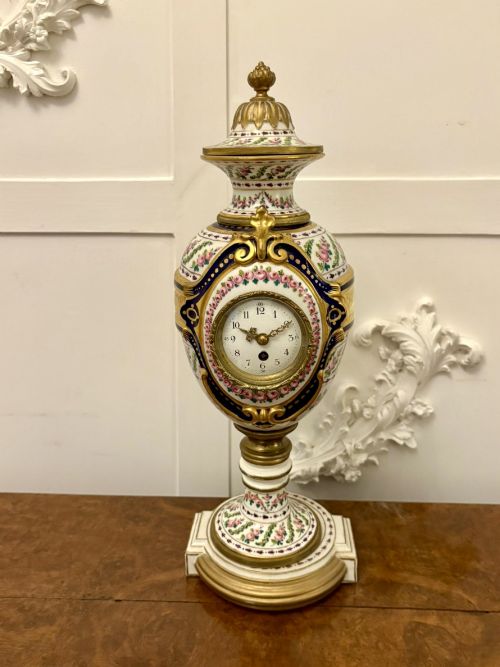


Classical Urn Mantel Clock
A classical urn mantel clock brings a disciplined Neoclassical presence to a room, anchoring the mantel with architectural bronze, marble, and gilt.
Classical Urn Mantel Clock
A classical urn mantel clock takes the form of a decorative classical vessel mounted on a substantial base, often accompanied by matching side pieces in a garniture set. These items emerge primarily from nineteenth-century French and British workshops, spanning periods from the French Empire through the Victorian era.
The selections available here range from austere marble portico designs and drum head clocks to ornate porcelain urn shapes and elaborate gilt bronze garnitures. Buyers encounter both single striking mantel clocks and complete three-piece sets featuring matching side urns or candelabra.
Makers working in the Neoclassical, Louis XVI, and French Empire styles drew heavily on ancient architectural motifs, combining urn bodies with brass, ormolu, and contrasting columns. These timepieces served both a practical domestic function and a grand decorative purpose in nineteenth-century interiors.
How they were made
Foundry workers cast cases in bronze, brass, and ormolu, employing mercury gilding or electroplating to achieve a brilliant metallic finish. Marble bodies, particularly Sienna and white varieties, required precise stonemasonry to carve the columns, plinths, and urn bodies that house the mechanical movements.
Clockmakers fitted eight-day striking movements behind enamel dials, while porcelain urn sections featured hand-painted pastoral or floral scenes fired onto the ceramic glaze. Artisans assembled these mixed-media objects by securing heavy stone and metal components with threaded pins and brass nuts.
Listings feature nineteenth-century timepieces utilising materials such as Sienna marble, ormolu, porcelain, and cast bronze.
What varies in quality
The weight and crispness of the cast metal mountings distinguish standard production from superior examples, with finer pieces showing deep chisel work and varied surface finishes in the ormolu and bronzed sections. The choice of materials also dictates the grade, as rich Sienna marble and finely painted porcelain demand greater artisanal skill than plain white marble or simple brass.
Movement quality separates workshop standards, evident in signed brass backplates by established makers like A.D. Mougin, Pons de Paul, or James Ritchie & Son. Complete garniture sets that retain their original matching side pieces and undamaged enamel dials represent the upper tier of survival.
Pons de Paul·A.D Mougin·James Ritchie and Son
The Classical Urn Mantel Clock Glossary
- Ormolu
- Gilded bronze, where a layer of gold amalgam is applied to a cast bronze base and heated to drive off the mercury. This technique produces a deep, lasting metallic lustre characteristic of fine French clock cases.
- Garniture
- A set of matching decorative ornaments designed to be displayed together on a mantelpiece. In clock sets, this typically comprises a central timepiece flanked by two matching urns or candelabra.
- Portico clock
- A mantel clock featuring a architectural case supported by four or more columns, resembling a miniature classical temple. They frequently incorporate marble and gilt brass elements.
- Drum head clock
- A timepiece where the movement is housed in a circular metal case resembling a drum barrel, mounted on a rectangular marble or wooden base. This form highlights the mechanical housing as the primary visual element.
- French Empire period
- A decorative style inspired by the art of classical Greece and Rome during the rule of Napoleon. It favours military motifs, severe architectural lines, and rich combinations of bronzed and gilded metal.
Classical Urn Mantel Clock: Frequently Asked Questions
How do I wind an eight day clock?
Use the appropriate winding key to turn the arbors located on the enamel dial clockwise until you feel firm resistance. Take care not to overwind the mainspring, as this can damage the internal mechanism.
Ensure you stop winding the moment the spring reaches full tension. Allow the pendulum to settle into an even beat after setting the time.
What is a clock garniture?
A clock garniture is a matched set consisting of a central mantel clock accompanied by two side pieces, such as urns or candelabra. These sets were designed to create a symmetrical arrangement across a mantelpiece or sideboard.
The pieces share identical materials, styles, and decorative motifs, creating a unified display. Complete sets remain particularly sought after by collectors.
How do I identify a French Empire clock?
French Empire clocks feature strict classical proportions, architectural symmetry, and heavy use of military or ancient Roman motifs. The cases combine polished ormolu with dark patinated bronze elements.
These pieces originate from the early nineteenth century and reflect the neoclassical tastes of the Napoleonic era. Dials are frequently enclosed within glazed bezels surrounded by cast bezels of laurel or acanthus leaves.
Where should I place a marble clock?
Place your marble clock on a sturdy, level surface capable of supporting its substantial weight, such as a slate or stone mantelpiece. Avoid locations subject to direct sunlight, excessive moisture, or sudden temperature fluctuations.
Stable placement ensures the heavy pendulum swings evenly without striking the inside of the case. A level base also protects delicate marble plinths from uneven stress.