
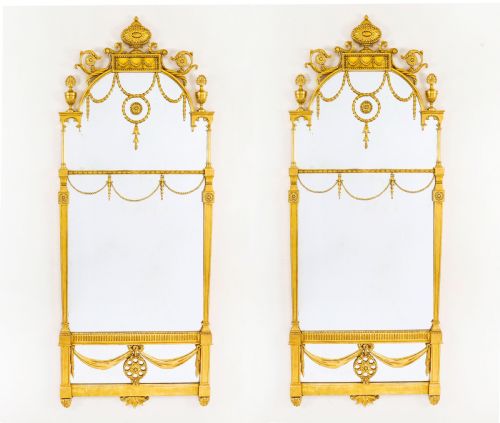


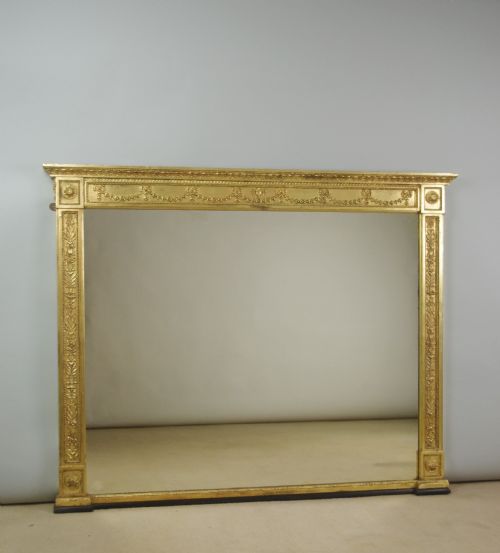


Classical Revival Gilt Mirror
These classical revival gilt mirror pieces bring neoclassical elegance and grand proportions to a room.
Classical Revival Gilt Mirror
When you search for a classical revival gilt mirror, you look at wall mirrors and overmantel mirrors spanning the nineteenth century and the early twentieth century. The selection leans heavily towards Victorian interpretations of earlier Regency and Adam designs, alongside direct Regency pieces.
You will encounter large overmantel mirrors designed to sit above a fireplace alongside vertical wall mirrors and pier mirrors. Many pieces draw directly on Adam revival and Neoclassical styles, featuring symmetrical ornamentation and classical motifs.
How they were made
Makers built these frames using wood or carved wood cores, applying layers of gesso to build up intricate surface ornament. Artisans then applied gold leaf or water gilding to achieve the bright metallic finish characteristic of the period.
Some examples utilise painted wood and parcel-gilt techniques or silvered finishes rather than traditional gold leaf. Mirror glass is set within these heavy frames, occasionally showing the gentle foxing and age expected of nineteenth-century glass.
Listings feature Victorian and nineteenth-century pieces alongside Regency and early twentieth-century examples, dominated by giltwood and gesso materials.
What varies in quality
The crispness of the gesso moulding and the depth of the carving separate the finer frames from simpler production. Superior examples retain their original water gilding and crisp neoclassical detail without excessive later restoration.
The scale and proportion of the frame dictate its presence in a room, with larger overmantel pieces requiring substantial timber construction to support the heavy glass. The condition of the original mirror glass and the stability of the mitred joints also influence the overall character.
The Classical Revival Gilt Mirror Glossary
- Gesso
- A mixture of plaster of Paris and glue binder applied to wood frames to create a smooth surface for carving and gilding. This material allowed makers to fashion deep relief ornamentation.
- Giltwood
- Timber that has been coated with gold leaf or metal leaf. It forms the primary structural and decorative medium for these grand frames.
- Overmantel mirror
- A wide mirror specifically proportioned to hang above a fireplace mantelpiece. These large pieces dominated nineteenth-century interior reception rooms.
- Adam revival
- A decorative style reviving the classical symmetry and ornamentation popularised by Robert Adam in the eighteenth century. You see urns, swags, and classical columns replicated on Victorian frames.
- Water gilding
- A traditional technique applying gold leaf over a wet bole ground, allowing the metal to be burnished to a high shine. This method produces the brilliant reflective quality seen on finer frames.
Classical Revival Gilt Mirror: Frequently Asked Questions
Where should I hang an overmantel mirror?
These large mirrors traditionally sit directly above a fireplace mantelpiece to reflect light and anchor the room's proportions. They also function effectively on principal living room walls when secured adequately to masonry.
Because many examples span significant dimensions and weight, ensure the fixings engage directly with wall studs or solid brickwork. Their horizontal spread makes them natural centerpieces for formal reception spaces.
How do I identify a Regency mirror?
Regency pieces date from the early nineteenth century and typically display restrained classical lines, convex glass forms, or architectural motifs. They often incorporate parcel-gilt and painted elements rather than heavy Victorian gesso.
Look for crisp detailing and proportions that reflect neoclassical taste rather than later revival exuberance. The framing tends to be tighter and more architectural than the busier Victorian equivalents.
Are the mirror plates original?
Many nineteenth-century mirrors retain their original glass, which can exhibit subtle foxing, minor speckling, and gentle distortion. These signs of age confirm the long history of the piece.
Replacement glass occasionally appears in pieces that suffered accidental breakage over the decades. Inspecting the silvering from the reverse often helps determine whether the plate dates to the same period as the frame.
What is the difference between gesso and carved wood?
Carved wood frames feature ornament cut directly into the timber base, whereas gesso frames build up the decorative relief using a plaster compound over a simpler wooden structure. Both methods were standard practice for gilt frames.
Gesso allowed makers to achieve sharp, intricate neoclassical details more rapidly than carving solid timber. Fine pieces frequently combine a solid wood structure with applied gesso mouldings.