
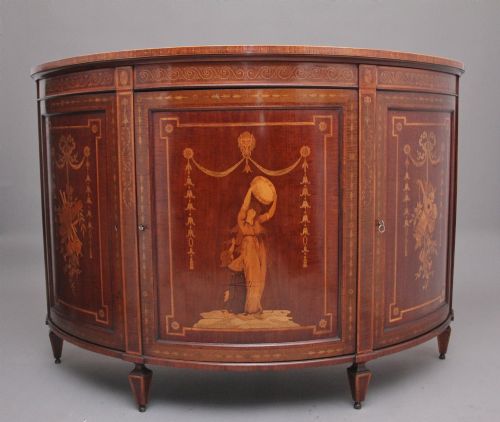


Classical Revival Credenza
A classical revival credenza brings the balanced symmetry of antiquity into a room through rich timber and careful marquetry.
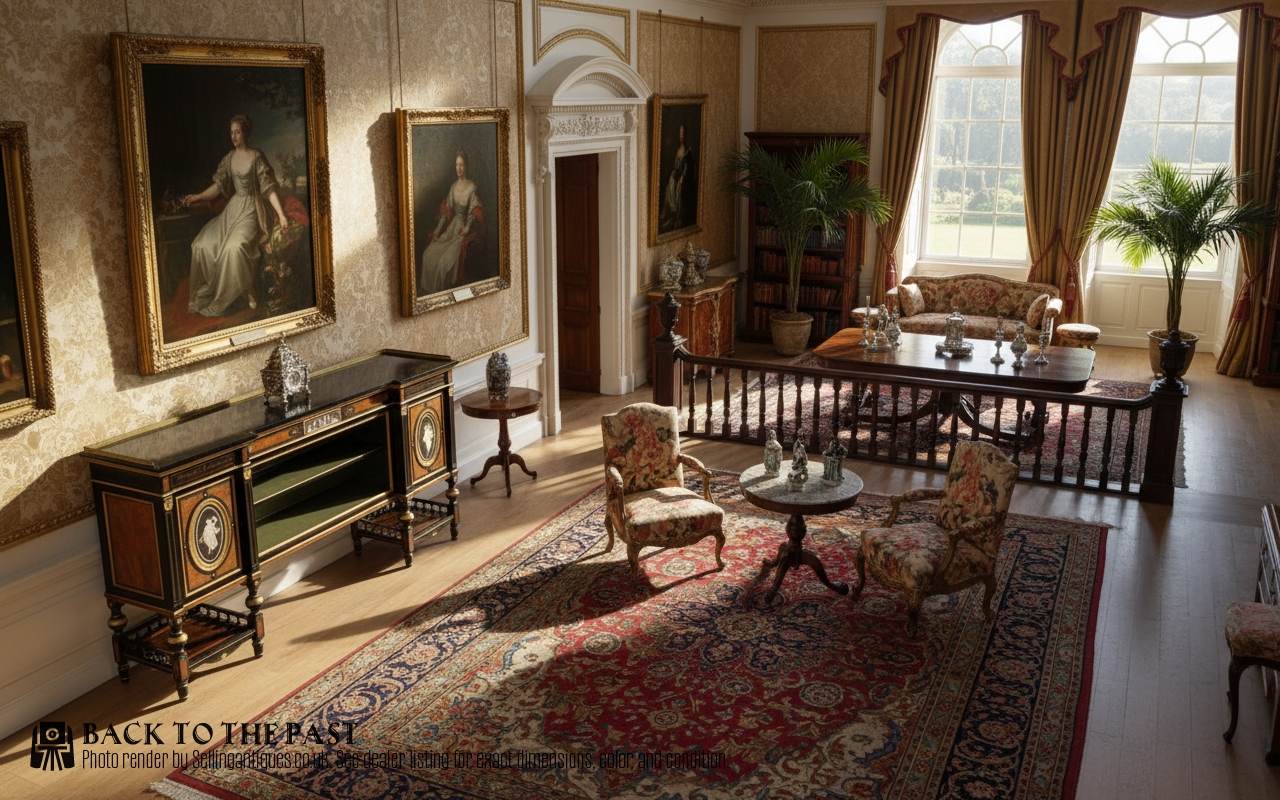
Classical Revival Credenza
A classical revival credenza draws on historical architectural motifs, translating grand proportions into domestic scale storage furniture.
Buyers encounter forms ranging from bow front and demi-lune side cabinets to serpentine Credenzas & Side Cabinets rooted in nineteenth century design.
Sheraton Revival and Victorian Aesthetic Movement pieces dominate the selection, bringing lighter satinwood and painted panels to traditional carcass forms.
Materials and construction methods
Craftsmen built these cabinets using foundational timbers like walnut and timber carcasses faced with fine veneers including satinwood and rosewood.
Decoration relied on contrasting inlaid marquetry wood and delicate oil paint applied to panels, complemented by cast brass hardware and carved details.
Several cabinets feature hand-painted floral panels that bring permanent spring blooms into Victorian parlours.
Distinctions in craftsmanship and design
Quality rests in the precision of the marquetry and the delicacy of the painted panels, where brushwork remains crisp and deliberate rather than mechanical.
Structural integrity reveals itself in the selection of timbers and the seamless joining of curved forms like bow fronts and demi-lune profiles.
Edwards and Roberts·Lamb of Manchester
The Classical Revival Credenza Glossary
- Credenza
- A low dining room or parlour cabinet used for display and storage. The form evolved significantly during the nineteenth century revival periods.
- Marquetry
- The art of applying small pieces of veneer to a structure to form decorative patterns. Craftsmen utilised various coloured woods to create pictorial designs.
- Demi-lune
- A half moon shape commonly found in the footprint of side cabinets and tables. This profile allows the furniture to sit flush against a wall.
- Satinwood
- A lustrous hardwood native to Ceylon and India prized for its golden sheen. It serves as a pale background for detailed inlay and paint.
Classical Revival Credenza: Frequently Asked Questions
What is a classical revival credenza?
A classical revival credenza is a low cabinet inspired by ancient architectural motifs, combining timber construction with decorative marquetry and painted panels.
These pieces emerged strongly during the nineteenth century, drawing upon earlier Neoclassical and Sheraton design vocabularies for Victorian drawing rooms.
How were these cabinets used?
Historically, such pieces functioned as display surfaces and storage units in formal reception rooms, often holding porcelain or silver.
Today, they serve similar decorative and practical roles in contemporary interiors, anchoring a room while offering concealed storage space.
What woods are common in these cabinets?
Satinwood and walnut provide the primary surfaces, often enhanced with contrasting marquetry inlays and bordered by darker timbers.
Subordinate construction timbers form the hidden structural carcasses beneath these decorative exterior veneers.