


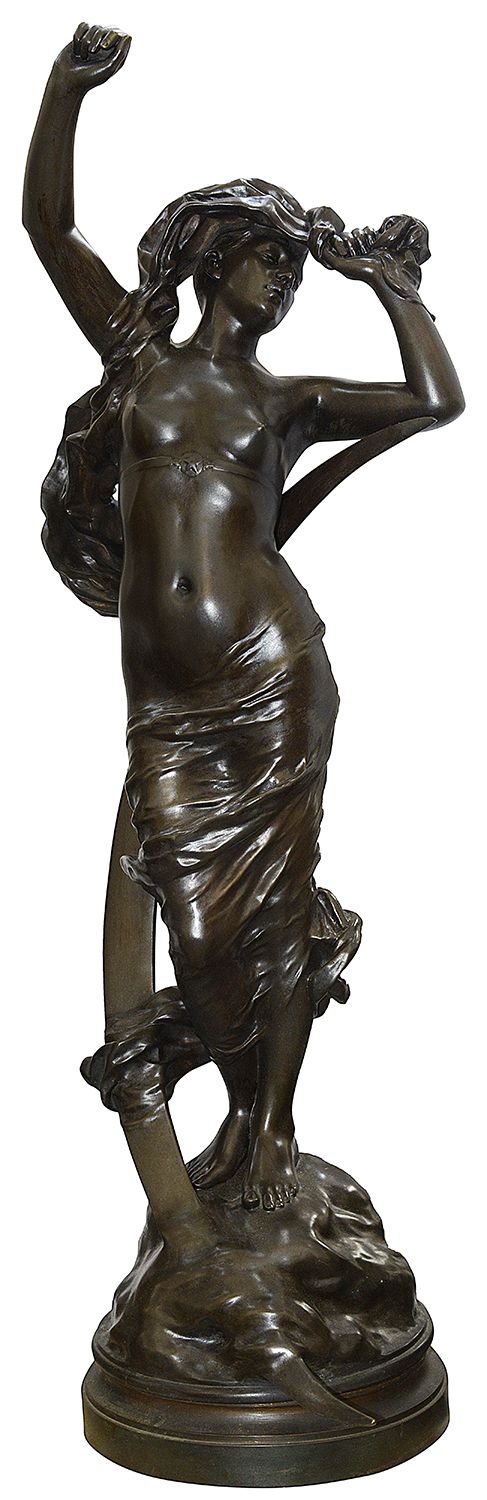


Classical Nymph Statue
A classical nymph statue brings the timeless elegance of mythological grace into your interior scheme.
Classical Nymph Statue
When you search for a classical nymph statue, you enter a world of mythological figures captured in enduring forms. These pieces portray female maidens and dancers inspired by classical antiquity, frequently rendered in standing or dancing poses. You are most likely to encounter nineteenth-century French examples on this page, reflecting the enduring popularity of classical themes throughout the period.
The objects take the form of standalone sculptures, figure groups, and sculptural vases designed for display. Creators drew heavily upon mythological subjects, depicting dancing maidens, pipers, and mother figures with children. These works range from modest terracotta figures to substantial bronze and marble statues representing classical motifs.
How they were made
The physical construction of these sculptures relies upon traditional foundry and carving methods practised across Europe. Bronze pieces utilise the casting process, yielding fine details in drapery and hair before receiving patination, silvering, or gilding. Marble and terracotta alternatives demonstrate alternative sculptural traditions, relying on direct carving or moulding to achieve their finished appearance.
Surface finishes contribute significantly to the visual character of the metal works, employing patinated bronze, silvered bronze, and gilt brass. Foundries and individual sculptors applied these treatments to enhance depth and highlight the contours of the figures. Terracotta and marble offer natural matte textures that rely entirely on the modeller's skill and the quality of the stone.
Listings feature works spanning the nineteenth and early twentieth centuries, produced in bronze, marble, terracotta, and brass.
What varies in quality
Quality in these sculptures rests upon the crispness of the casting and the fidelity of the modelling. Finer examples exhibit meticulous attention to anatomical proportion, facial expression, and the fluid movement of drapery. Lesser pieces often display softer definition in extremities and simpler surface finishing.
The reputation of the maker or foundry provides a further distinction within the selection. Signed works or productions from established Parisian foundries carry evidence of higher artisan input and rigorous quality control. Materials also dictate grade, with heavy cast bronze and carved marble representing more ambitious output than moulded terracotta.
Auguste Moreau·S. Kinsburger·Clodion·Eugène Désiré Piron·Houdebine·Carrier·Antoine Coysevox·Barbedienne
The Classical Nymph Statue Glossary
- Patinated bronze
- Bronze with a chemically induced surface coloration that protects the metal and adds visual depth. This treatment accentuates the shadows and highlights modelled by the sculptor.
- Terracotta
- Fired clay used for sculptural modelling before or without glazing. It allows for immediate touch from the artist's hand.
- Neoclassical
- A style drawing inspiration from the art and culture of classical Greece and Rome. It prioritises symmetry, proportion, and mythological subject matter.
- Silvered bronze
- Bronze treated with a layer of silver to create a reflective, pale surface finish. This technique offers a distinct alternative to traditional dark patination.
- Gilt brass
- Brass coated with a thin layer of gold or gold-coloured alloy. It provides a bright, decorative metallic sheen.
Classical Nymph Statue: Frequently Asked Questions
What is a classical nymph statue?
A classical nymph statue is a sculptural representation of a mythological maiden, typically depicted in bronze, marble, or terracotta. These figures often capture dancers, pipers, or semi-nude maidens in graceful poses.
Originating largely from nineteenth-century French studios, these pieces reflect a deep cultural fascination with classical antiquity. They serve as decorative indoor sculptures designed for prominent display on mantelpieces, pedestals, or tables.
Where were these statues made?
The majority of these statues originate from France, particularly Paris, which served as a major centre for bronze casting and sculpture production during the nineteenth century. Foundries and individual artists worked within established metropolitan workshops.
French sculptors and foundries dominated the production of patinated and silvered bronze figures during this era. Their output drew inspiration from classical Greek and Roman art traditions.
How do I care for bronze statues?
Bronze sculptures require minimal maintenance beyond regular dusting with a soft, dry cloth to prevent grime accumulation. Avoid using chemical cleaners or abrasive cloths that can strip the patinated or silvered surface.
Keep bronze and marble pieces away from direct sources of heat and excessive moisture. Occasional gentle cleaning preserves the integrity of the original metal finish.
How do I identify the period?
Identifying the period involves examining the material, casting technique, and stylistic markers such as Neoclassical or Art Nouveau influences. Nineteenth-century pieces frequently bear foundry stamps, signatures, or stylistic traits associated with French revival movements.
Signatures from known artists or foundry marks provide direct evidence of the date and origin. The choice of materials, from heavy cast bronze to terracotta, also helps contextualise the era of production.