




Classical French Candelabra
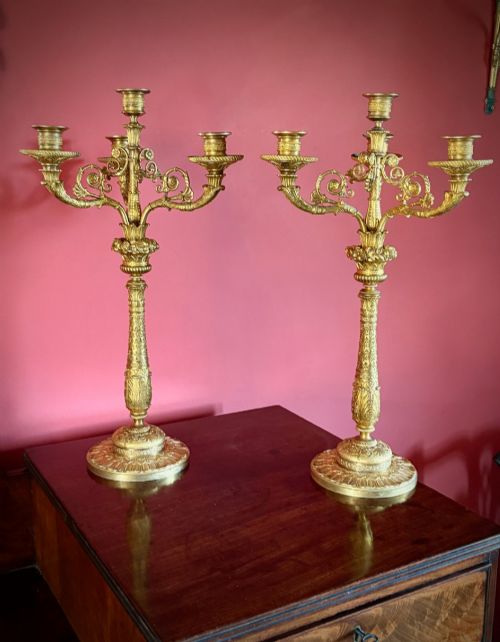
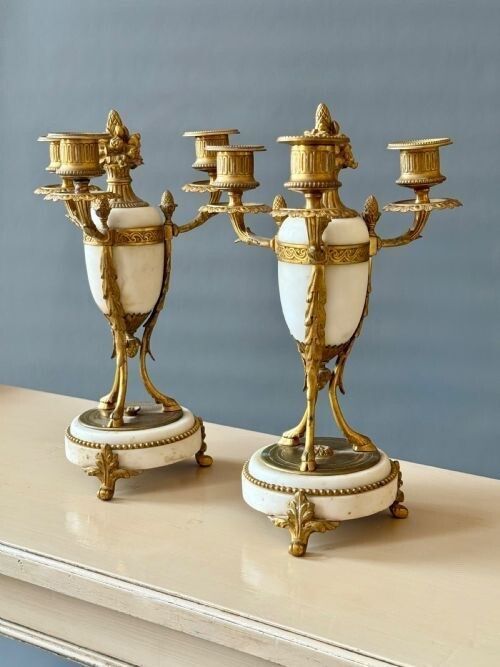
These classical french candelabra bring bronze, marble and ormolu together in heavy pairs shaped by nineteenth-century workshops.
Classical French Candelabra
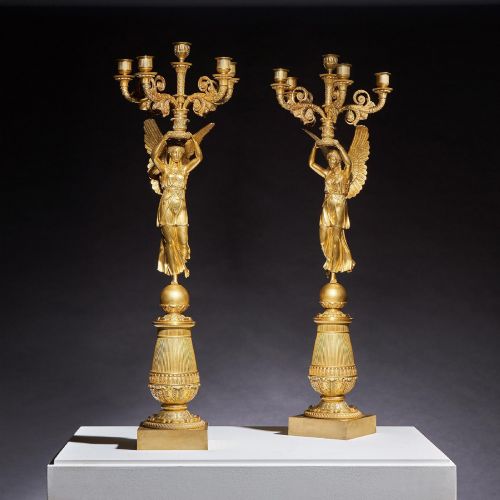
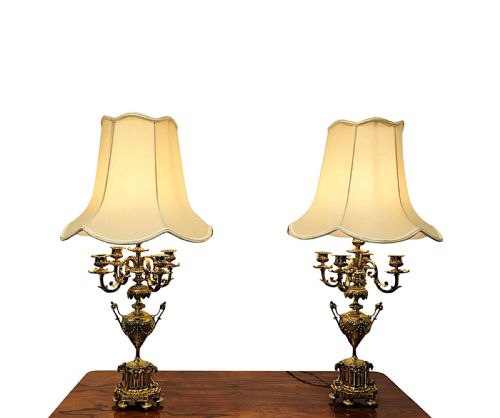
Classical French candelabra appear primarily as nineteenth-century pairs fashioned in bronze, ormolu and marble, reflecting periods from the French Empire through the Louis XVI Revival and Victorian eras. Buyers seeking this phrase encounter multi-branch candleholders alongside related garniture clock sets and occasional conversions to lamps.
The decorative vocabulary draws heavily on neoclassical, Greco-Roman and Empire motifs, frequently incorporating figures such as putti, cherubs or mythological subjects upon plinths. Most examples divide their output between patinated dark bronze and bright gilded bronze or ormolu, often set against white or dark marble bases.
Materials and Construction
The construction relies on cast bronze and brass components, assembled from multiple sections that are mechanically joined rather than cast as a single piece. Surfaces combine chemically patinated dark bronze with mercury gilding or fire-gilding known as ormolu, yielding deep contrast against stone elements.
Bases frequently incorporate turned and polished white marble, slate or onyx, providing heavy counterweights to the branch assemblies above. Where enamel, glass or porcelain components appear, they are integrated into the central shafts or garniture companion pieces.
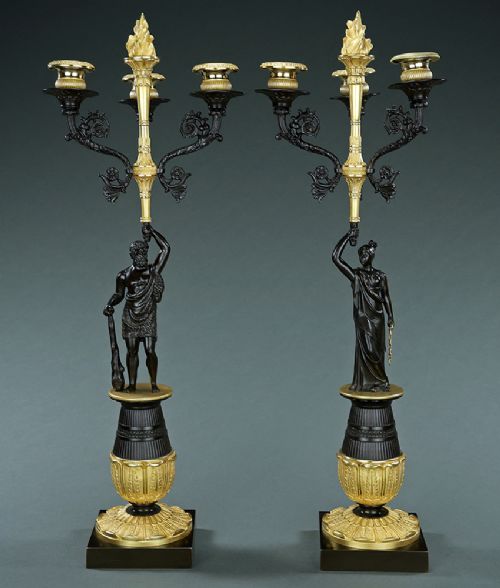
Hercules holds Hesione aloft on one heavy bronze base, turning a Greek myth into a sturdy support for evening candlelight.
Quality and Execution
The weight and selection of the supporting stone bases also signal grade, with dense, finely polished marble or slate outperforming lighter or loosely fitted mounts. Maker signatures or attribution to established foundries provide further indication of high-tier manufacture.
Pierre Philippe Thomire·Thiebaut Freres·Rabiat·H Luppens Paris
The Classical French Candelabra Glossary
- Ormolu
- Gilded bronze produced through the application of a mercury and gold amalgam fired onto the metal surface. This historic technique creates a warm, deep lustre distinct from modern electroplating.
- Garniture
- A set of matching decorative objects, typically comprising a mantel clock flanked by a pair of candelabra or urns. These ensembles were designed to sit symmetrically on a fireplace mantel.
- Patinated Bronze
- Bronze treated with chemical solutions to produce a controlled dark brown or greenish surface tone. It provides visual contrast against bright ormolu mountings.
- Torchère
- A stand or candelabrum designed to hold a light source high, often taking the form of a classical figure bearing a torch or branch cluster.
- Bleu De Roi
- A deep, rich royal blue ceramic glaze developed at French porcelain factories and utilised on clock bodies and companion pieces.
Classical French Candelabra: Frequently Asked Questions
How do I date these candelabra?
Dating relies on stylistic markers tied to specific French periods, such as the military motifs of the early nineteenth-century Empire style or the lighter neoclassical revivals of the later decades. Construction methods, including the type of hand-chasing on the bronze and the assembly screws used internally, offer further chronological clues.
Makers' marks or foundry stamps, when present on the metal or the movement of associated clock sets, provide the most secure verification of a manufacturing decade.
Were these originally electrified?
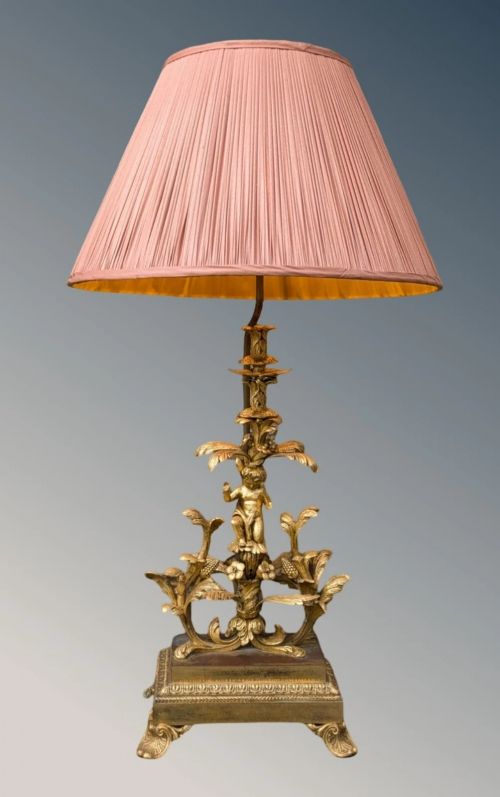
Nineteenth-century candelabra were manufactured exclusively for wax candles, designed to reflect light off ormolu surfaces during evening gatherings. Many surviving examples have been subsequently converted to table lamps by wiring through the central shaft.
Conversions range from reversible setups that preserve the original candle sockets to permanent alterations, so buyers should examine how the wiring has been routed.
How should I clean ormolu and bronze?
Maintenance requires only a soft, dry cloth to remove dust from the crevices of the cast ornament. Moisture and abrasive cleaning agents must be avoided, as they strip the historic mercury gilding and damage the chemical bronze patina.
Marble bases benefit from gentle wiping with a damp cloth followed immediately by drying, taking care not to let water seep into unsealed stone joints.
What is a clock garniture set?
A garniture set is a coordinated mantel arrangement consisting of a central clock flanked by two matching side pieces, such as candelabra, urns or vases. These suites were produced as cohesive decorative ensembles by French clockmakers and bronze founders.
Keeping the set together preserves its original decorative integrity, as the materials, patination and neoclassical design motifs match across all components.