


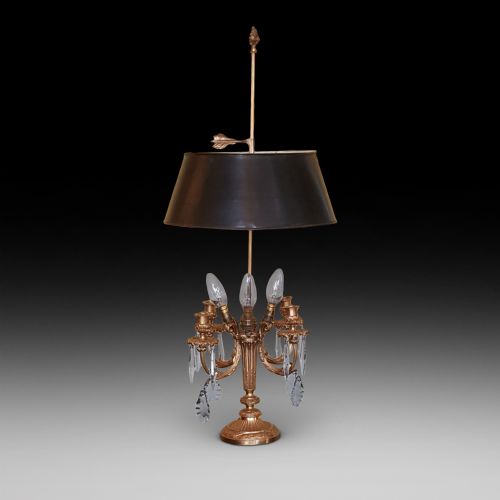


Vintage Crystal Candelabra Lamp
A vintage crystal candelabra lamp brings glittering, layered candle-style illumination and period presence to a room.
Vintage Crystal Candelabra Lamp
When you search for a vintage crystal candelabra lamp, you are looking at decorative lighting pieces that combine branching candleholders with electrical illumination. The vintage crystal candelabra lamp typically appears in forms originating around the late nineteenth and early twentieth centuries, drawing heavily on French and English design vocabularies.
The pieces listed on this page encompass table lamps, candelabra lamps, girandoles, and table chandeliers spanning from the eighteen-seventies through to the nineteen-thirties. You will most frequently encounter pairs originating from French workshops, dating predominantly to the nineteen-twenties and incorporating multiple light branches.
These items merge the functional requirements of electric lighting with the decorative grandeur of traditional candelabra. Makers adapted existing chandelier and candelabra forms into table-standing units, resulting in objects designed to sit on side tables, consoles, and mantelpieces.
How they were made
Construction relies on structural frameworks of brass, gilded brass, or bronze, often combined with silvered metal. These metal mounts form the central shafts, bases, and branching arms that support the electrical fittings and glass elements.
The visual impact depends heavily on cut crystal and glass drops, pendants, and bobeches suspended from the metal armature. These reflective glass components refract light from the bulbs, utilising traditional lapidary cutting techniques developed over centuries.
Listings feature items dated from eighteen-seventy through to the nineteen-thirties, dominated by nineteen-twenties French works.
What varies in quality
Quality differentiates itself through the crispness of the metal casting and the depth of the hand-finishing on the brass, ormolu, or bronze frames. Finer examples display sharply defined ornamentation and heavier gauge metalwork that holds its structural integrity across the branching arms.
The clarity, weight, and cutting precision of the crystal drops and bobeches also dictate the overall standard of the piece. Superior glass elements feature sharp facets and substantial weight, whereas lesser examples utilise thinner, simpler pressed glass without hand-cut detailing.
The Vintage Crystal Candelabra Lamp Glossary
- Candelabra
- A branched candlestick holder designed to hold multiple candles or, in later adaptations, electric bulbs. They form the primary structural silhouette for these lamps.
- Girandole
- A branched wall sconce or ornamental table candelabrum featuring mirrors or glass to reflect light. These pieces often incorporate extensive crystal drops.
- Bobeche
- A collar or drip pan fitted beneath the candle nozzle to catch wax, typically hung with crystal prisms on finer lighting. They anchor the upper tiers of the design.
- Ormolu
- Gilded bronze or brass created through a mercury amalgamation process or gold plating. It provides the warm, golden metallic finish seen on many French frames.
- Table Chandelier
- A smaller chandelier form adapted with a base for placement on tables or surfaces rather than hanging from a ceiling. They share identical construction methods with their larger ceiling-mounted counterparts.
Vintage Crystal Candelabra Lamp: Frequently Asked Questions
What is a vintage crystal candelabra lamp?
A vintage crystal candelabra lamp is a decorative lighting fixture that merges the multi-branched form of a traditional candle candelabrum with electric illumination. These pieces typically incorporate metal frames adorned with cut crystal drops and glass prisms.
They were designed as decorative tabletop ornaments for grand interiors, functioning both as sculptural objects and as ambient light sources.
How do I style a candelabra lamp?
These lamps suit formal reception rooms, dining spaces, or entrance halls where their reflective crystal and gilded metalwork can catch natural and artificial light. Placing them symmetrically as a pair on a sideboard or console creates a balanced, classical arrangement.
Because of their ornate profiles, they work best against simple backgrounds that allow the intricate glass drops and metal branches to stand out.
Are these lamps originally electric?
Many examples from the late nineteenth and early twentieth centuries began life as non-electric candelabra or were subsequently adapted during the period to accept wiring. Conversions allow historical decorative metalwork and crystal to function safely with modern electricity.
When examining these pieces, you will see evidence of period wiring integration alongside traditional threaded metal assembly components.
How do I distinguish French styles?
French pieces from this selection often draw on Louis XV, Neo-Classical, or chateau aesthetics, characterised by flowing rococo curves, urn motifs, and elaborate cast ormolu mounts. The metalwork tends towards decorative exuberance with symmetrical branching arms and dense clusters of crystal pendants.
English variants from the same eras typically display a slightly more restrained geometry, aligning with Regency or Edwardian design principles while retaining similar brass and glass materials.