

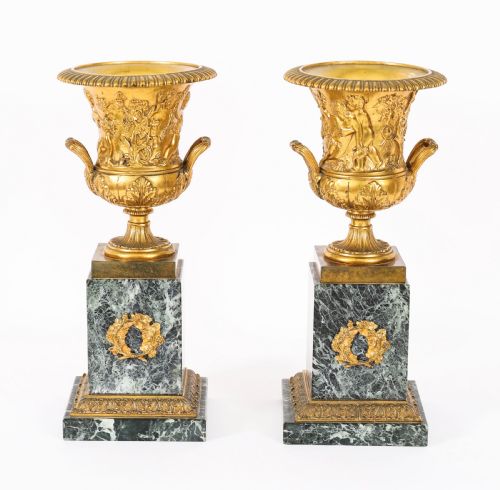
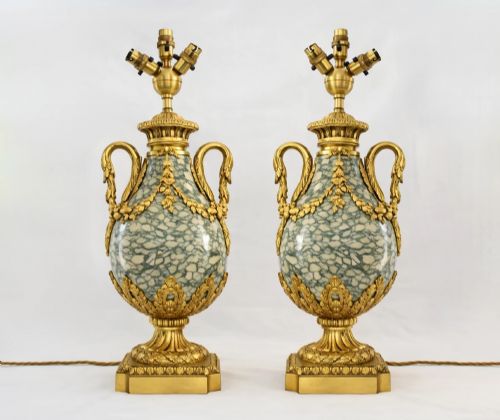
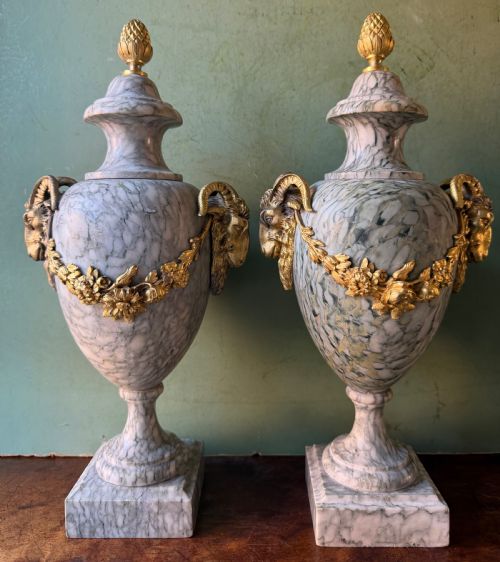
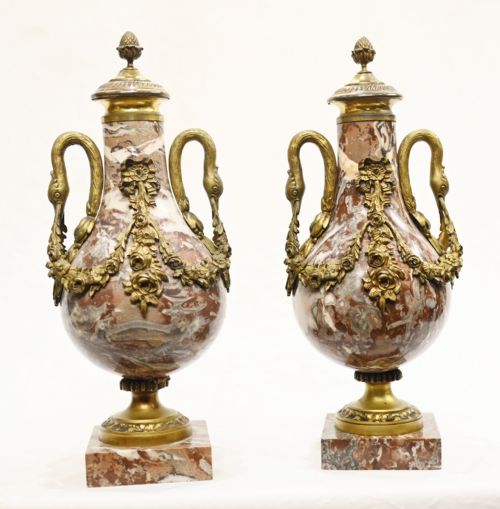


Classical Cassolette Urns
Classical cassolette urns are reversible decorative vessels that transform from solid urns into candle holders, bringing distinct neoclassical elegance to a room.
Classical Cassolette Urns
Classical cassolette urns are decorative vessels rooted in neoclassical and French Empire styles, often encountered as matched pairs. These pieces frequently date to the nineteenth century, including the Regency period, Victorian era, and eighteen-ninety.
Buyers will find forms functioning as decorative urns, amphora vases, clock garnitures, and table lamps. French makers heavily influence the selection through Louis XVI style designs and Grand Tour souvenirs.
The defining characteristic of these objects is their dual nature, featuring lids that reverse to reveal candle sockets. They serve primarily as mantel ornaments or decorative centrepieces rather than utilitarian storage.
How they were made
Maker workshops utilised contrasting materials, pairing carved white onyx, green marble, and standard marble bodies with cast metal mounts. Gilt bronze and ormolu provide the golden highlights typical of French neoclassical and Empire aesthetics.
Foundry work involved casting bronze and brass elements, which were then chased and gilded. Some pieces incorporate majolica porcelain or silvered finishes alongside the stone and metal components.
Classical Cassolette Urns Retail Price Guide 2026
Typical asking prices for classical cassolette urns among the pieces listed under this phrase on Sellingantiques today, from the lower quarter to the upper quarter. They describe what is for sale here now, not the wider market.
Listings feature nineteenth-century pieces spanning the Regency and Victorian eras, predominantly utilising marble, gilt bronze, and ormolu.
What varies in quality
Quality rests in the crispness of the bronze casting and the precision of the marble or onyx turning. Finer examples show sharp relief in the acanthus leaves, handles, and mounts, whereas simpler versions lack deep definition.
The harmony between the stone body and the metal mounts dictates the visual success of the piece. Superior items integrate the reversible lid mechanism seamlessly into the overall silhouette of the urn.
Auguste Cain
The Classical Cassolette Urns Glossary
- Cassolette
- A decorative vessel with a reversible lid that converts an urn into a candle holder. This dual function defines the primary category.
- Ormolu
- Gilt bronze used extensively for decorative mounts on nineteenth-century furniture and objects. The technique involves applying a gold amalgam to a bronze base.
- Grand Tour
- Cultural travel undertaken by nineteenth-century Europeans to collect art and antiquities. Many decorative objects stem from this tradition.
- Garniture
- A set of ornamental objects designed to be displayed together, frequently comprising a clock flanked by matching urns or vases.
- Amphora
- A classical two-handled jar with a narrow neck, utilised as a distinct stylistic form for decorative vases and urns.
Classical Cassolette Urns: Frequently Asked Questions
What is a cassolette urn?
A cassolette urn is a decorative vessel featuring a removable, reversible lid. One side presents a solid urn top, while the reverse holds a candle socket.
This clever design allowed nineteenth-century households to shift a mantelpiece ornament into a functional lighting accessory with a simple turn of the lid.
How do you date these pieces?
Dating relies on stylistic markers such as French Empire or Louis XVI motifs, combined with material choices like white onyx, green marble, and ormolu. Nineteenth-century examples often display specific casting techniques and patination typical of the period.
Makers frequently took inspiration from classical antiquity during the Regency and Victorian eras, producing revival pieces that mirror earlier aesthetics.
Were they used for lighting?
They served a dual purpose as both decorative ornaments and functional candle holders. Reversing the lid transformed the display object into a source of ambient light.
Many surviving nineteenth-century examples retain this mechanical feature, though some later adaptations converted the bodies permanently into table lamps.
What styles are most common?
French neoclassical and Empire styles dominate the available selection. These pieces frequently incorporate gilt bronze mounts upon marble or onyx bodies.
Grand Tour souvenirs and Louis XVI revival designs also appear regularly, reflecting nineteenth-century fascination with classical antiquity.