




Decorative Marble Mantel Cassolettes
These decorative marble mantel cassolettes bring classic French neoclassical elegance to a room, offering the versatility of lidded urns that double as perfume burners.
Decorative Marble Mantel Cassolettes
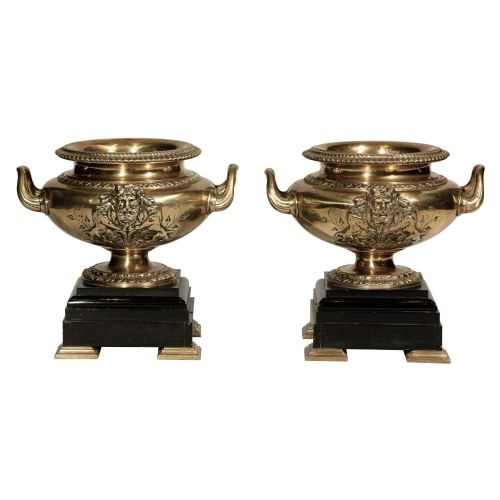
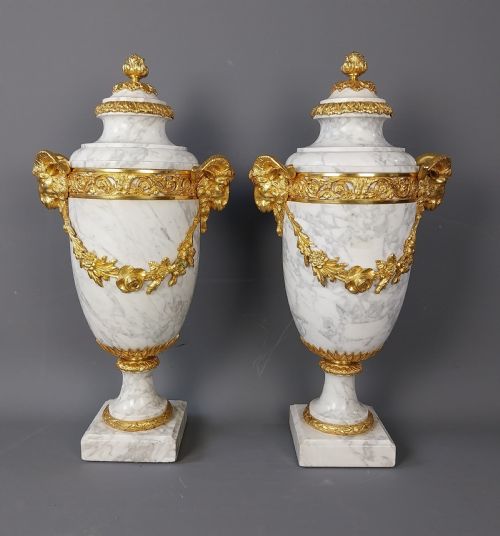
Decorative marble mantel cassolettes are ornamental vessels designed to sit upon a fireplace mantel or console, combining turned stone bodies with metal mounts. When you search for decorative marble mantel cassolettes, you encounter pairs of French Neoclassical, Louis XVI style, and Grand Tour pieces dating across the nineteenth century.
The selections on this page span the Victorian era up to around nineteen hundred, featuring green marble, white onyx, and black marble paired with contrasting metals. These lidded urns and vases often arrive as matched pairs, standing on pedestals or plinths ready for display.
Materials and construction
The foundation of these pieces relies on turned natural stone, specifically white onyx, green marble, and black marble, shaped into urn, coupe, and vase forms. Artisans then integrated cast metal elements to form the structural mounts, handles, and lids.
Gilt bronze and ormolu provide the bright metallic contrast against the polished stone, whilst patinated bronze and silvered finishes offer a more subdued tonal variation. Casting precision determines the sharpness of the decorative details on the mounts.
Decorative Marble Mantel Cassolettes Retail Price Guide 2026
Typical asking prices for decorative marble mantel cassolettes among the pieces listed under this phrase on Sellingantiques today, from the lower quarter to the upper quarter. They describe what is for sale here now, not the wider market.
Some lids pivot to reveal their hidden function as ancient air fresheners.
Factors that define quality
Quality rests upon the crispness of the metal casting and the depth of the chasing on the bronze and ormolu mounts. Finer examples display intricate surface work that remains sharp and well-defined across both pieces in a pair.
The selection of the stone body dictates visual weight and presence, with uniform veining and careful polishing elevating the piece. Successful integration between the stone vessel and its metal fittings marks the difference between standard production and superior craftsmanship.
The Decorative Marble Mantel Cassolettes Glossary
- Cassolette
- A decorative vessel featuring a reversible or pierced lid that allows it to function as a perfume burner or standard covered urn. They typically sit upon mantelpieces as decorative pairs.
- Ormolu
- Gilt bronze created by applying a mercury and gold amalgam to a bronze base, then firing to leave a rich golden layer. This technique was widely utilised in French furniture and decorative objects.
- Grand Tour
- A nineteenth-century cultural journey undertaken by wealthy Europeans to study classical antiquities, inspiring domestic souvenir items in classical styles. Pieces in this manner often draw directly on ancient Greek and Roman forms.
- Coupe
- An open-topped shallow vessel or bowl, frequently mounted on a pedestal base. These serve as decorative display pieces rather than lidded containers.
Decorative Marble Mantel Cassolettes: Frequently Asked Questions
How do I use cassolettes?
These vessels were traditionally used to burn perfumes or scented resins by utilising the pierced sections of their reversible lids. Today, they serve primarily as decorative mantel ornaments and focal points within a room.
Pairs are typically arranged symmetrically on a mantelpiece, sideboard, or console table to frame a mirror or artwork.
How do I date these pieces?
Dating relies on stylistic indicators such as Louis XVI revival motifs, material choices like white onyx or green marble, and the manufacturing characteristics of the bronze casting. Nineteenth-century examples frequently exhibit the revival styles popular during the Victorian period and the Grand Tour era.
Examining the construction of the interior mounts and the wear on the stone base provides further clues to age.
Are these pieces always sold in pairs?
The selection listed here consists entirely of matched pairs designed for symmetrical placement. Pairs were intended to balance mantelpiece arrangements in formal nineteenth-century interiors.
Single pieces appear less frequently in this specific category.