




Church Landscape Painting
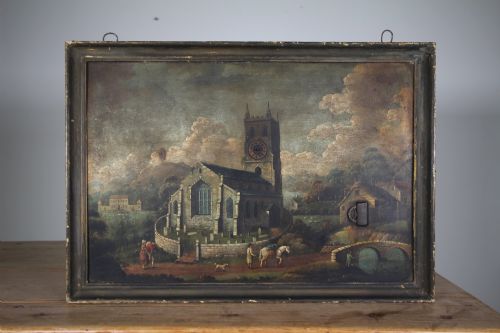
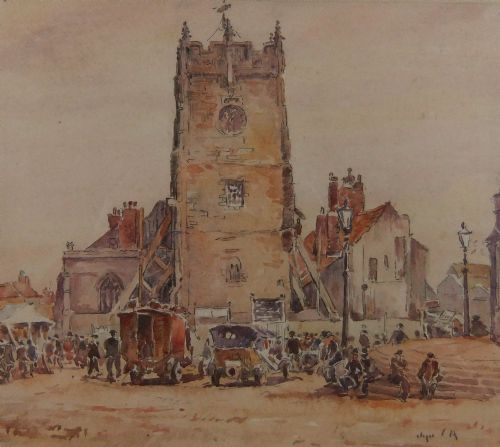
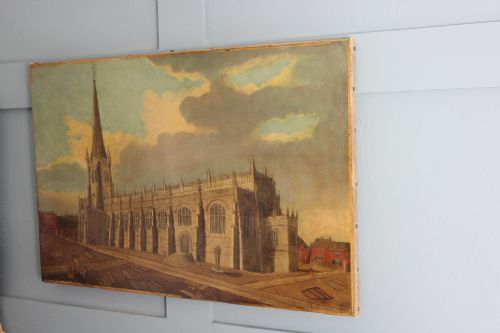
A church landscape painting captures architectural landmarks within rural and urban settings across several centuries of British and European art.
Church Landscape Painting
The selections span from Georgian and Victorian periods through Edwardian and mid-twentieth-century movements. Watercolours and oil paintings on canvas, board, or paper represent the primary formats available.
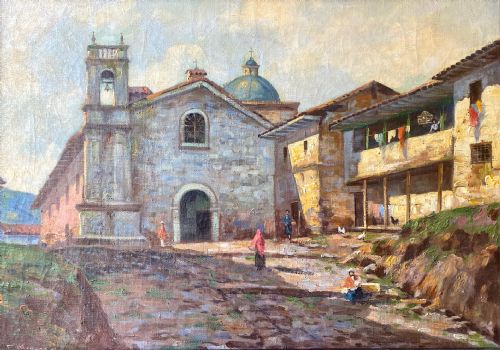
Many compositions focus on English and Welsh country churches, while others depict Scottish, French, or Latin American settings. Artists range from named professionals to regional schools and naive painters.
How They Were Made
Artists applied oil paint to stretched canvas or wooden boards, building up layers of pigment to capture light and texture. Watercolours were painted on paper, often utilising washes to render atmospheric skies and rural topography.
Supports varied according to period and medium, with nineteenth-century works frequently housed in substantial gilt frames. Pigments and brushwork reflect the distinct techniques of Post-Impressionism, British Impressionism, and traditional topographical illustration.
Geographic subjects span English country parishes, Welsh valleys, Scottish towns, and continental European street scenes.
What Varies in Quality
Skill in handling perspective, light, and architectural detail distinguishes accomplished works from simpler regional studies. The fidelity of the topographical recording and the strength of the surrounding landscape composition also determine the standing of each piece.
The handling of the medium, whether through confident oil impasto or delicate watercolour washes, dictates the visual impact of the finished artwork.
John Smith Atherton·Joan Gillchrest·Alfred George Morgan·William Greaves·John Edward Bale·Walter Meegan·Kershaw Schofield·John Cawthorn·Rowland Henry Hill·Maurice Asselin·Jeffrey Pratt·John Jaques·Henri Therme·David Bates·Frederick Underhill·Stephanie Cooper·Fred Lawson·Daniel Sherrin·John Thirttle·Thomas Henry Hunn·Thomas Ditmas·Max Ludby·Joseph Pighills·James Hardaker·AF de Breanski
The Church Landscape Painting Glossary
- Watercolour
- A paint consisting of water-soluble pigments applied to paper. This medium allows for transparent washes and fine illustrative detail.
- Impasto
- Paint applied thickly to a canvas or board so that the brush or palette knife marks remain visible. This technique adds tactile dimension to foliage and stonework.
- Naive art
- Work produced by an artist lacking formal academic training, often characterised by a direct perspective and simplified forms. These pieces offer candid social and architectural records.
- Diptych
- An artwork made of two hinged or paired painted panels. Such formats allow artists to present contrasting views of a single ecclesiastical site.
Church Landscape Painting: Frequently Asked Questions
What is a church landscape painting?
These artworks depict churches, abbeys, and cathedrals set within rural or urban surroundings. They serve as historical records of specific parishes and local topography.
Artists across different centuries recorded these buildings using oils or watercolours to capture changing light and weather conditions.
How old are these paintings?
The works span from the eighteenth century through the Georgian, Victorian, and Edwardian eras into the mid-twentieth century. Each period brought distinct stylistic approaches to landscape and architectural rendering.
Dating is typically determined by artist signatures, period framing, inscriptions, and stylistic traits.
Where were these scenes painted?
Compositions frequently record locations across English counties such as Yorkshire, Norfolk, and Surrey, alongside Welsh and Scottish sites. Some pieces also capture continental European views in France and Latin America.
Many titles explicitly name the specific church and surrounding village or river.
How should I care for these paintings?
Works on paper require protection from direct sunlight to prevent fading of watercolours. Framed canvases and boards benefit from stable indoor humidity and gentle dusting.
Maintaining original frames helps preserve the historical context of antique pieces.