
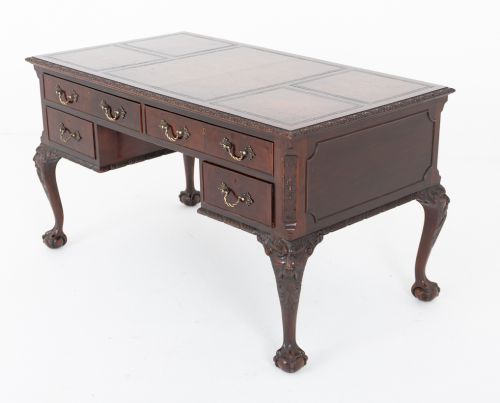
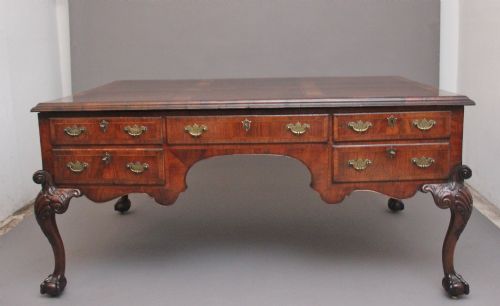


Chippendale Style Library Table
These chippendale style library table pieces bring formal eighteenth-century gravitas into the study through carved mahogany timbers and partner formats.
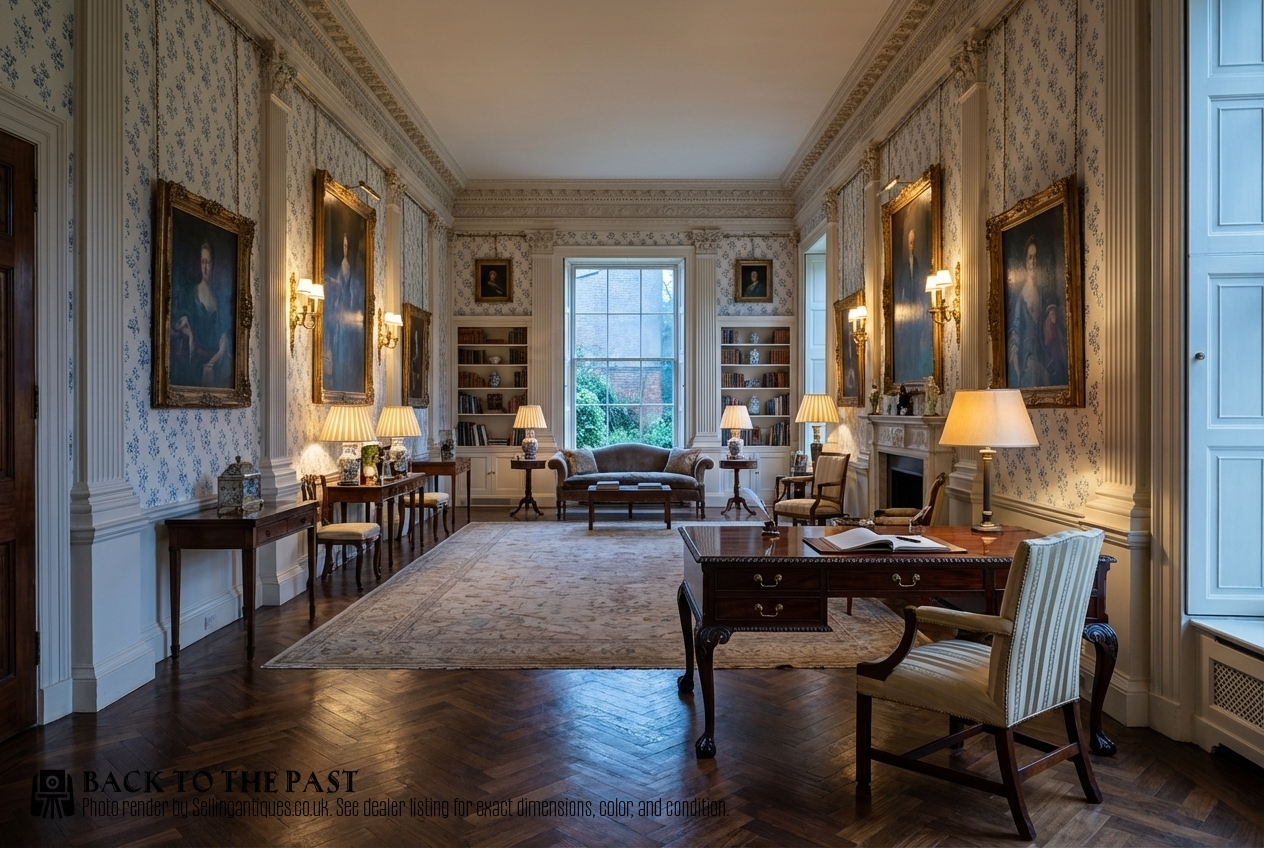
Chippendale Style Library Table
A chippendale style library table combines the robust proportions of Georgian workspaces with the decorative flourish characteristic of revival periods from the nineteenth and early twentieth centuries.
Originating across eras spanning the Georgian period through Edwardian and 1920s revivals, these heavy desks frequently feature leather writing inserts and multiple storage drawers.
How they were made
Cabinetmakers utilised dense timbers such as mahogany and walnut, often applying flame veneer over secondary woods to create dramatic figuring on primary surfaces.
Structural hardware relied upon cast brass handles and escutcheons, while writing surfaces incorporated inset leather panels tooled with gilt decoration.
Several pieces double as revolving bookcases, ensuring your heavy volumes spin gracefully at the touch of a single finger.
What varies in quality
The standard of carving distinguishes superior examples, where motifs like acanthus leaves and gadrooning display crisp hand-chiselled depth rather than shallow mechanical moulding.
Construction methods dictate longevity, separating heavy freestanding partners desks built for central room placement from lighter single-sided writing tables.
Gillows·Druce and Co·Shapland and Petter
The Chippendale Style Library Table Glossary
- Partners desk
- A large double-sided desk designed for two people to work opposite one another, featuring matching drawer arrangements on both long faces.
- Flame mahogany
- A veneer cut from the fork of the mahogany tree, producing a distinctive flickering flame-like pattern across the timber surface.
- Gadroon
- A decorative carved moulding consisting of parallel curved notches, frequently seen edging the tops or aprons of formal tables.
- Kneehole
- A recessed central space beneath a desk top designed to accommodate the user's legs while seated.
Chippendale Style Library Table: Frequently Asked Questions
Where should a partners desk go?
These large tables demand central room placement rather than sitting against a wall, as drawers and kneeholes appear on both opposing sides.
Position them in spacious studies or libraries where people can walk entirely around the structure.
How do I care for leather desk tops?
Apply a microcrystalline wax periodically to nourish the leather insert and protect the gilt tooling from cracking or fading under light.
Avoid using harsh chemical cleaners that strip the original dyed finish from the hide.
Are these desks solid mahogany?
Construction varies between solid timber and secondary woods faced with decorative mahogany or walnut veneers, particularly on large flat surfaces.
Revival pieces often combined sturdy structural framing with figured veneers to achieve an impressive aesthetic.
How do I date a revival table?
Examine the secondary interior timbers, drawer construction techniques, and hardware styles to differentiate Georgian originals from later nineteenth and twentieth-century revivals.
Revival workshops frequently adopted earlier aesthetic idioms while utilising machine-sawn framing methods characteristic of their own era.