
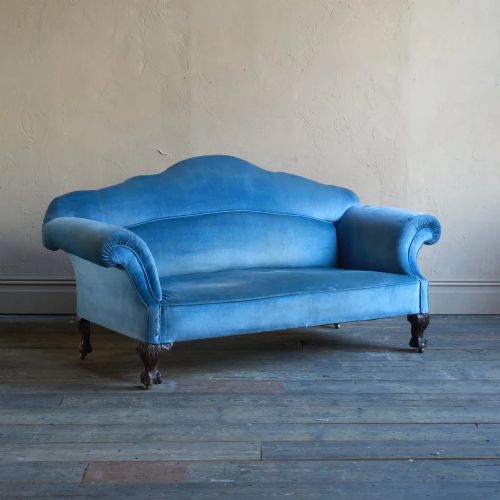


Chippendale Camelback Couch
These Chippendale camelback couch examples combine serpentine lines and mahogany frames, offering traditional seating built for period interiors.
Chippendale Camelback Couch
A chippendale camelback couch presents a distinctive arched backrest that curves smoothly downwards toward the arms, taking the form of sofas, settees, and serpentine front camel back sofas. Buyers searching for a chippendale camelback couch will most frequently encounter 19th Century examples alongside Edwardian and 1910 revivals.
The listings show these pieces span the 18th Century, 19th Century, Edwardian period, 1910, and 1940, capturing both genuine period manufacture and later revivals. Common forms include serpentine front camel back sofas and pieces built in Georgian proportions with mahogany frames.
Makers and craftsmen working in these traditional styles produced both individual sofas and pairs of settees. The overarching design unites the curved profile of the back with various period leg treatments such as ball and claw feet.
Materials and construction
Frames are constructed from timber, predominantly mahogany, providing the structural integrity needed for the sweeping serpentine lines. Beneath the upholstery, traditional stuffing materials like horsehair support the generous proportions of the seat and back.
Upholstery choices recorded in the evidence include velvet, velvet fabric, damask, and cotton chintz, which cover the padded surfaces. Metal details such as brass may appear on supporting elements or castors, while carved woodwork defines the legs.
At least one pair of settees proves that two camels are occasionally better than one when furnishing a grand room.
Judging quality in a chippendale camelback couch
The distinction between standard production and finer work lies in the sharpness of the timber carving and the fidelity of the proportions to Georgian standards. Finer examples display balanced serpentine curves in the woodwork and frame that maintain structural grace.
Upholstery finish and the quality of the fabric covering - ranging from standard cotton chintz to heavier velvet and damask - affect the overall presentation. The integrity of the underlying timber frame and the execution of details like ball and claw legs separate the exceptional pieces from simpler revivals.
The Chippendale Camelback Couch Glossary
- Camelback
- A sofa style featuring an undulating, curved top rail that rises and falls in gentle humps resembling a camel's back. This silhouette gained prominence during the eighteenth century.
- Serpentine front
- A furniture front characterised by a wavy contour, curving outward in the centre and inward toward the ends. It adds visual movement to the base of the couch.
- Ball and claw
- A type of furniture foot depicting a bird's talon gripping a ball, commonly carved into mahogany legs. It is a defining feature of traditional cabinetmaking.
- Chippendale revival
- A period of nineteenth and twentieth-century furniture production that imitated the designs of Thomas Chippendale. These pieces emulate eighteenth-century aesthetics using later timber and techniques.
- Horsehair
- A traditional upholstery stuffing material woven from equine hair, valued for its resilience and firm support. It was widely used in period seating before synthetic alternatives.
Chippendale Camelback Couch: Frequently Asked Questions
What is a camelback couch?
A camelback couch is a traditional seating form defined by its characteristic arched backrest, which curves gracefully downward toward the arms. These pieces often feature exposed mahogany frames and serpentine front edges.
Historically associated with Georgian design, the style continues to be valued for its formal silhouette and comfortable proportions in period and traditional living spaces.
How do I date a chippendale camelback couch?
Dating requires examining the timber, construction methods, and upholstery techniques used within the frame. Pieces span genuine eighteenth-century origins to nineteenth-century and Edwardian revivals.
Characteristics such as mahogany framing, specific revival styles like Chinese Chippendale, and secondary woods help place a couch within the eighteenth, nineteenth, or early twentieth century.
Where should I place a settee?
Settees and smaller sofas fit well in living rooms, parlours, or hallways where full-sized sofas might overwhelm the floor plan. Their decorative backs make them suitable for placement against panelled walls.
Positioning a settee away from direct sunlight protects sensitive upholstery fabrics like velvet, damask, and cotton chintz from fading over time.
Are these couches comfortable?
These couches were designed for formal sitting, featuring upright backrests and deep seats upholstered over traditional stuffing. The internal padding provides firm support rather than deep slouching.
Living with a period couch involves appreciating its supportive structure and pairing it with cushions if additional softness is required for daily lounging.