





Chinoiserie Pattern Serving Tray
A chinoiserie pattern serving tray brings orientalist scenery into domestic service through transfer printing.
Chinoiserie Pattern Serving Tray
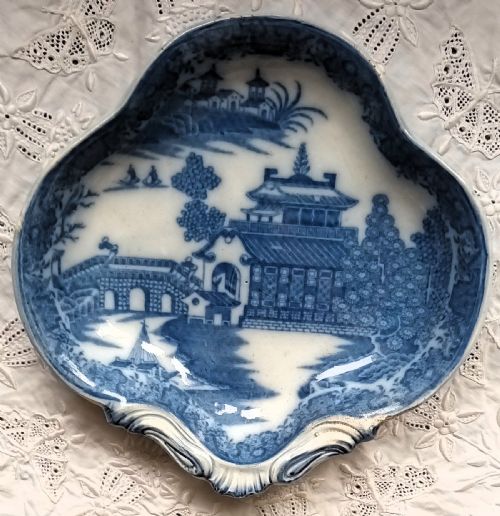
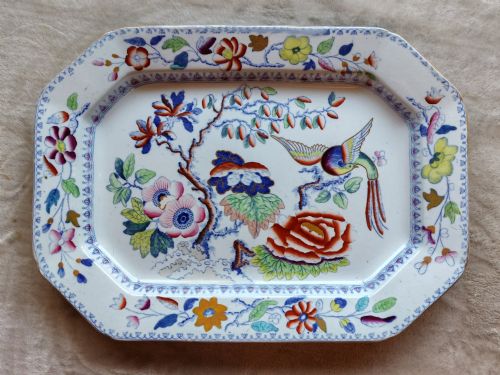
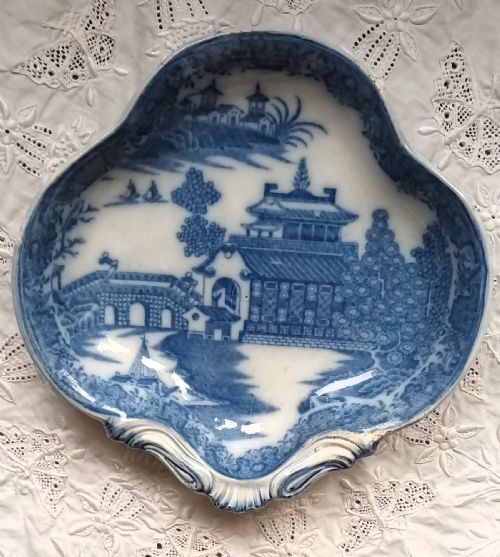
When you search for a chinoiserie pattern serving tray, you are looking at earthenware and ironstone platters decorated with exotic pavilions, figures, and landscapes. These serving pieces span the Georgian and Victorian periods, often taking large rectangular or trefoil forms.
The versions you are most likely to meet on this page include blue and white transfer ware dishes from the nineteenth century alongside later ironstone platters. Makers applied specific named designs such as the Buffalo, Elephant, Chinese Villa, and Pagoda patterns.
These items functioned as meat dishes, bread stands, and general serving platters for the dining table. Their origins are rooted in English potteries adopting eastern motifs to satisfy contemporary tastes for exotic scenery.
Materials and methods
Potters formed these pieces using earthenware, pearlware, and ironstone body pastes. Cobalt pigment provided the blue colour for transfer printing, while glaze sealed the ceramic surface before kiln firing.
Makers utilised copper plate transfer printing to apply intricate scroll and landscape designs onto the pottery body. Some pieces incorporate enamel painting and gilt highlights over the glaze to enrich the finished appearance.
Chinoiserie Pattern Serving Tray Retail Price Guide 2026
Typical asking prices for chinoiserie pattern serving tray among the pieces listed under this phrase on Sellingantiques today, from the lower quarter to the upper quarter. They describe what is for sale here now, not the wider market.
Named patterns on these dishes include the Buffalo, Elephant, Chinese Villa, and Pagoda designs.
Evaluating quality
Quality in these ceramics rests upon the clarity of the transfer print and the crispness of the earthenware moulding. Finer examples display sharp cobalt lines without blurring, whereas weaker pieces suffer from smudged pigment during the printing transfer.
The weight and density of the ceramic body also distinguish standard earthenware from robust ironstone platters. Superior items maintain a balanced form across large serving surfaces and retain smooth, even glazing across the foot ring.
Masons Ironstone·Minton·Elkington·John Rogers and Son
The Chinoiserie Pattern Serving Tray Glossary
- Transfer ware
- Pottery decorated by applying a printed design from an engraved copper plate onto the ceramic surface using a tissue paper medium. This technique allowed intricate oriental scenes to be replicated consistently across multiple dishes.
- Pearlware
- A refined earthenware developed during the late eighteenth century featuring a subtle bluish glaze that pooled in recesses. It bridged the transition between creamware and later white ironstone bodies.
- Ironstone
- A heavy, durable ceramic patented in the nineteenth century that resisted chipping and staining effectively. It provided a strong foundation for large meat platters and serving dishes.
- Trefoil dish
- A vessel shaped with three lobes or compartments, often utilised for serving specialised foodstuffs. Examples appear in nineteenth century blue and white transfer printed wares.
- Cobalt pigment
- A metallic oxide used under the glaze to produce deep blue coloration on ceramics during high temperature firing. It remained stable under intense kiln heat, making it ideal for transfer printing.
Chinoiserie Pattern Serving Tray: Frequently Asked Questions
What were chinoiserie trays used for?
These platters served meat, bread, and cheese at the dining table during Georgian and Victorian meals. Their large surfaces accommodated substantial joints of meat and other shared dishes.
Household staff brought them directly from the kitchen to the dining room for formal service. Afterwards, they were washed and stored in pantries until the next formal gathering.
How do I date a transferware platter?
Dating relies on ceramic body composition, pottery marks, and stylistic clues within the printed border. Pearlware bodies and early Georgian shapes point toward the turn of the nineteenth century.
Heavier ironstone bodies and Victorian registry marks indicate production closer to the middle of the nineteenth century. Comparing the pattern name against known potters also helps narrow the manufacturing decade.
Can I use these for serving food?
These antique ceramics are suitable for serving dry foods or room temperature items at the table. Their glazed earthenware and ironstone surfaces create a stable barrier for food presentation.
Modern dishwashers and harsh detergents should be avoided to protect the historic glaze and cobalt transfer prints. Gentle hand washing preserves the structural integrity of the ceramic body.
What is the difference between earthenware and ironstone?
Earthenware is a porous ceramic body fired at lower temperatures, requiring a complete glaze to become waterproof. It tends to be lighter and more delicate in structure.
Ironstone is a denser, vitrified earthenware formulated to resist heavy wear in busy kitchens. It feels substantially heavier and displays greater durability against daily impacts.