
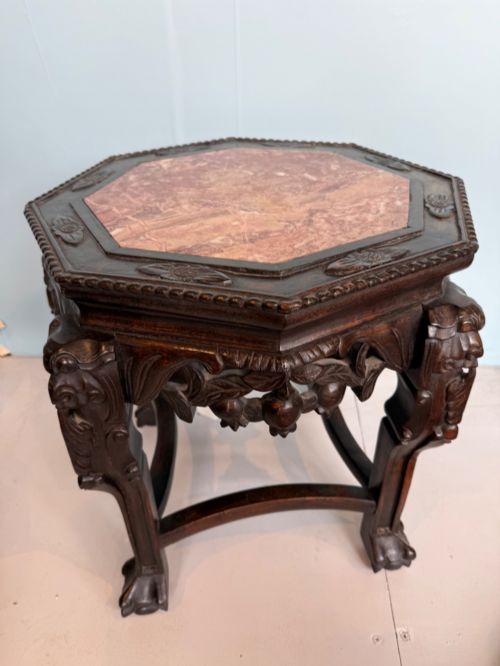


Chinese Marble Top Stool
These Chinese marble top stool pieces are carved hardwood and hongmu stands designed for plants and lamps, bringing carved detail and stone tops to interiors.
Chinese Marble Top Stool
A chinese marble top stool functions primarily as a plant stand, occasional table, or pedestal stand within nineteenth century domestic spaces. These pieces emerge from the Qing Dynasty and Chinese Export traditions alongside Victorian interpretations.
Forms vary from standard square or circular tops to unusual barrel shapes and rootwood configurations. Buyers frequently encounter carved hardwood examples featuring inset marble, quartz, or rouge marble surfaces.
The objects serve multiple roles in nineteenth century interiors, acting as lamp tables, wine stands, or low occasional tables. Carved ebonised hardwood and rosewood constructions dominate the items found on this page.
Materials and construction methods
Artisans construct these pieces using dense timbers including hongmu, rosewood, and rootwood, occasionally applying an ebonised finish to the hardwood frame. Deep carving defines the wooden structures, showing intricate floral or figural motifs around the aprons and legs.
Stone tops are carefully inset into the wooden frames, utilising marble, quartz, or rouge marble surfaces that sit flush with the surrounding timber. Mother-of-pearl and lacquer accents appear on select examples to provide contrast against the dark hardwood.
The furniture spans Qing Dynasty Chinese Export workshops and Victorian domestic adaptations of oriental forms.
Assessing quality in carved stands
The depth and crispness of the carving separate standard items from finer works, particularly where the floral motifs meet the structural joints. High quality pieces exhibit tight joinery in the hardwood frame and a seamless fit between the timber and the inset stone top.
Materials dictate distinct tiers of craftsmanship, with select hongmu and rosewood examples showing superior grain density compared to ebonised alternatives. The figuring within the marble or quartz insert further influences the visual weight of the stand.
The Chinese Marble Top Stool Glossary
- Hongmu
- A traditional Chinese term for dense hardwoods, often translated as red wood. These heavy timbers provide the structural foundation for carved stands.
- Ebonised
- Wood treated with a chemical process or finish to resemble ebony. This dark surface appears frequently on Victorian interpretations of Chinese furniture.
- Rouge marble
- A deep red or reddish-brown decorative limestone with white or grey veining. This stone provides a striking contrast when inset into dark hardwood tables.
- Rootwood
- Timber fashioned from the root burls of trees, celebrated for its twisted, organic grain patterns. Stands utilise this material for rustic decorative impact.
Chinese Marble Top Stool: Frequently Asked Questions
What were these stands used for?
These pieces functioned primarily as plant stands, lamp tables, and pedestal supports in nineteenth century rooms. Their sturdy hardwood construction held heavy ceramic planters and decorative objects safely.
They also served as wine stands or low occasional tables beside seating furniture. The flat stone surface provided a stable, water-resistant area for daily domestic use.
How do I date a Chinese marble top stool?
Dating relies on examining the timber species, carving style, and construction methods typical of the nineteenth century and the Qing Dynasty. Artisans of this era utilised dense hardwoods like hongmu and rosewood with hand-carved joinery.
Comparison with Victorian and Chinese Export pieces helps narrow the origin. Look for characteristic tool marks and the specific geological type of the inset marble or quartz top.
Are these pieces stable for plants?
The heavy hardwood frames and inset stone tops provide exceptional stability for heavy ceramic plant pots. The dense timber prevents warping under moderate moisture from watering.
Care should be taken with uneven antique floors, as historical stands often feature fixed legs without modern leveling adjustments. Placing felt pads beneath the feet protects both the floor and the antique wood.
How do I care for the marble top?
Cleaning requires only a soft, damp cloth to remove dust and light debris from the polished stone surface. Avoid acidic cleaners or harsh chemical agents that can etch the marble or quartz.
Applying a neutral wax to the surrounding hardwood frame helps maintain the finish without harming the stone insert. Lift planters rather than sliding them across the table to prevent scratching the polished surface.