




Chinese Export Nest Tables
Chinese export nest tables are graduated sets designed to slide together, offering versatile surfaces for display and entertaining.
Chinese Export Nest Tables
Chinese export nest tables are sets of matching occasional tables designed to fit neatly inside one another when not in use. Buyers searching this phrase will find graduated sets of three or four pieces intended for flexible placement around a room.
The versions most frequently met on this page date from the nineteenth century and the early twentieth century, spanning periods such as the Edwardian era and Qing Dynasty. Forms range from plain hardwood frames to richly decorated lacquer surfaces.
Originating for Western markets, these items combine traditional Chinese furniture construction with forms suited to European and British drawing rooms. They appear in materials like teak, rosewood, hongmu, and black lacquer.
Construction and materials
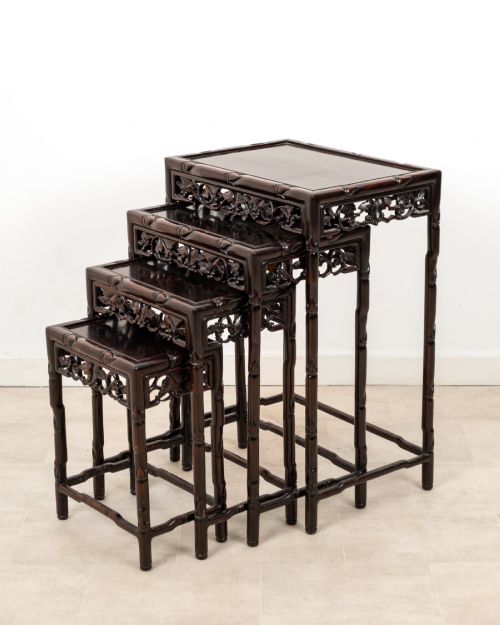
These tables rely on dense hardwoods such as hongmu, rosewood, and teak, selected for their structural stability and capacity for intricate carving. Cabinetmakers shaped the frames to allow each smaller table to slide smoothly into the one above it.
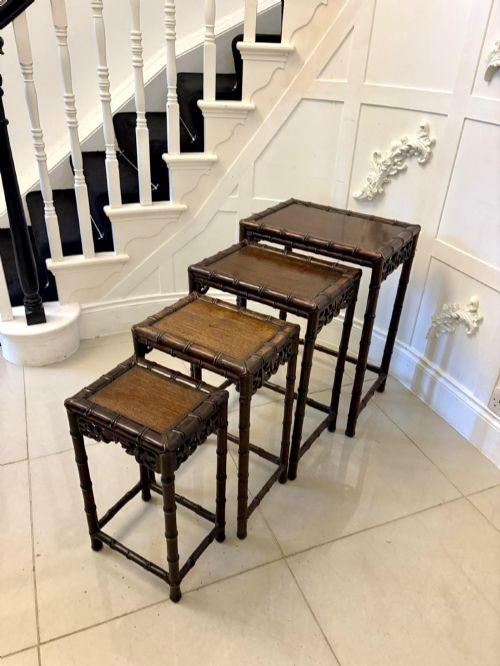
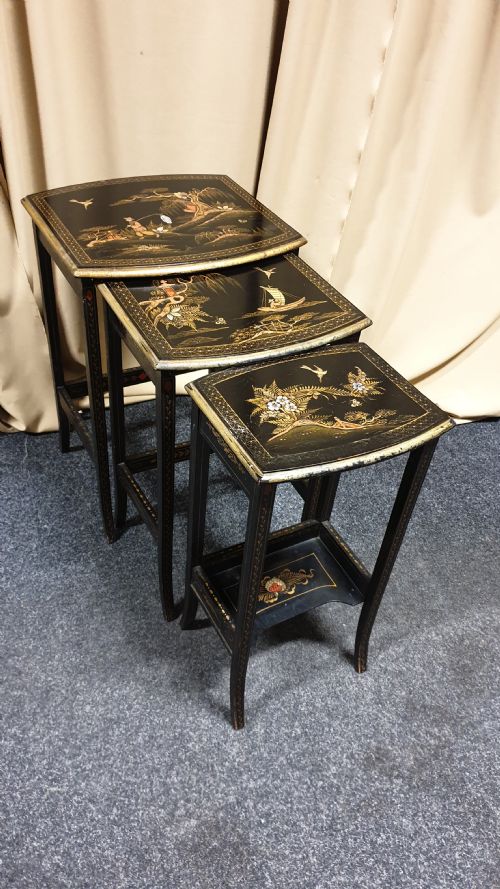
Lacquered examples utilise successive layers of black lacquer applied to wood bases, often finished with hand-painted Chinoiserie decoration and gold leaf accents. Carved hardwood sets feature detailed relief work along the friezes and legs, executed by hand.
Joinery techniques prioritize durability to withstand the repeated friction of nesting and unnesting. Some nineteenth-century examples incorporate specialised timbers like burrwood panels alongside primary hardwood structures.
Judging quality in nest tables
Quality in these sets is determined by the crispness of the carving and the depth of the timber selection. Dense, heavy hardwoods like hongmu and rosewood command greater attention than lighter, softer substitute woods.
The precision of the graduated fit distinguishes superior examples, ensuring each table slides smoothly without binding or excessive clearance. Surface decoration, whether delicate gold leaf on lacquer or deep relief carving, reflects the artisan's skill.
Condition of the original finish and structural integrity of the joints dictate the standing of a set. Uniformity across all four tables indicates a cohesive manufacture rather than a later assembled grouping.
The Chinese Export Nest Tables Glossary
- Nest of tables
- A set of graduated occasional tables designed to fit one beneath another to save floor space. These sets typically comprise three or four pieces.
- Hongmu
- A traditional Chinese term for dense, reddish-brown hardwoods prized for furniture making. It translates literally as red wood and includes dense timbers like padauk.
- Chinoiserie
- European artistic style reflecting Chinese motifs and decorative techniques. It appears on nineteenth-century lacquer furniture produced for export.
- Quartetto
- A nineteenth-century term for a set of four nesting tables. The word derives from musical terminology denoting a group of four.
- Faux bamboo
- A decorative technique where wood is carved and painted to resemble natural bamboo stalks. This style appears frequently on nineteenth-century bamboo-turned occasional furniture.
Chinese Export Nest Tables: Frequently Asked Questions
What is a Chinese export nest table?
A Chinese export nest table is a set of graduated occasional tables created in China for Western markets during the nineteenth and early twentieth centuries. Each table is sized incrementally so the smaller ones slide beneath the largest.
These sets were popular in British homes for serving tea or displaying ornaments without occupying permanent floor space.
How do I date a nest of tables?
Dating relies on examining the timber species, construction methods, and decorative styles present in the set. Nineteenth-century examples often feature dense hardwoods like hongmu or rosewood, alongside hand-applied black lacquer with gold leaf.
Early twentieth-century pieces, including Edwardian iterations, show similar traditional forms but often incorporate lighter secondary woods or simpler turned elements.
Where were these tables used?
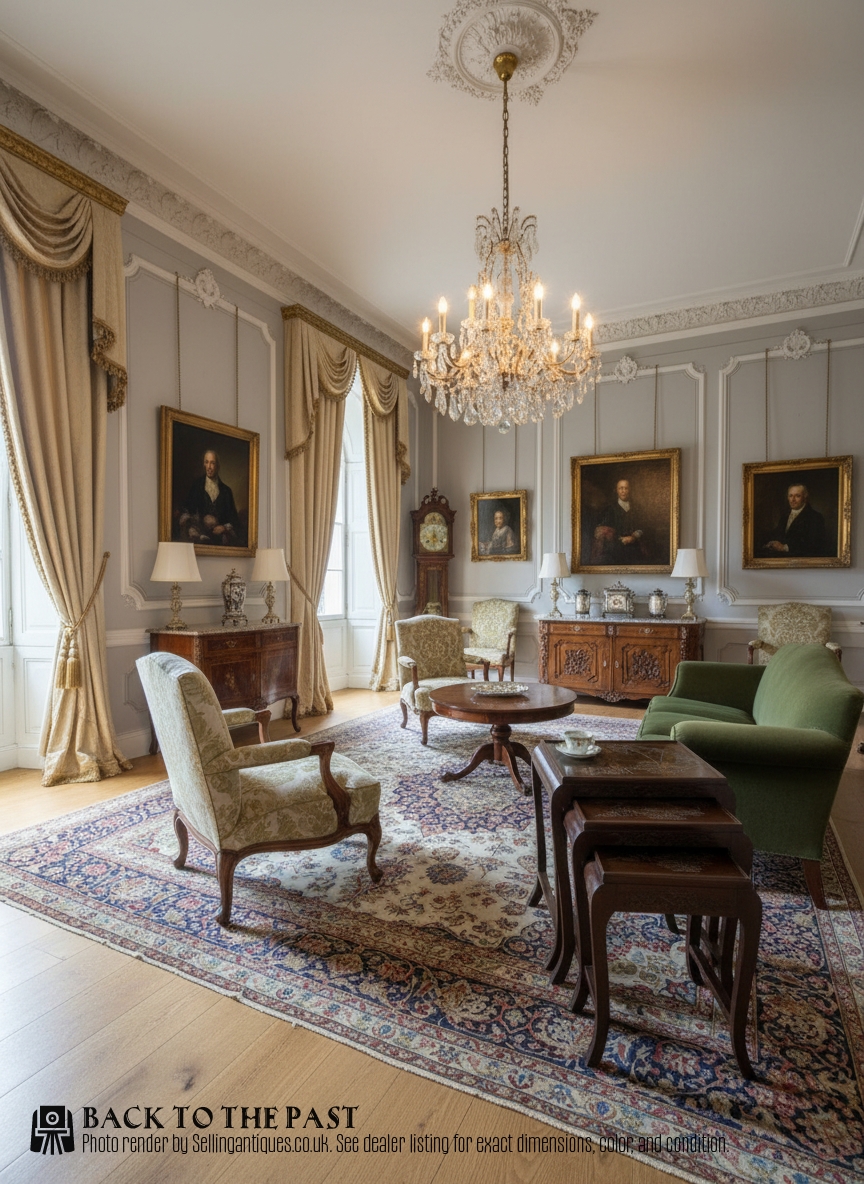
These tables were designed primarily for drawing rooms and parlours in British and European homes. Their nested format allowed households to expand surface space rapidly when entertaining guests.
When not in use, the entire set occupied the footprint of just a single small table against a wall.
What is the difference between hongmu and rosewood?
Hongmu is a collective Chinese classification for heavy, durable, dark-toned hardwoods used in traditional cabinetmaking. Rosewood is a specific botanical timber family frequently categorised under the broader hongmu umbrella.
Both materials provide the structural strength and fine grain necessary for intricate carving on export furniture.
How should I care for lacquer nest tables?
Lacquer surfaces require gentle treatment using a soft, dry cloth to remove dust without abrasive cleaners. Direct sunlight and fluctuating humidity should be avoided to prevent cracking the delicate lacquer finish.
Lifting tables individually rather than sliding them roughly helps preserve the wooden runners and the exterior edges.