
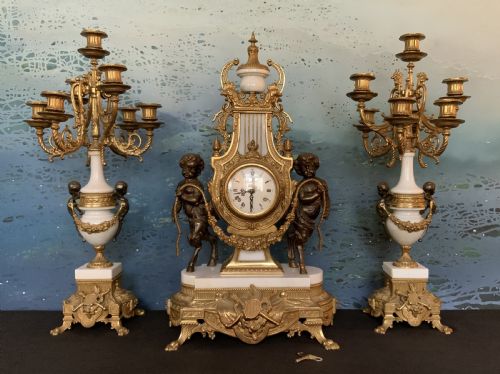


Cherub Marble Clock
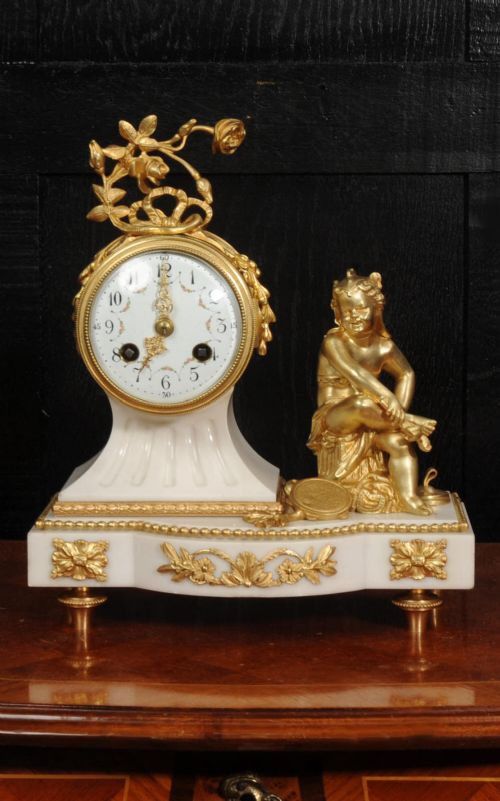
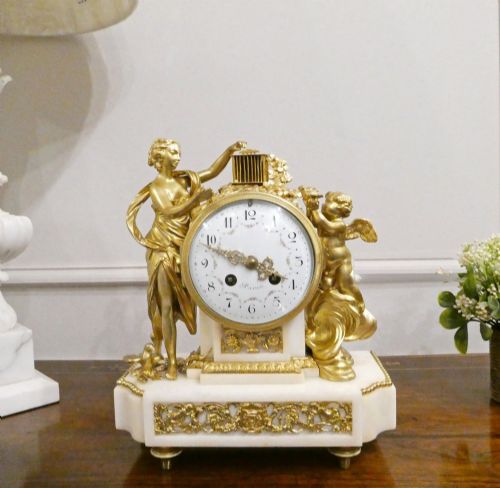
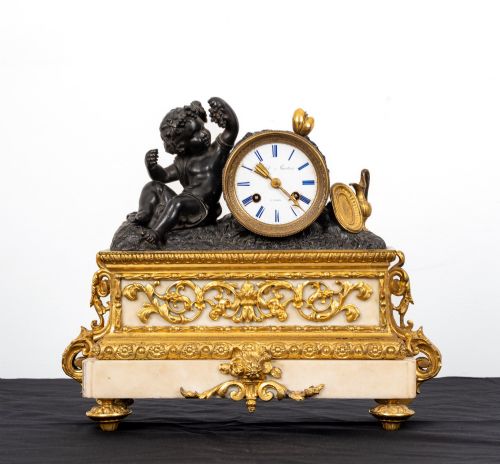
When you search for a cherub marble clock, you are looking at substantial nineteenth-century mantel timepieces and garnitures featuring figural cherubs paired with stone bases.
Cherub Marble Clock
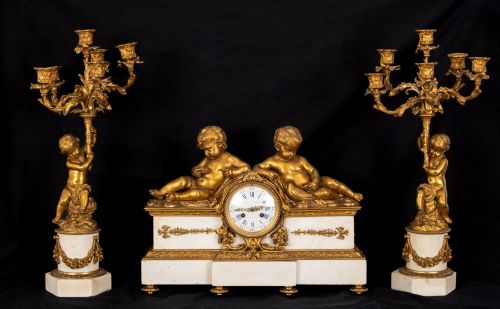
A cherub marble clock combines sculptural metal figures of winged putti with solid stone architectural cases, primarily originating from nineteenth-century French workshops. These pieces frequently appear as part of larger garniture sets accompanied by matching candelabra or side urns.
The dominant aesthetic draws heavily from the Louis XVI and Empire styles, incorporating classical symmetry, urn motifs, and naturalistic stone pedestals in white, red, pink, or variegated marble. Most examples encountered here date from the Victorian era and the latter half of the nineteenth century.
Beyond standalone mantel clocks, buyers often find complex clock sets designed to form a symmetrical decorative scheme for a salon fireplace or console table. The integration of bronze or ormolu cherubs interacting with the clock face or casing defines this specific category of antiquehorology.
Materials and Construction
The cases rely on heavy slabs of natural marble, shaped and polished to form architectural porticos, columns, or simple rectangular plinths that support the internal clock movements. Ormolu, gilt bronze, and standard bronze provide the medium for the figural cherubs, bezel mounts, and decorative friezes.
Foundries utilised lost-wax or sand-casting methods for the metal components, subsequently applying mercury gilding or electroplating to achieve the characteristic ormolu surface finish. Enamel dials, often painted with Roman or Arabic numerals, sit protected behind bevelled glass within the metal bezel.
Listings feature French Empire, Louis XVI, and Rococo Revival styles executed in various marble colours including white, pink, red, and variegated stone.
Markers of Distinction
Quality in these pieces rests upon the crispness of the bronze chasing and the depth of the marble selection, where finely detailed hand-finished cherub wings and uniform stone graining elevate a piece above standard production. The weight and complexity of the cast mounts dictate the overall presence of the clock.
The sophistication of the internal movement, whether featuring silk suspension, an eight-day striking train, or specialised escapements by notable makers, separates standard workshop output from exceptional horological examples. Original matching garniture components and undamaged enamel dials further influence the standing of the piece.
Japy Freres·Siffel and Cartier·H Luppens Paris·F Marti·Le Roy et Fils Paris·Charles Hour of Paris·Vincenti et Cie
The Cherub Marble Clock Glossary
- Ormolu
- Gilded bronze produced through an application of a mercury-gold amalgam onto a cast bronze base, creating a durable golden lustre. This technique was widely employed in nineteenth-century French clock manufacturing.
- Garniture
- A set of decorative matching objects designed to be displayed together on a mantelpiece, typically consisting of a central clock flanked by two candelabra or urns.
- Portico Clock
- A clock featuring an architectural case supported by four or more columns resembling a classical temple facade.
- Silk Suspension
- An early pendulum hanging method using a thin strip of silk thread to support the pendulum bob, commonly found in older French movements.
- Putto
- A plump, naked male child figure, frequently winged, often referred to in these pieces as a cherub or cupid.
Cherub Marble Clock: Frequently Asked Questions
How do I wind the clock?
Most nineteenth-century mechanical movements require a specific key inserted into the dial arbors to tension the spring barrels every eight days. Care must be taken not to overwind the springs.
Ensuring the clock rests on a completely level surface keeps the pendulum beating in even rhythm and prevents the movement from stopping.
Are these clocks suitable for daily use?
While these timepieces were built for functional domestic use, antique movements require gentle handling and periodic professional servicing to remain reliable. Daily timekeeping depends on correct beat adjustment.
Many collectors run them occasionally rather than keeping them in continuous daily operation to preserve the historical mechanism.
How do I clean the marble and ormolu?
Marble surfaces respond best to dusting with a dry microfibre cloth and gentle cleaning with lukewarm water when necessary, avoiding acidic solutions that etch the stone. Ormolu requires minimal intervention to preserve the original gilding.
Harsh metal polishes strip the gold layer from bronze mounts, so only gentle surface dust removal should be performed on the metal elements.
How can I identify the period?
Stylistic cues such as neoclassical symmetry point towards Louis XVI revival designs, while heavy cast bronze and specific maker stamps on the backplate help date the movement. The type of marble and casting technique provide additional chronological clues.
Examining the escapement type and dial construction often narrows down the decade of manufacture within the broader nineteenth-century timeline.