




Cherub Clock Garniture
A cherub clock garniture brings sculptural figures and matching side pieces together into a unified mantel display.
Cherub Clock Garniture
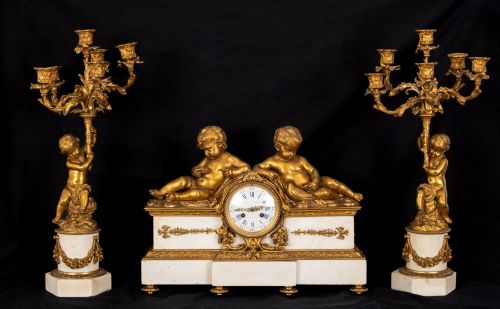
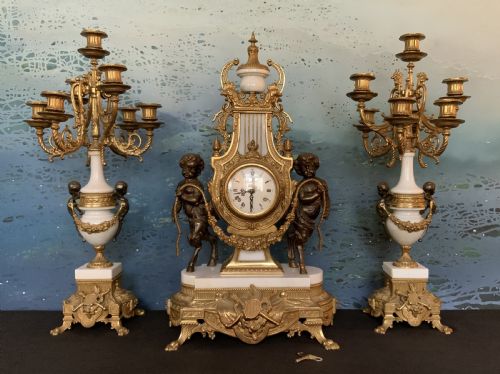
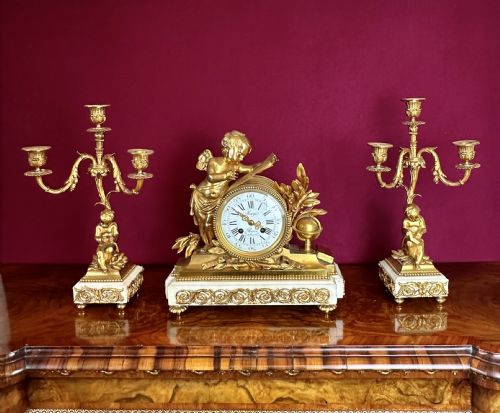
A cherub clock garniture consists of a central mantel clock accompanied by matching side pieces such as candelabras or urns, frequently featuring cast figures of cherubs. These decorative sets originate primarily from the nineteenth century, spanning periods from the Victorian era through the late eighteen-hundreds.
The most common configurations on this page pair a striking clock in styles like Louis XVI Revival or Rococo Revival with matching side ornaments. Materials range from white and red marble to onyx, combined with gilt bronze or ormolu mounts.
Buyers encounter French workshop productions predominantly, alongside occasional Italian bronze sets and Meissen porcelain examples. The overarching design scheme matches the central timepiece with its flanking garnitures to create a symmetrical mantel arrangement.
Materials and construction
The construction relies heavily on metal casting, utilising ormolu, gilt bronze, and spelter to shape the intricate cherub figures and decorative mounts. These metal elements undergo careful chasing and gilding to achieve bright surface highlights.
The structural bodies of the clocks and garnitures incorporate natural stones such as white marble, red marble, and onyx, shaped into plinths and column bases. Glass components protect enamel dial faces, while mechanical movements provide eight-day striking functions.
Several cherubs manage to look entirely unbothered while hauling around massive bronze clock cases and heavy marble pillars.
Assessing quality and execution
The selection of stone also dictates the grade of the piece, with solid marbles and dense onyx elevating the visual weight of the set. Furthermore, the integration between the clock movement, enamel dial, and accompanying garnitures shows the original maker's ambition and skill.
H Luppens Paris
The Cherub Clock Garniture Glossary
- Garniture
- A set of decorative objects designed to be displayed together on a mantelpiece, usually comprising a central clock and two matching side pieces.
- Ormolu
- Gilding technique where finely ground high-carat gold is applied to a bronze base, creating a rich yellow metallic finish.
- Spelter
- An alloy of zinc and lead used as a less expensive alternative to bronze for casting sculptural figures.
- Louis XVI Revival
- A nineteenth-century decorative style drawing on neoclassical symmetry, straight lines, and classical motifs from the reign of Louis XVI.
- Enamel dial
- A clock face made by fusing powdered glass onto a metal substrate at high heat, typically featuring painted numerals.
Cherub Clock Garniture: Frequently Asked Questions
What is included in a cherub clock garniture?
A complete set includes a central mantel clock accompanied by two matching side ornaments, such as candelabras or urns. These secondary pieces repeat the motifs and materials of the main clock.
Most configurations incorporate cast cherub figures across the composition to tie the three pieces together into a symmetrical display.
How do I wind an antique clock set?
Antique mechanical movements require a winding key inserted into specific holes on the enamel dial to tension the springs. Most nineteenth-century examples operate on an eight-day cycle.
Care must be taken not to overwind the mechanism, and professional servicing helps maintain accurate timekeeping and striking functions.
Where should I place a clock garniture?
These large three-piece sets demand a stable surface with sufficient depth and width, such as a large mantelpiece, sideboard, or heavy console table. The central clock sits flanked by the matching garnitures to preserve visual balance.
Placing the pieces away from direct heat sources and sunlight protects the marble bodies and the delicate ormolu surfaces.
How do I identify the period of a garniture?
Dating relies on examining the casting style, the materials used, and any maker marks on the movement backplate. Nineteenth-century pieces frequently display revival aesthetics such as Louis XV or Louis XVI styling.
Changes in marble selection and the transition from bronze to spelter in later Victorian pieces also offer clues to the manufacturing date.