


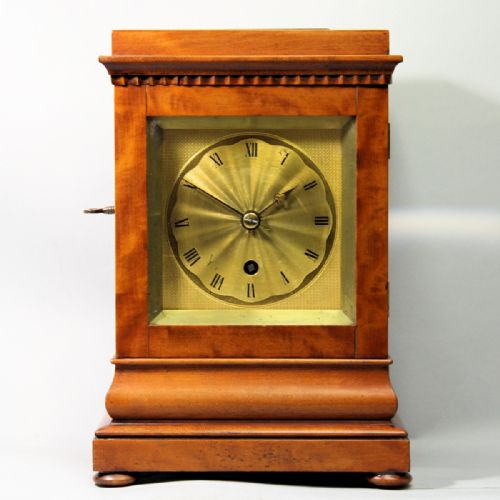


Chain Fusee Bracket Clock
A chain fusee bracket clock is a precision timepiece driven by a delicate chain and fusee movement, prized for its mechanical ingenuity and handsome desktop or mantel presence.
Chain Fusee Bracket Clock
A chain fusee bracket clock represents the pinnacle of traditional horology, utilising a conical pulley and chain to equalise the mainspring power as it unwinds. When you search for a chain fusee bracket clock, you encounter sophisticated timepieces spanning the eighteenth, nineteenth, and mid-Victorian periods.
The materials and styles vary widely across the examples, ranging from rich mahogany and satinwood cases to ebonised wood, slate, and ornate gilt bronze. Formats include traditional library clocks with glass panels, striking mantel pieces, and elaborate revival designs.
Makers London and provincial alike housed these complex mechanisms in architectural or tabletop cases designed to anchor a room. The versions most commonly found combine robust eight-day movements with classical wood or metal cases from the nineteenth century.
Materials and construction
Clockmakers housed the complex brass and steel chain fusee movements within dense timber carcasses or heavy cast metal frames. Mahogany, satinwood, and ebonised wood provide the wooden cases, frequently accented with ormolu, gilt bronze, and glass panels.
The mechanical heart relies on a tiny steel chain connecting the barrel to a spirally grooved fusee cone, ensuring even force is delivered to the escapement. Dials are often meticulously engraved, silvered, or engine-turned, reflecting the high standard of period metalwork.
The archive and active listings demonstrate diverse regional origins, including provincial makers in Swansea and Hull alongside prominent London horologists.
Assessing quality and execution
Quality in these timepieces rests upon the crispness of the movement components and the fineness of the case cabinetry. Superior examples exhibit hand-engraved backplates, intricate dial work, and cabinet timber selected for rich grain and deep colour.
Goldsmiths & Silversmiths London·Barraud & Lund London·Payne London·Fatton Eleve De Breguet·Winterhalder and Hoffmeier
The Chain Fusee Bracket Clock Glossary
- Fusee
- A conical pulley with a spiral groove designed to maintain constant driving power on the clock train as the mainspring loses tension. This ingenious device ensures steady timekeeping throughout the running cycle.
- Chain drive
- The tiny, highly flexible steel chain used instead of catgut cord to connect the spring barrel to the fusee cone. It offers immense durability and precision.
- Bracket clock
- A portable table or mantel clock historically designed to sit upon a matching wall bracket or furniture top. Many feature glass panels to expose the inner workings.
- Engine-turned
- A decorative geometric pattern mechanically cut into metal dials using a rose engine or straight-line machine. This catches the light and aids legibility.
- Ormolu
- Gilt bronze ornamentation applied to clock cases to provide rich metallic highlights. It involves a mercury amalgamation technique historically used on luxury decorative objects.
Chain Fusee Bracket Clock: Frequently Asked Questions
How does a chain fusee movement work?
The fusee is a cone-shaped pulley connected to the spring barrel by a fine steel chain. As the mainspring unwinds and loses power, the chain pulls higher up the wider part of the cone, leveraging increased mechanical advantage to keep the force constant.
This clever compensation prevents the gradual slowing of the clock as it runs down between windings, ensuring accurate timekeeping.
Where should I place a bracket clock?
Historically, these clocks sat on dedicated wall brackets or prominent mantelpieces where their striking mechanisms could resonate through the room. They require a stable, level surface away from direct sunlight and drafts to protect the delicate movement.
Ensure the location allows easy access for winding the movement and viewing the dial from your seating area.
What is the difference between single, double, and triple chain movements?
A single chain movement powers only the timekeeping train of the clock. Double chain movements add a second train for striking the hours and sometimes quarters, while triple chain versions incorporate an additional train for playing musical tunes or chimes.
More chains indicate a more complex mechanism requiring expert adjustment and maintenance.