
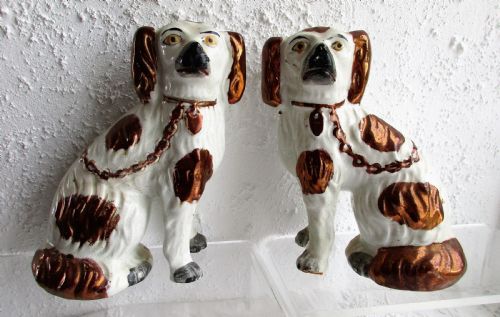
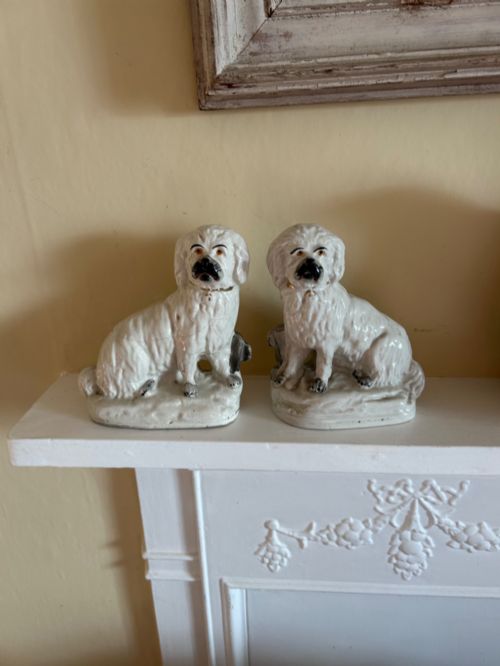


Ceramic Spaniel Figures
Ceramic spaniel figures are decorative ornaments that bring historic character and traditional English charm to a mantelpiece.
Ceramic Spaniel Figures
Ceramic spaniel figures encompass a range of traditional Staffordshire pottery and porcelain models, often presented as mirror-image pairs intended for fireside display. These ornamental dogs appear as seated spaniels, comforter spaniels, and specialised forms such as money boxes, spill vases, and clock groups.
The selection on this page leans heavily towards nineteenth-century Victorian earthenware examples alongside earlier Chinese export porcelain and later twentieth-century ceramic pieces. Buyers encounter both plain white and gilt finishes as well as hand-painted red, white, and copper lustre variations.
The physical configuration of these figures ranges from standard mantel pairs to more complex groupings featuring puppies, musicians, and Toby jugs shaped like the canonical dog. Most pieces originate from the Victorian period, reflecting a widespread domestic taste for hearthside animal ornaments.
Materials and production methods
Potters shaped these figures primarily from earthenware and ceramic bodies, utilising clay moulded into hollow forms before firing. Some specialised examples incorporate stoneware or porcelain structures.
The listings span from eighteenth-century Chinese export porcelain through nineteenth-century Victorian earthenware to mid-twentieth-century ceramics.
Judging the quality of the figures
The depth and consistency of the glaze also separate standard production wares from finer pieces. Pairs that retain their matching configuration and original surface decoration without heavy wear demonstrate the best standards of survival.
Royal Doulton·Beswick
The Ceramic Spaniel Figures Glossary
- Comforter spaniel
- A traditional Victorian Staffordshire pottery figure designed to sit on a mantelpiece as a domestic companion. These dogs usually face inward toward each other as a matched pair.
- Copper lustre
- A metallic pottery glaze that produces a reflective, coppery sheen across the ceramic surface. This finish appears frequently on nineteenth-century Staffordshire dog figures.
- Spill vase
- A hollow cylindrical holder attached to a figure, originally intended to hold wooden spills for lighting fires or candles. Several spaniel figures incorporate these functional vertical tubes.
- Earthenware
- A porous, fired clay body that forms the base of most nineteenth-century Staffordshire figures. It requires an applied glaze to become impervious to liquids.
- Toby jug
- A pottery jug shaped in the form of a seated full-bodied figure or head, occasionally adapted to represent a spaniel. These combine utilitarian vessel forms with decorative ceramic modelling.
Ceramic Spaniel Figures: Frequently Asked Questions
What are Staffordshire spaniels?
Staffordshire spaniels are ceramic mantelpiece ornaments produced in pairs during the nineteenth century to decorate domestic hearths.
Potters modelled these figures to resemble popular lapdogs of the era, finishing them with hand-painted enamels and gilt details.
Why do the dogs face each other?
Makers designed these figures as mirror-image pairs so they could sit at either end of a mantelpiece facing inward.
This symmetrical arrangement suited Victorian interior styling and balanced the display above the fireplace.
How were spill vase spaniels used?
Spill vases incorporate an integrated cylindrical holder behind the dog figure to store thin wooden spills.
Households used these spills to transfer flames from the hearth fire to candles or lamps before matches were common.
How do I date a ceramic spaniel?
Dating relies on observing the clay body, glaze characteristics, and painting style relative to nineteenth-century production norms.
Victorian earthenware pieces often show distinct crazing and hand-applied copper lustre or gold paint distinct from twentieth-century manufacturing methods.