


Celestial Gold Brooch
A celestial gold brooch captures the night sky in precious metal and gemstones, offering wearable Victorian and Edwardian astronomy.
Celestial Gold Brooch
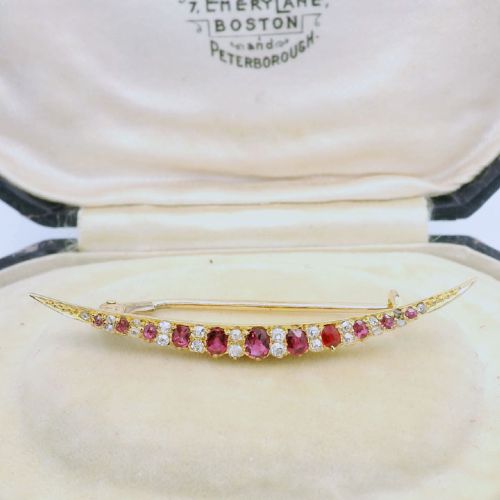
A celestial gold brooch draws on heavenly motifs, presenting stars, crescents, sunbursts, and moons. These pieces span the Victorian, Edwardian, and Art Deco periods, bringing together romantic astral themes that fascinated collectors of the late nineteenth and early twentieth centuries.
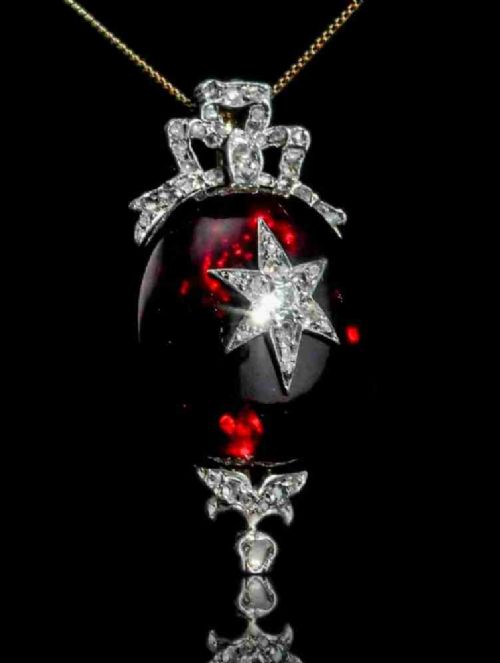
Most items on this page take the form of crescent brooches, starbursts, and convertible pendant brooches. Makers frequently set these shapes in combinations of gold and silver to enhance the brilliance of the stones.
Origins stretch from the 1880s through to the 1920s, showing a clear preference for silver-topped gold settings that frame old cut diamonds, rubies, sapphires, turquoises, and pearls.
How they were made
Goldsmiths utilised varied purities of gold, including 9ct, 15ct, 18ct, and 14K, alongside silver settings. Silver was often mounted over gold on the face of the piece to provide a bright, white background for diamond settings while retaining the strength of gold underneath.
Craftsmen set old European cut diamonds, seed pearls, rubies, sapphires, and garnets by hand into intricate star and crescent frames. Many designs also incorporated convertible fittings, allowing a brooch to double as a pendant or mount onto a tiara frame.
What varies in quality
The choice of gemstones and the precision of the stone-setting dictate the calibre of each piece. Starbursts featuring substantial old cut diamonds or balanced clusters of rubies and sapphires sit at the upper end of the range.
Construction detail also separates standard examples from finer ones, particularly where convertible mechanisms allow a brooch to function as a pendant or tiara. Original fittings and secure pin assemblies demonstrate superior workmanship.
The Celestial Gold Brooch Glossary
- Old European cut
- A diamond cut popular during the nineteenth century featuring a small table, heavy crown, and open culet. This facet pattern produces distinctive broad flashes of light under candlelight.
- Convertible
- A piece of jewellery designed with detachable elements or hidden loops. This allows a brooch to transform easily into a pendant or a tiara.
- Seed pearl
- A very small, naturally formed or cultured pearl used in clusters or borders. These delicate pearls define many Edwardian and Victorian celestial designs.
- Silver-topped gold
- A dual-metal technique where a thin layer of silver is soldered to a gold backing. This method combined the bright white appearance favoured for diamonds with the durable warmth of gold.
- Starburst
- A radiating design motif imitating a distant star. Goldsmiths rendered these using symmetrical gemstone rays spreading from a central cluster.
Celestial Gold Brooch: Frequently Asked Questions
What is a celestial gold brooch?
A celestial gold brooch is an antique pin shaped like a star, crescent moon, or sunburst. These pieces use gold and silver settings to hold diamonds, pearls, and coloured gemstones.
Craftsmen produced them in large numbers during the Victorian and Edwardian eras, inspired by an intense cultural fascination with astronomy and the night sky.
How do you wear a convertible brooch?
A convertible brooch includes hidden loops, screw fittings, or detachable frames that alter its function. You can slide the piece onto a chain to wear it as a pendant or mount it onto a rigid frame to wear as a tiara.
These versatile mounts allowed nineteenth-century wearers to adapt a single piece of jewellery for daywear or formal evening occasions.
How do you date a star brooch?
Dating a star brooch involves examining the metal purity marks, the cut of the stones, and the construction of the pin mechanism. Victorian examples often pair silver with 15ct or 18ct gold and feature hand-cut old European diamonds.
Later Edwardian and 1920s pieces frequently utilise 9ct gold alongside finer millgrained edges and seed pearl borders.
Were pearls natural in antique jewellery?
Pearls found in nineteenth-century celestial jewellery are natural saltwater pearls or early cultured varieties. Seed pearls were graded by size and meticulously stitched or pegged onto gold frames to form crescent moons.
Their soft lustre provided a gentle contrast to the sharp sparkle of surrounding diamonds and rubies.
What metals are used in celestial brooches?
These brooches primarily feature yellow gold in 9ct, 14K, 15ct, and 18ct purities, frequently paired with silver. Silver was soldered to the front of the gold structure to hold diamonds securely without introducing yellow reflections.
Platinum also appears in later Edwardian and transitional pieces as metalworking techniques advanced.