
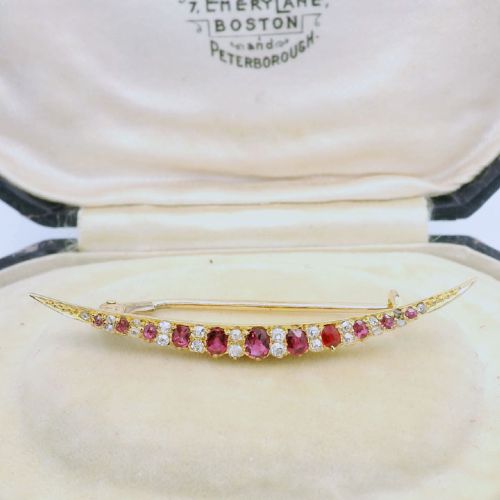


Antique Moon Brooch
These pieces are antique moon brooch examples, formed as celestial crescents set with diamonds, rubies, sapphires, and pearls to capture the night sky.
Antique Moon Brooch
An antique moon brooch takes the form of a crescent, representing the lunar shape that fascinated Victorian and Edwardian jewellers. These jewels combine symbolic celestial motifs with fine gemstones, offering a distinct miniature sculptural quality.
The crescent design appears frequently alongside birds or insects, notably swallows and scorpions, rendered in gold or silver. Most examples belong to the Victorian and Edwardian eras, spanning the late nineteenth century into the early twentieth century.
The form functions both as a traditional fastening and as a decorative pendant when fitted with loops. Buyers encounter both substantial gem-set gold crescents and delicate bar pins featuring pearls or moonstones.
How they were made
Goldsmiths utilised yellow gold in varying purities, alongside silver and platinum settings to mount individual stones securely. Stones are meticulously claw-set or flush-set to follow the sweeping curve of the crescent frame.
Pearls and moonstones provide luminous contrast against faceted rubies, sapphires, and diamonds. Metalsmiths shaped the gold into hollow or solid crescent rails, incorporating pin stems and secure c-clasps or safety catches.
Brooch forms include crescent moons, stick pins, bar pins, and pieces combined with swallows and scorpions.
What varies in quality
The quality rests upon the selection and matching of the gemstones, from natural unheated sapphires and Thai rubies to finely graded diamonds and uniform pearls. Superior pieces demonstrate precise stone graduation along the crescent curve, ensuring no gaps disrupt the silhouette.
Craftsmanship in the metalwork distinguishes standard production from exceptional work, particularly where platinum or silver tops are soldered to gold bases. The articulation of small decorative elements, such as swallows or scorpion tails, reveals the skill of the original workshop.
The Antique Moon Brooch Glossary
- Crescent
- A curved lunar shape tapering to two points. This motif dominated late Victorian and Edwardian jewellers crafting celestial ornaments.
- Moonstone
- A feldspar mineral exhibiting adularescence, a floating bluish shimmer. It serves as the central body for insect or star motifs in period pieces.
- Bar brooch
- A pin constructed around a central horizontal metal bar. Jewels frequently mount the crescent motif directly upon this linear support.
- Paste
- Faceted glass used as an affordable gemstone substitute. Victorian makers cut and set paste to imitate diamonds with high brilliance.
Antique Moon Brooch: Frequently Asked Questions
How do I date a crescent brooch?
Dating relies upon metal purity marks, stone cuts, and overall construction styles characteristic of the Victorian and Edwardian periods. Earlier pieces often feature closed-back settings or distinct pin mechanisms.
Later Edwardian examples commonly incorporate platinum tops over yellow gold to enhance the brilliance of mounted diamonds.
Were these worn as pendants too?
Many brooch mountings include hidden or integrated loops designed to accommodate a thin neck chain. This dual functionality allowed the wearer to transition the jewel easily from lapel to chain.
Examining the reverse side reveals whether conversion loops formed part of the original design.
What stones are typically found together?
Rubies and sapphires frequently appear paired with diamonds or pearls along the curve of the crescent. These combinations provided striking colour contrast popular during the late nineteenth century.
Moonstones also appear alongside pearls, particularly within insect and star themed variations.
How should I care for antique gold jewellery?
Gentle cleaning with a soft cloth removes everyday surface dust without risking fragile claws or seed pearls. Professional inspection helps ensure stone settings remain secure within their gold channels.
Storage in a lined box prevents scratching against other metal items.