



Victorian Gold Crescent Pin
A victorian gold crescent pin captures the celestial fascination of the late nineteenth and early twentieth centuries, offering a wearable moon set with precious gems.
Victorian Gold Crescent Pin
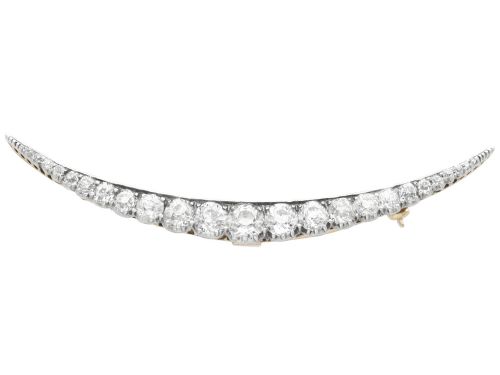
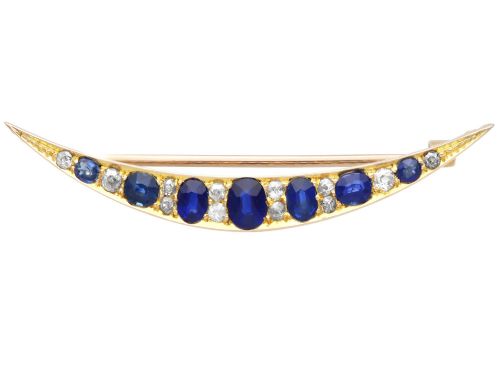
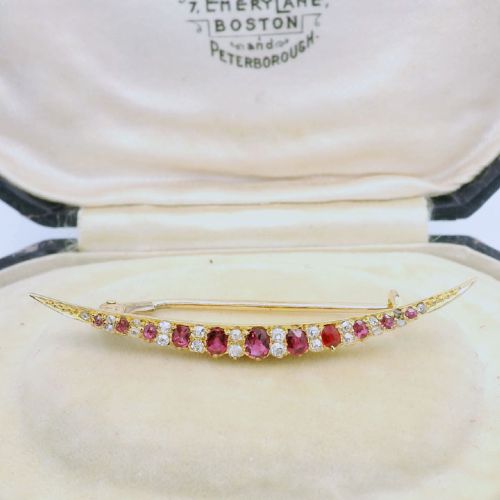
A victorian gold crescent pin typically takes the form of a curved lunar motif fashioned from yellow gold and set with diamonds, rubies, sapphires, pearls, or turquoise. These celestial jewels date from the late nineteenth century through the Edwardian period, capturing a distinct romantic aesthetic.
The pieces appearing here range from simple nine-carat and fifteen-carat yellow gold frames to elaborate bar brooches incorporating natural rubies and seed pearls. The crescent shape itself remains the dominant unifying form across these listings.
Materials and construction
Goldsmiths constructed these pins using varying purities of yellow gold, notably nine-carat, fifteen-carat, and occasionally higher purities like eighteen-carat. Gemstones such as diamonds, rubies, and sapphires were meticulously flush-set or claw-set directly into the gold crescent framework.
Pearls and seed pearls appear frequently, often secured with fine wire or peg settings that follow the curve of the moon. Jewelers combined these organic gems with faceted stones to create striking textural contrast against the yellow gold background.
Victorian Gold Crescent Pin Retail Price Guide 2026
Typical asking prices for victorian gold crescent pin among the pieces listed under this phrase on Sellingantiques today, from the lower quarter to the upper quarter. They describe what is for sale here now, not the wider market.
Listings feature yellow gold spanning nine-carat, fifteen-carat, and eighteen-carat purities, paired with diamonds, rubies, sapphires, turquoise, and pearls across Victorian and Edwardian periods.
Assessing quality
Quality in a victorian gold crescent pin rests upon the selection and matching of the gemstones, from calibrated rubies to uniformly graded pearls. Superior examples display precise stone-setting and substantial gold weight rather than hollow or pressed metal construction.
The proportion between the gold crescent frame and the applied gems dictates the visual balance of the piece. Finer items integrate secondary motifs like swallows or floral elements with crisp detail and secure pin mechanisms.
The Victorian Gold Crescent Pin Glossary
- Crescent brooch
- A curved, moon-shaped piece of jewellery designed to be fastened to clothing with a pin mechanism on the reverse. This form represents the primary shape found throughout these listings.
- Seed pearl
- A very small, naturally formed or cultured pearl used in clusters or rows to adorn jewellery. These tiny pearls line the curves of many crescent pins from the Victorian and Edwardian eras.
- Bar brooch
- A piece of jewellery featuring a slender horizontal metal bar, sometimes with a central ornamental motif such as a crescent moon. Several listings combine the crescent shape with this traditional bar format.
- Yellow gold
- Gold alloyed with metals such as silver and copper to produce a warm yellow colour, characteristic of nineteenth-century jewellery. This material forms the structural base for virtually every piece shown here.
Victorian Gold Crescent Pin: Frequently Asked Questions
How do I wear a crescent pin?
These pieces function traditionally as lapel or bodice ornaments, fastened securely through heavy fabrics using the original pin and C-clasp or safety catch.
Collectors today also wear them pinned to silk scarves, hats, or heavier knitwear, ensuring the pin stem engages enough material to support the weight of the gold and gemstones.
Are these pins made of solid gold?
The listings comprise items fashioned from solid gold alloys, specifically marked or tested as nine-carat, fifteen-carat, or eighteen-carat yellow gold. These figures denote the proportion of pure gold within the metal.
Victorian and Edwardian makers utilised these specific gold purities to provide sufficient strength for holding small diamonds, rubies, and pearls securely without bending.
How do I date a crescent pin?
Dating relies upon the stylistic details, gemstone combinations, and the specific gold carat marks recorded in each piece. Pieces span the late Victorian era through the Edwardian period.
Items from around eighteen-ninety often incorporate larger cluster arrangements or distinct accompanying motifs like swallows, whereas later Edwardian examples frequently pair sapphires with seed pearls.
What gems are found on these pins?
The pieces incorporate a mix of precious and organic gems, most notably diamonds, rubies, sapphires, turquoise, and pearls. Seed pearls are particularly common for tracing the curved outline of the moon.
Coloured stones like Thai rubies or unheated sapphires often serve as focal points, sometimes contrasted against bright white diamonds in star settings along the gold crescent.