



Antique Celestial Pin
An antique celestial pin captures the night sky in precious metal and gemstones, offering wearable moons and stars to collect.
Antique Celestial Pin
When you search for an antique celestial pin, you encounter brooches and pendants configured as crescents and starbursts. These ornaments date from the Victorian, Edwardian, and Art Deco periods, spanning the nineteenth century into the nineteen twenties. Most examples function as versatile brooch and pendant combinations or dedicated lapel brooches.
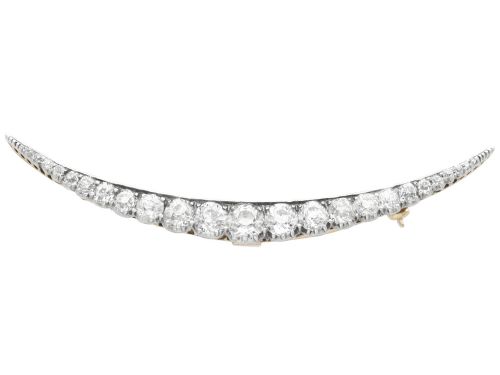
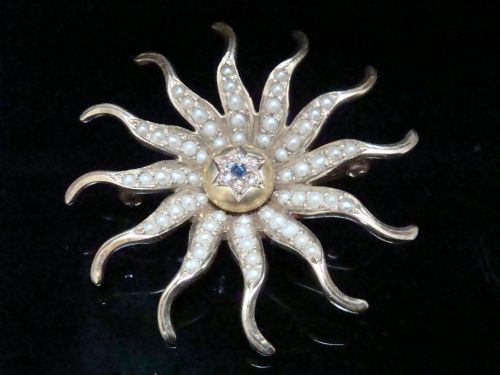
The crescent moon motif dominates this category, frequently paired with stars, rubies, pearls, and diamonds. You will regularly find 9ct gold, 15ct gold, and silver-set constructions among the available inventory. The forms range from small crescent brooches to large starburst pendants adorned with old European cut diamonds.
Materials and construction methods
Goldsmiths utilised 9ct, 15ct, and 18K gold alongside silver settings to mount gemstones securely. Silver top-mounting on gold backing was standard practice for securing diamonds, enhancing the brilliance of old-cut stones by reflecting light effectively against the dark metal.
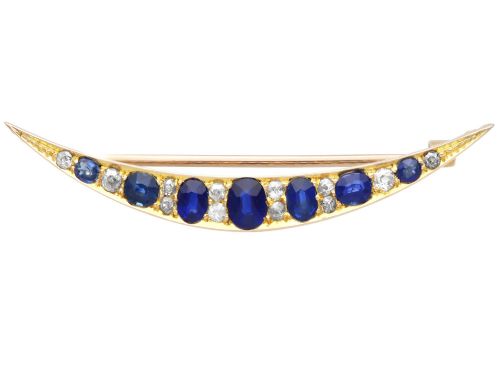
Crescent and starburst frameworks were populated with rubies, pearls, sapphires, turquoise, and diamonds. Gemstones were hand-set into shaped bezels and claw settings that trace the curving contours of moons and the radiating points of stars.
Antique Celestial Pin Retail Price Guide 2026
Typical asking prices for celestial pin among the pieces listed under this phrase on Sellingantiques today, from the lower quarter to the upper quarter. They describe what is for sale here now, not the wider market.
Listed forms span from compact crescent brooches to large starburst pendants dating up to nineteen twenty.
Assessing quality in celestial jewellery
Quality rests on the selection and matching of gemstones, such as uniform pearls and well-matched rubies or sapphires accompanying diamonds. The weight and purity of the gold, alongside the precision of the stone-setting work, define the superior tier of these pieces.
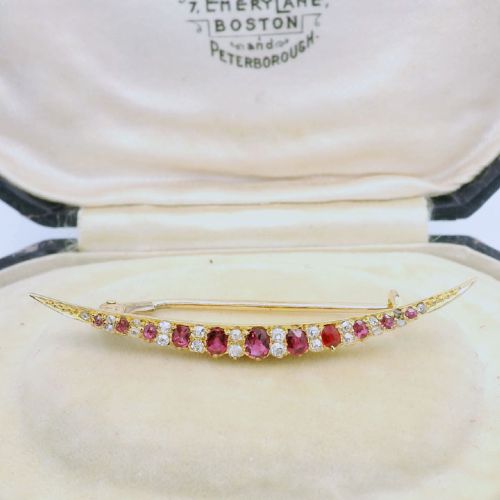
The fineness of the piercing and metalwork in the starburst rays or crescent bodies dictates visual elegance. Superior examples combine multiple gem varieties, such as diamonds and sapphires or diamonds and rubies, within intricate gold or silver-topped structures.
The Antique Celestial Pin Glossary
- Crescent brooch
- An ornamental pin shaped in the form of a waxing or waning moon. This motif was exceptionally popular during the late Victorian and Edwardian eras.
- Star burst brooch
- A circular pin featuring rays radiating outward from a central diamond or cluster, representing a celestial star. These pieces frequently double as pendants.
- Old European cut
- An early form of brilliant diamond cut characterised by a small table, heavy crown, and open culet. This cut appears frequently in nineteenth century celestial pins.
- Paste
- Hand-cut and polished lead glass used as a substitute for gemstones. Large Victorian paste crescents offer the visual impact of diamonds using historical simulant materials.
Antique Celestial Pin: Frequently Asked Questions
What periods do these pins come from?
The available pieces originate from the Victorian and Edwardian eras, extending into the early twentieth century around nineteen twenty. Victorian examples often feature silver-topped gold set with old-cut diamonds.
Later Edwardian and Art Deco pieces incorporate lighter nine carat yellow gold mounts paired with sapphires, rubies, and pearls.
Are these pins also pendants?
Several listed items are dual-purpose pieces designed as pendants and brooches. They feature a fold-down or removable pin alongside a discreet suspension loop at the top.
This versatility allows you to transition the ornament from a jacket lapel to a neck chain easily.
How are moon and star motifs distinguished?
Moon motifs utilise curved crescent shapes, frequently embellished with graduating pearls or alternating rubies and diamonds. Star motifs feature symmetrical radiating rays centred on a prominent diamond or gem cluster.
Some elaborate designs combine both symbols into a single cohesive celestial composition.