



Victorian Crescent Moon Pin
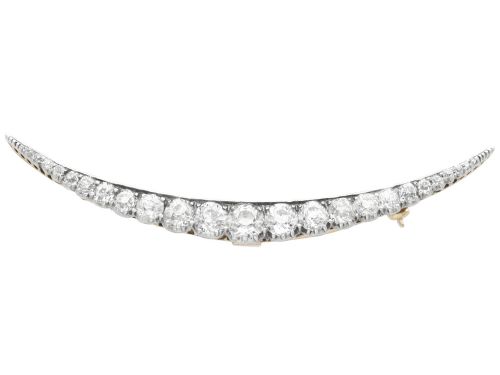
A victorian crescent moon pin captures the celestial fascination of the late nineteenth and early twentieth centuries in gold, diamonds and pearls.
Victorian Crescent Moon Pin
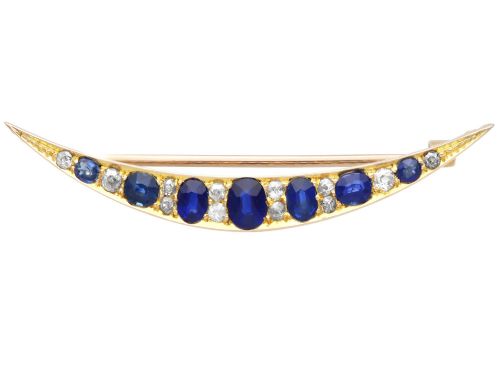
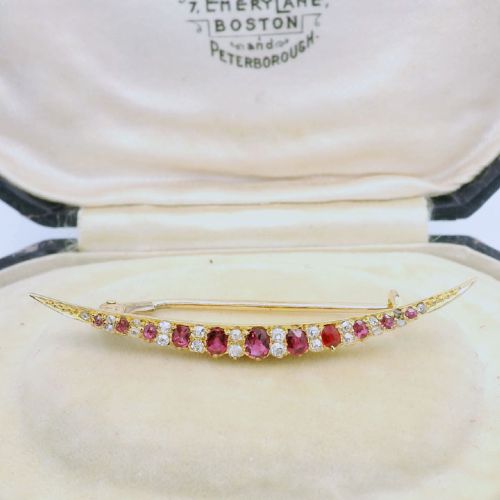
When you search for a victorian crescent moon pin, you enter a world of celestial jewellery spanning the Victorian and Edwardian eras. These brooches celebrate the night sky with curved rows of gemstones set against precious metals.
Materials and construction
The foundation of these brooches rests on 9ct and 15ct yellow gold, shaped into the characteristic curved crescent silhouette. Goldsmiths of the period employed durable metal alloys to securely mount stones while maintaining a delicate profile.
Gemstones such as diamonds, rubies, sapphires and pearls are painstakingly flush-set or claw-set along the curving gold bar. Seed pearls and graduated diamonds create the illusion of glowing moonlight against the warmer tones of yellow gold.
Victorian Crescent Moon Pin Retail Price Guide 2026
Typical asking prices for victorian crescent moon pin among the pieces listed under this phrase on Sellingantiques today, from the lower quarter to the upper quarter. They describe what is for sale here now, not the wider market.
The listings here span the Victorian and Edwardian periods, featuring materials from 9ct and 15ct yellow gold to diamonds, rubies, sapphires and pearls.
Judging quality in crescent brooches
Quality reveals itself in the uniformity of the gemstones and the precision of the stone-setting along the curve. Finer examples balance larger rubies or sapphires with crisp diamonds, whereas simpler pieces rely on seed pearls and lower carat gold.
The artistry extends to secondary motifs, such as feathered swallows or turquoise cabochons integrated into the lunar design. Superior workmanship ensures the pin mechanism operates securely behind a balanced and harmonious composition.
The Victorian Crescent Moon Pin Glossary
- Crescent brooch
- A piece of jewellery shaped like a moon in its waxing or waning phase. It was extremely popular during the late Victorian and Edwardian periods.
- Seed pearl
- A very small, naturally formed pearl often drilled and strung or set en masse. They create delicate shimmering borders on antique crescent pins.
- Bar brooch
- A slender horizontal metal pin that often supports a central decorative element. Many crescent moon designs are mounted directly onto a yellow gold bar.
- Turquoise
- An opaque blue-to-green mineral utilised in Victorian jewellery for its striking colour contrast. It frequently appears alongside pearls in nineteenth-century celestial pieces.
Victorian Crescent Moon Pin: Frequently Asked Questions
How do I wear a antique crescent brooch?
These pins attach securely to lapels, scarves or heavy knitwear using traditional pin and C-clasp mechanisms.
Ensure the fabric is sturdy enough to support the weight of gold and gemstones without pulling.
Are these brooches made from solid gold?
The pieces utilise solid 9ct, 15ct or 18ct yellow gold rather than plated metals.
This higher purity standard reflects the manufacturing practices of the Victorian and Edwardian eras.
What gemstones appear on these pins?
Common stones include diamonds, rubies, sapphires, seed pearls and turquoise.
Maker combinations frequently paired fiery rubies or deep sapphires with bright white diamonds.
How can I tell a Victorian piece from an Edwardian one?
Victorian examples often feature heavier yellow gold settings and rich rubies, dating from the late nineteenth century.
Edwardian pieces tend toward lighter yellow gold work and delicate sapphire or pearl combinations from the early nineteen hundreds.