


Cased Silver Berry Spoons
Cased silver berry spoons are formal serving pieces housed in fitted presentation boxes, combining rich fruit repoussé work with functional elegance for the dining table.
Cased Silver Berry Spoons
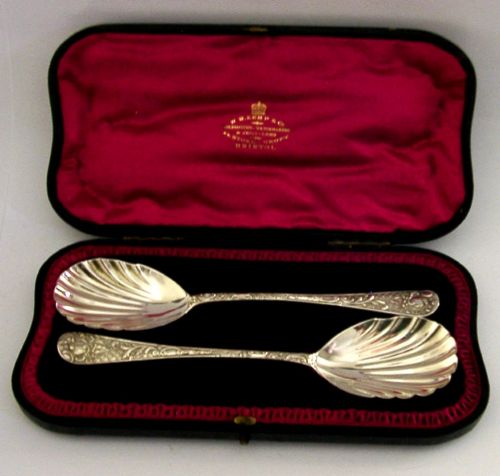
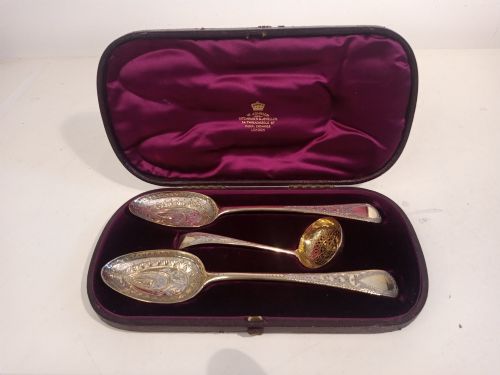
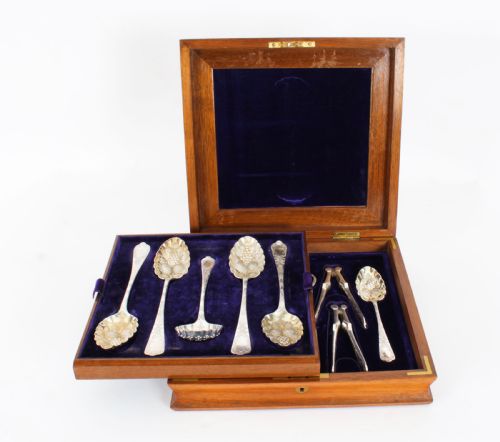
When you search for cased silver berry spoons, you find ornate serving items designed primarily for portioning fruits and desserts during formal Victorian and Georgian meals. These matching pairs or small sets usually arrive in fitted presentation boxes lined with silk, velvet, or satin.
The pieces on this page span the Georgian and Victorian eras, alongside Edwardian examples and later twentieth-century pieces. They appear predominantly as sterling silver, sometimes featuring silver-gilt finishes, alongside occasional silver plate variations.
How they were made
Silversmiths shaped the base flatware from sterling silver or silver-gilt, hammering and casting the metal into deep, wide bowls suited for serving berries and soft fruits. They then applied elaborate repoussé and chasing techniques to the bowl backs and handles, creating tactile fruit and floral motifs.
Makers housed these sets in protective outer cases covered in leatherette, fitted internally with moulded bases and padded lids lined in silk, satin, or velvet to secure the spoons safely.
The available items span Georgian, Victorian, and Edwardian periods, including specialised fruit serving sets and sugar sifters.
What varies in quality
The distinction between standard examples and finer pieces lies in the crispness of the repoussé work on the bowl and the depth of the chased detailing along the handle. Sharp, well-defined fruit clusters and clean hand engraving demonstrate superior silversmithing skill compared to softer, shallower stamping.
The quality of the fitted case also influences the overall standard, where robust leatherette exteriors and undamaged silk or velvet internal linings complete a cohesive survival of the set.
Hukin & Heath·Bateman·Hester Bateman·George Smith III
The Cased Silver Berry Spoons Glossary
- Repoussé
- A metalworking technique where the silversmith hammers the design from the reverse side to form a raised pattern on the front. This method gives berry spoon bowls their characteristic three-dimensional fruit decoration.
- Silver-gilt
- Sterling silver that has been coated with a thin layer of gold, often referred to as vermeil. This treatment imparts a warm golden hue to the interior of the spoon bowls.
- Cased
- Refers to items sold within their original fitted storage box. These protective enclosures are custom-shaped to hold the spoons securely in fabric linings.
- George III
- The period spanning the reign of King George III from seventeen sixty to eighteen twenty. Pieces from this era often exhibit neoclassical lines later adapted with berry decoration.
Cased Silver Berry Spoons: Frequently Asked Questions
What are cased silver berry spoons used for?
These utensils were created to serve soft fruits, particularly strawberries and raspberries, at the end of a formal meal. Their large bowls helped portion delicate fruits without bruising them.
Today, collectors also utilise them as decorative serving pieces for desserts or display them within their original presentation boxes.
How can I tell Georgian spoons from Victorian ones?
Georgian pieces typically display simpler, crisper handle forms made before the heavy ornamentation of the later nineteenth century became fashionable. Makers often added berry repoussé work to older plain spoons during the Victorian era.
Examining the hallmarks helps confirm the original date of manufacture versus any subsequent decorative additions.
Are these spoons made of solid silver?
The pieces recorded here include both sterling silver and silver plate examples. Sterling items carry official hallmarks indicating solid silver content.
Silver plate versions feature a layer of silver bonded to a base metal, commonly found in later nineteenth and early twentieth-century fruit sets.
Why do some spoons have gold colouring?
This golden appearance indicates a silver-gilt finish, where a micro-layer of pure gold is applied over the sterling silver. Silversmiths used this technique to prevent fruit acids from tarnishing or corroding the silver bowls.
It also provides a striking visual contrast against the polished silver handles.