


Cased Napkin Rings
Cased napkin rings bring together matched sets of table silver and the fitted presentation boxes designed to protect them.

Cased Napkin Rings
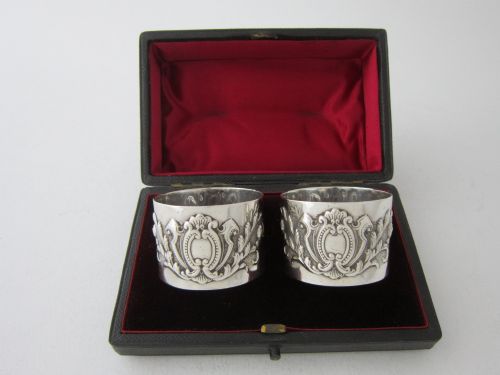
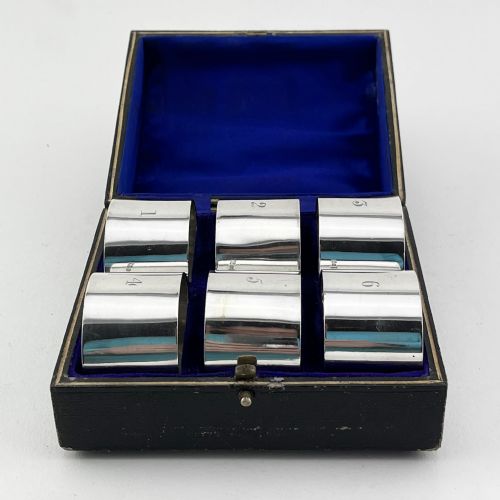
Cased napkin rings are matching sets of table accessories presented in fitted storage containers lined with protective materials. When you search for cased napkin rings, you encounter matched pairs, quartets, and larger sets designed to keep individual dining linens organised at the table.
The pieces appearing on this page span the late nineteenth century through to the mid-twentieth century, covering periods from the Victorian era to Art Deco and mid-century modern design. Sterling silver forms the primary metal standard, accompanied occasionally by silver plate.
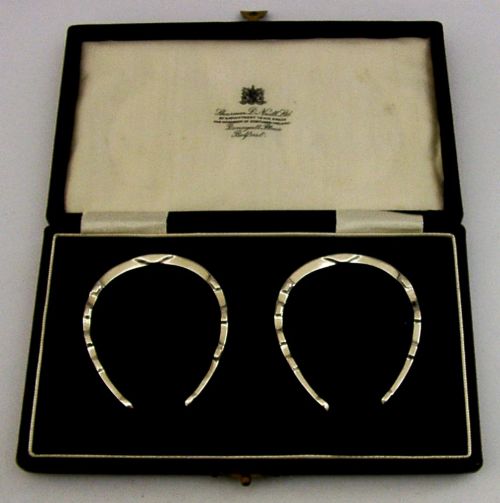
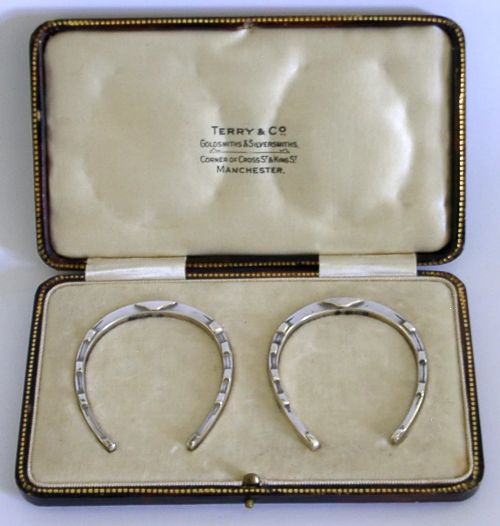
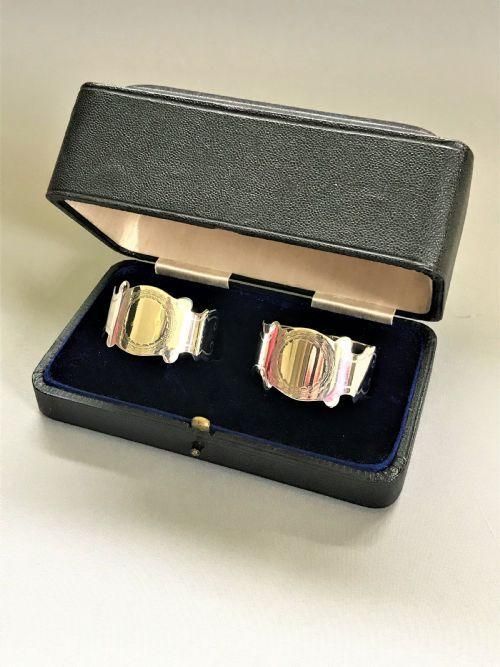
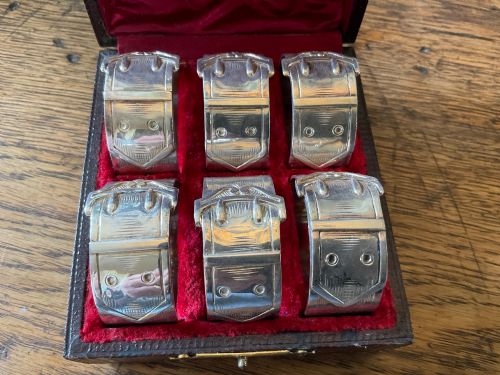
Most examples originate from British assay offices, displaying hallmarks from Birmingham, Sheffield, Chester, and London. They emerge in various configurations, from plain circular bands to novelty forms such as lucky horse shoes and belt buckles.
Materials and construction
Makers shaped sterling silver and silver plate into rigid cylindrical or formed bands through pressing, soldering, and hand-chasing. Surfaces received decoration via engine-turning, bright-cutting, or cast novelty motifs like horse shoes and belt buckles soldered to the main body.
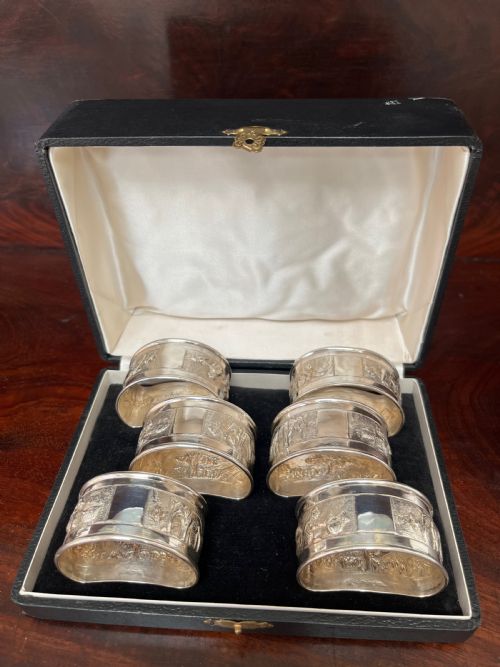
Presentation cases utilise a wooden or heavy card carcass wrapped in leatherette, leather, or cloth. The interior fittings typically comprise moulded bases covered in silk, satin, or velvet to cradle each ring securely in an individual recess.
Listings feature Victorian, Edwardian, and Art Deco styles, alongside George V periods spanning the early to mid-twentieth century.
Assessing quality and craftsmanship
Quality reveals itself in the thickness of the silver gauge used for the rings and the crispness of the applied decoration or cast details. Superior examples maintain their structural roundness under pressure and exhibit sharp, unrubbed hallmarks and clear hand-engraving.
The construction of the presentation box indicates the standard of the whole set. Finer boxes feature robust hinges, accurately fitted internal partitions, and unblemished silk or velvet linings that have survived without tearing or fading.
C.T. Burrows & Sons·Mappin & Webb·James Dixon & Sons·Asprey & Co·Cooper Brothers·Rolason Brothers·Robert Chandler·F.H. Adam & Co·Selfridge & Co·Walker & Hall·Broadway & Co·George Adams·Elkington·Hermes, Paris·Thomas Thomason & Co
The Cased Napkin Rings Glossary
- Hallmark
- Official stamps punched into precious metals to indicate the maker, standard of purity, assay office, and year of testing. These marks provide the primary evidence for dating British silver.
- Sterling silver
- An alloy containing 92.5 percent pure silver and 7.5 percent other metals, usually copper, chosen for durability in tableware. It forms the standard material for the majority of antique napkin rings.
- Assay office
- An official body charged with testing the purity of precious metal items and stamping them with statutory hallmarks. Principal offices include Birmingham, Sheffield, London, and Chester.
- Engine-turning
- A mechanical decoration technique that cuts intricate geometric patterns of fine lines into metal surfaces. This method was widely utilised on Edwardian and Art Deco napkin rings.
- Aesthetic movement
- A nineteenth-century design style that emphasised visual beauty over narrative content, often drawing on Japanese motifs. Pieces from this movement show distinct asymmetry and naturalistic engraving.
Cased Napkin Rings: Frequently Asked Questions
How were cased napkin rings used?
These items served a practical function in middle and upper-class households where dining linens were reused across multiple meals. Each family member or guest had a designated ring to identify their specific napkin between laundering.
The fitted presentation case kept the set together in the sideboard or dining room cabinet when not in active service. This storage protected the polished metal from tarnishing prematurely and prevented individual pieces from becoming separated or scratched.
Are all cased napkin rings made of solid silver?
While the majority of surviving examples consist of solid sterling silver, many period sets utilised silver plate over a base metal core. Manufacturers marked solid pieces with standard silver hallmarks, whereas plated items bore alternative maker marks or numerical designations.
Both solid and plated versions were housed in identical fitted presentation boxes lined with silk or velvet. Examining the interior marks and checking for any wear revealing a base metal helps distinguish between solid silver and plate.
Can I use antique napkin rings today?
Antique napkin rings remain fully functional for daily dining use provided they are handled with reasonable care. Solid silver and silver plate are durable materials that withstand normal placement around the table.
Regular, gentle cleaning with a specialised silver cloth maintains the polished finish without wearing down the engraved details. The presentation cases are best utilised for storage rather than active table display to preserve the vintage silk and leatherette.