

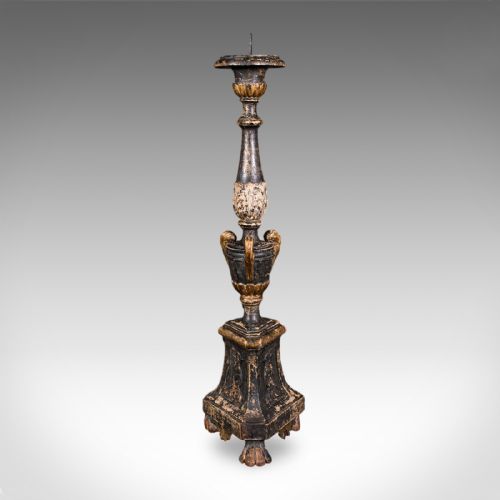


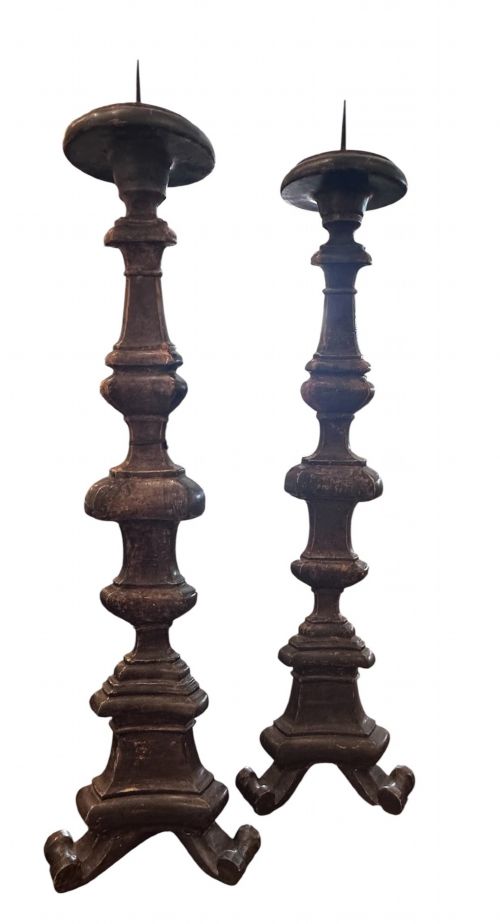

Carved Wooden Candle Sticks
These carved wooden candle sticks bring warmth and texture to a room, ranging from simple folk art pieces to grand altar lights.
Carved Wooden Candle Sticks
When you search for carved wooden candle sticks, you encounter a mix of domestic turned treen and architectural church altar pieces. The selection spans from the eighteenth century through the Victorian era and into the early twentieth century.
Domestic pairs include open barley twist oak and mahogany stems, sometimes fitted with brass sconces or converted into table lamps. Alongside these sit heavier decorative altar pieces, French silver leaf prickets, and idiosyncratic folk art figures.
Italian Neoclassical, French Chateau, Georgian, and Jacobean Revival styles dominate the aesthetic range. You are just as likely to find a pair of lignum vitae treen candlesticks as you are a gilt-wood church pricket.
How they were made
Makers shaped these objects primarily from dense timbers like oak, mahogany, and lignum vitae, utilising lathes for turned stems or hand-chiselling for figurative folk art. Woodworkers applied gesso as a smooth foundation layer before laying down silver leaf, gold leaf, or ebonised finishes.
Many altar pieces and church prickets incorporate iron spikes to secure large wax candles directly to the top. Gilding and silvering techniques required specialist application over carved wooden bases, creating surfaces that catch candlelight.
Carved Wooden Candle Sticks Retail Price Guide 2026
Typical asking prices for carved wooden candle sticks among the pieces listed under this phrase on Sellingantiques today, from the lower quarter to the upper quarter. They describe what is for sale here now, not the wider market.
Listings feature oak, mahogany, lignum vitae, and gesso surfaces across eighteenth and nineteenth-century forms.
What varies in quality
Depth of carving and proportion separate standard turned items from exceptional sculptural works. A pair with crisp chisel marks on folk art figures or well-defined barley twists holds more visual weight in a room.
The integrity of the surface finish dictates much of the character, particularly where original silver leaf or giltwood has aged gracefully over the underlying gesso and wood. Alterations, such as later lamp conversions or replaced sconces, shift the balance between utilitarian survival and decorative polish.
The Carved Wooden Candle Sticks Glossary
- Pricket
- A candlestick featuring a sharp metal spike at the top to impale a candle, common in church and altar pieces.
- Treen
- Small handmade wooden household objects, often turned on a lathe from dense timbers like lignum vitae.
- Gesso
- A plaster-like mixture applied to wood to provide a smooth surface for gilding with gold or silver leaf.
- Ebonised
- Wood treated with a chemical stain or finish to imitate the dark, dense appearance of ebony.
- Sconce
- The metal cup or nozzle fitted to the top of a candlestick to catch melting wax.
Carved Wooden Candle Sticks: Frequently Asked Questions
Are these sticks safe for modern candles?
Many older pairs feature prickets or wide sconces designed for altar or tallow candles rather than modern tapered household wax. You may need to pare down the base of a modern candle for a secure fit.
Pricket sticks require a candle with a hollow base or a pierced bottom to sit safely upon the central metal spike without wobbling.
How do I clean carved wooden candle sticks?
Dust gently with a soft, dry brush to protect fragile surfaces like silver leaf, gold leaf, and aged gesso. Avoid water and modern chemical polishes which strip historic patination.
Wax drips are best left alone or removed very carefully with a plastic scraper when cold, taking care not to gouge the underlying timber.
Why do some have metal spikes instead of cups?
Metal spikes indicate pricket candlesticks, which originated in ecclesiastical settings where large candles rested directly on the point. This design allowed churches to burn substantial wax columns efficiently.
Domestic sticks transitioned more toward sockets and brass sconces as candle manufacturing evolved in the nineteenth century.
Can I use lamp converted sticks as lighting?
Several pieces arrive already adapted into table lamps, often retaining their original gilt-wood or carved wooden columns. These provide atmospheric lighting while preserving decorative woodwork.
Ensure any older wiring is inspected by a qualified electrician before plugging the lamp into a mains supply.