
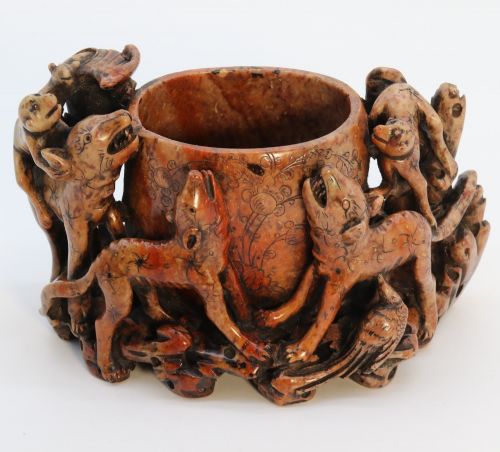


Carved Stone Vase
These carved stone vase examples bring classical presence and heavy mineral grain into a room, offering genuine weight and carved antiquity.
Carved Stone Vase
When you search for a carved stone vase, you encounter a distinct gathering of heavy mineral vessels originating from the nineteenth century. These objects bridge the gap between architectural ornament and cabinet display, drawing on classical antiquity and distant trade routes.
The items most frequently met on this page are European Grand Tour souvenirs and nineteenth-century Italian vessels shaped from various marbles and alabaster. Alongside these, occasional Chinese soapstone brush pots and Anglo-Indian pietra dura pieces appear, broadening the geographic scope.
Forms divide largely between classical campana urns, garden urns, and decorative vases designed for prominent display on mantelpieces or pedestals. Their presence relies entirely on solid mineral mass and the precision of the chiselled contour.
How they were made
The makers of these pieces utilised solid blocks of white marble, alabaster, serpentine marble, and soapstone, turning them on heavy lathes before finishing the surfaces by hand. This subtractive method required immense patience to avoid fracturing the stone during deep relief carving or hollow turning.
Decoration often involved intricate hand-chiselling for classical foliate motifs and gadrooning, alongside specialised inlay techniques. Indian works demonstrate pietra dura inlay using semi-precious stones set precisely into the marble ground.
Reconstituted stone also appears alongside natural minerals, reflecting later nineteenth-century manufacturing methods aimed at replicating traditional carved forms with uniform composition.
Listings feature pieces spanning from the 1870s through the early twentieth century, predominantly utilising marble, alabaster, and soapstone in neoclassical and Chinese styles.
What varies in quality
Quality rests primarily in the purity and grain of the mineral used, alongside the crispness of the hand-carved detail. Superior examples show deep, clean undercut foliage and smooth, even walls without natural fissures threatening the structure.
Proportion and classical accuracy dictate the standing of a piece, particularly within Grand Tour souvenirs where adherence to ancient architectural models marks the better workshop. Finer items possess a balanced silhouette where the foot, body, and handles form a harmonious architectural unit.
The presence of specialised decorative techniques, such as multi-coloured Breccia Medicea marble or meticulous semi-precious stone inlay, separates standard decorative vessels from exceptional collector pieces.
The Carved Stone Vase Glossary
- Campana urn
- A bell-shaped vessel with a flared rim and a pedestal foot, heavily favoured in classical design. These forms draw directly from ancient Roman pottery and stone prototypes.
- Grand Tour
- A cultural journey undertaken by wealthy young Europeans in the eighteenth and nineteenth centuries to study classical art. Souvenirs purchased along the way typically included alabaster and marble architectural models and vases.
- Pietra dura
- An artistic technique involving the inlay of cut and fitted highly-polished coloured stones into a stone background. It creates smooth, picture-like geometric or floral designs.
- Serpentine marble
- A major group of green-hued minerals often utilised for ornamental stonework. Its mottled appearance resembles snake skin, giving the stone its common descriptive name.
- Breccia Medicea
- A distinctive decorative marble characterised by angular fragments embedded in a contrasting matrix. It yields a rich, multicolored pattern popular in high-status neoclassical carving.
Carved Stone Vase: Frequently Asked Questions
Where were Grand Tour vases made?
These souvenirs were primarily produced in Italian workshops centred around Rome, Florence, and Naples during the nineteenth century. Local artisans catered directly to travelling foreigners seeking portable reminders of classical antiquity.
Workshops utilised native stones such as alabaster and local marbles, shaping them into miniature urns and vases that mirrored the monumental ruins tourists visited.
How do I clean an alabaster vase?
Alabaster is a remarkably soft and porous mineral that absorbs moisture and stains easily. Cleaning should be restricted to gentle dusting with a dry, soft cloth without the use of water or chemical solvents.
Exposing these vessels to damp environments or direct liquids will permanently alter the surface sheen and soften the gypsum structure.
What is the difference between marble and alabaster?
Marble is a metamorphic rock formed from recrystallized carbonate minerals, offering high hardness and durability. Alabaster is a softer mineral composed of gypsum, noted for a distinct translucent quality that allows light to pass slightly beneath the surface.
This translucency made alabaster particularly prized for miniature lamps and delicate Grand Tour carvings where a glowing quality was desired.
Can these garden urns stay outside?
Suitability for outdoor placement depends entirely on the specific stone composition and the local climate. Natural dense marbles and reconstituted stone handle exterior conditions better than soft alabaster or soapstone.
Freezing water entering porous stone or natural fissures can cause severe cracking, making indoor display the safer choice for delicate antique specimens.