


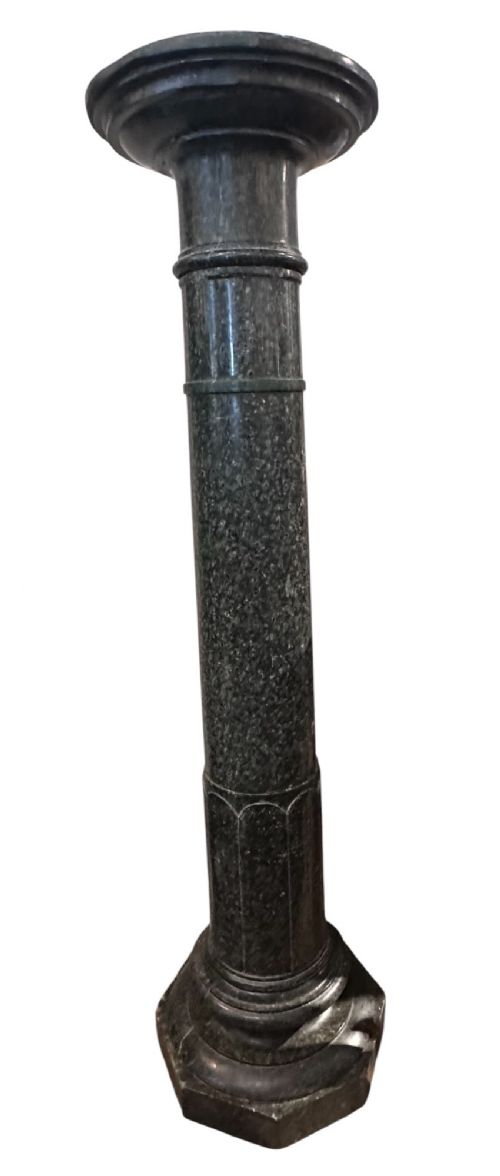


Carved Stone Display Pedestal
These carved stone display pedestals elevate sculpture and decorative objects, bringing classical proportion and substantial weight into a room.
Carved Stone Display Pedestal
A carved stone display pedestal serves to lift urns, tazze and statuary above floor level, framing them as focal points. When searching for a carved stone display pedestal, buyers encounter columnar supports, square plinths and tall torchere stands designed to carry weight.
The selection ranges across the nineteenth century, the Victorian era and early twentieth-century decades up to nineteen thirty. Forms include architectural salvage, garden plinths and plant stands executed in distinct classical revival styles.
Italian neoclassical grand tour souvenirs and monumental columns dominate the architectural offerings on this page. Buyers also meet smaller plant stands and decorative tazze paired with stone block bases.
How they were made
Masons utilised heavy marbles, alabaster, stoneware and scagliola to shape these columns and pedestals. Natural stones such as arabescato, verde antico and serpentine marble provide dramatic veining and varied colour palettes.
Carvers shaped raw blocks into fluted shafts, capitals and stepped bases using traditional masonry tools. Plaster and scagliola appear alongside solid stone, while certain nineteenth-century examples combine stone elements with wood.
Carved Stone Display Pedestal Retail Price Guide 2026
Typical asking prices for carved stone display pedestal among the pieces listed under this phrase on Sellingantiques today, from the lower quarter to the upper quarter. They describe what is for sale here now, not the wider market.
Grand tour travellers packed fragile alabaster tazze into carriage trunks, hoping Italian dust and horsehair packing would survive the Alps.
What varies in quality
Proportion and architectural rigour separate grand tour souvenirs and monumental columns from utilitarian plinths. The handling of capitals, fluting and base mouldings dictates whether a piece holds authority in a room.
The Carved Stone Display Pedestal Glossary
- Tazza
- A shallow cup or bowl on a stem and foot, frequently carved from marble or alabaster as a decorative centrepiece. These vessels often sit atop dedicated columns.
- Scagliola
- A composite material made from pigmented selenite, glue and plaster, applied to mimic genuine marble and stone. Artisans polished this mixture to achieve a convincing high gloss.
- Verde Antico
- A dark green serpentine breccia marble prized for its mottled appearance and historical use in classical architecture. Italian makers utilised this stone for columns and pedestals.
- Torchere
- A tall stand or pedestal originally intended to support a light source or candle, later adapted for display urns and figures. These vertical forms draw the eye upward.
- Grand Tour
- A cultural journey undertaken by nineteenth-century travellers who acquired miniature architectural models, bronzes and carved stone souvenirs. These portable antiquities imitated major classical monuments.
Carved Stone Display Pedestal: Frequently Asked Questions
What holds up a heavy marble column?
These columns rely on their own substantial mass and flat, squared bases to remain stable on even floors. Their weight prevents tipping when supporting heavy urns or statuary.
Larger nineteenth-century examples combine stone shafts with internal wooden construction or robust mortar beds to distribute loads safely.
How do I place a pedestal in a room?
Position these vertical supports in corners, empty wall spaces or flanking doorways to create architectural punctuation. They draw the eye upward and anchor smaller decorative objects.
Keep circulation space clear around the base so the stone form reads clearly as a standalone sculpture.
Are alabaster stands suitable for daily use?
Alabaster provides a translucent, fine-grained surface that suits indoor display stands and plant holders. Because the mineral is softer than granite or hard marble, it benefits from gentle handling.
Keep these pieces away from moisture and heavy impacts to preserve the polished carved details over time.
What is the difference between a plinth and a column?
A plinth is typically a low, solid block or square base designed to elevate a statue or urn by a modest height. Columns feature vertical shafts with distinct capitals and bases, lifting objects significantly higher.
Both forms belong to the broader category of display supports seen across neoclassical and Victorian interiors.