

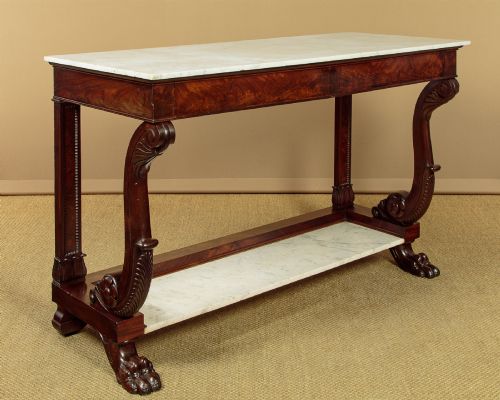
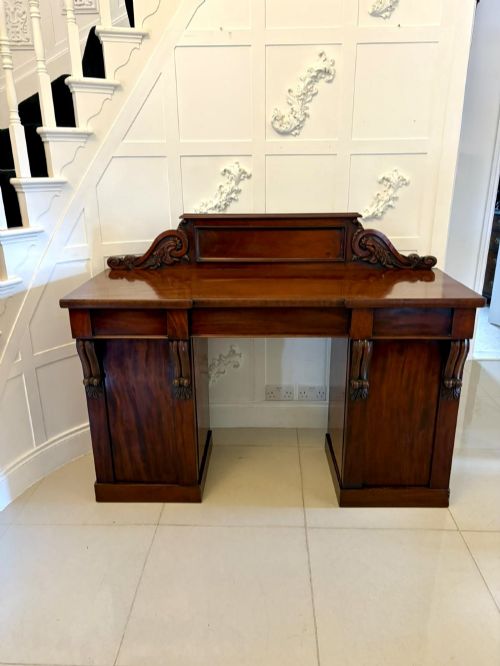


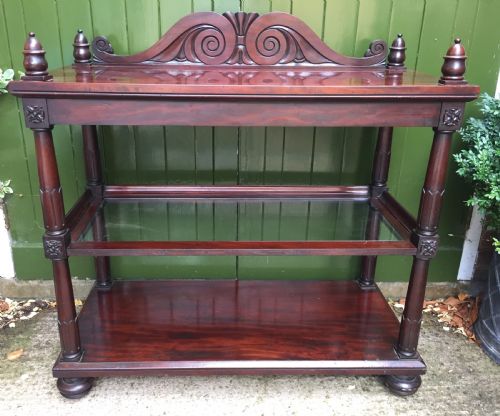


Carved Scroll Mahogany Sideboard
A carved scroll mahogany sideboard brings robust nineteenth-century presence and rich timber grain to a dining room or hall.
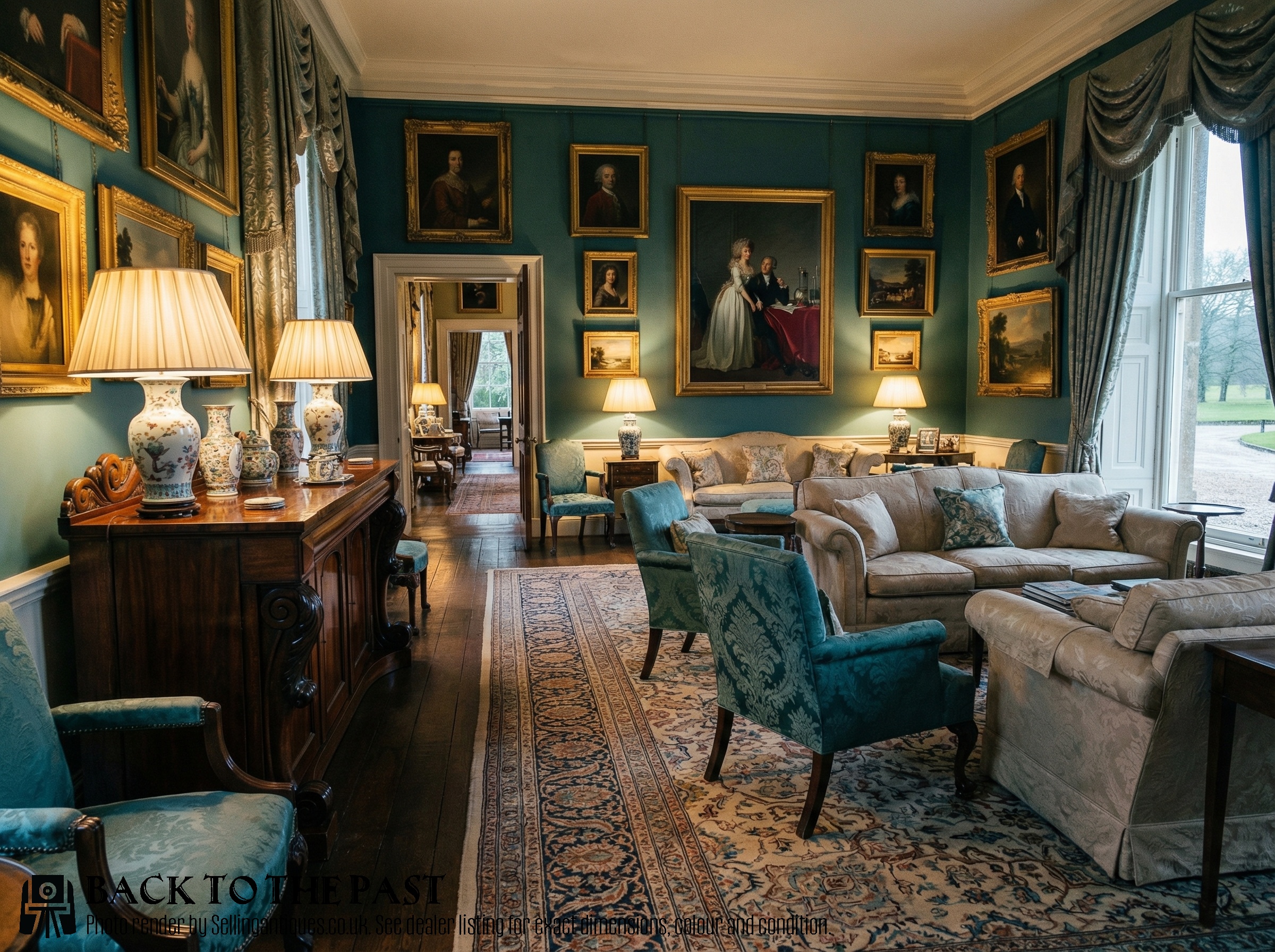
Carved Scroll Mahogany Sideboard
A carved scroll mahogany sideboard is a substantial serving and storage furniture piece built primarily from mahogany during the nineteenth century, including Georgian, Regency, William IV, George IV, and Victorian periods.
The form encompasses sideboards, chiffoniers, buffets, console tables, side cabinets, and serving stands featuring characteristic carved scroll details.
How they were made
Cabinet makers utilised solid mahogany and flame mahogany veneer applied over secondary timbers, shaping the wood into curvilinear forms and architectural pedestals.
Decorative enrichment relied on hand-carved scrollwork, barley twist turnings, and architectural mouldings executed directly into the timber.
Functional accessories such as brass galleries, glass panels, and marble tops were integrated into the primary mahogany structures of buffets and console tables.
Carved Scroll Mahogany Sideboard Retail Price Guide 2026
Typical asking prices for carved scroll mahogany sideboard among the pieces listed under this phrase on Sellingantiques today, from the lower quarter to the upper quarter. They describe what is for sale here now, not the wider market.
Certain early nineteenth-century pieces arrive equipped with multi-tier display stands ready to hold afternoon tea.
What varies in quality
Quality rests upon the selection of timber, particularly the choice of figured mahogany and lively flame mahogany veneers that display deep chatoyancy across the doors and panels.
The crispness and depth of the hand-carved scrollwork distinguish superior cabinet work from mechanical or softer detailing.
Proportion and architectural integrity elevate certain country house buffets and monumental sideboards above standard utility serving furniture.
The Carved Scroll Mahogany Sideboard Glossary
- Mahogany
- A durable tropical hardwood prized for its reddish-brown colour and stable grain, forming the primary structural material for these pieces.
- Flame mahogany veneer
- A thin slice of wood cut from fork or branch junctions to produce a fiery, rippled pattern applied over carcase timber.
- Chiffonier
- A compact sideboard or low cabinet equipped with doors and sometimes a shelved superstructure, common in nineteenth-century interiors.
- Buffet
- A serving piece designed for dining rooms, ranging from multi-tiered display stands to enclosed cabinets.
- Console table
- A wall-mounted or freestanding table designed to stand flat against a perimeter wall, frequently topped with marble in these listings.
Carved Scroll Mahogany Sideboard: Frequently Asked Questions
What rooms suit a carved scroll mahogany sideboard?
These substantial pieces anchor a dining room or spacious hallway, providing a traditional surface for serving food and displaying silver or glassware.
Their deep timber tones and classical proportions also complement a library or drawing room seeking period gravitas.
How do I identify a Regency period piece?
Regency items typically display classical restraint, balanced proportions, and architectural motifs inspired by ancient Greece and Rome.
Look for refined mahogany surfaces paired with understated brass mounts and crisp structural lines characteristic of the early nineteenth century.
What is the difference between a sideboard and a chiffonier?
Sideboards are generally larger dining room items built with extensive cupboards and drawers for storing heavy tableware and linen.
Chiffoniers are smaller, lower variants often fitted with enclosed doors and sometimes upper display shelves suited to more compact entertaining spaces.
How do I care for nineteenth-century mahogany?
Protect the polished timber surface from direct sunlight and excessive heat fluctuations to prevent the mahogany veneer from drying or cracking.
Apply traditional beeswax periodically and buff gently with a soft cloth to maintain the natural lustre of the grain.