
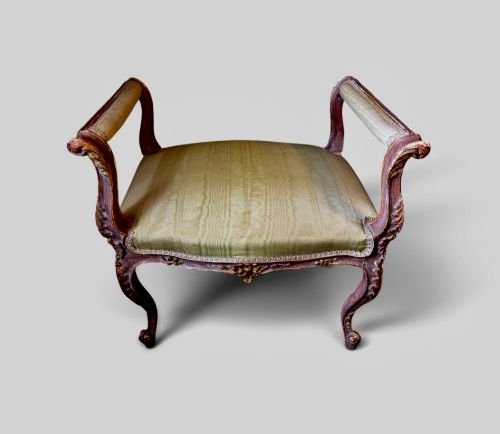
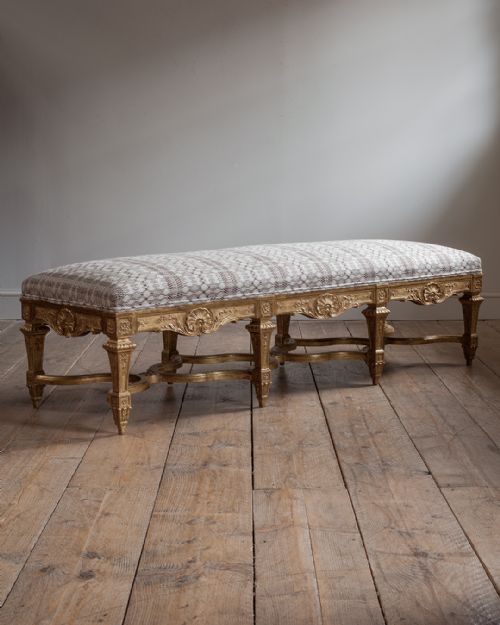
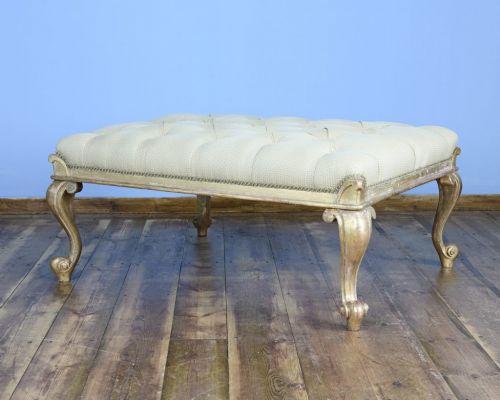
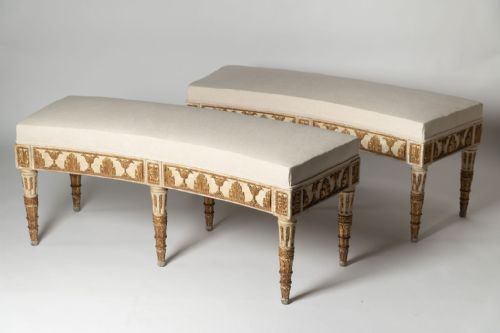

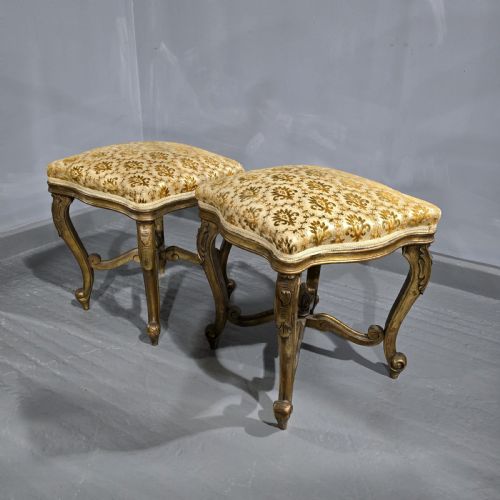
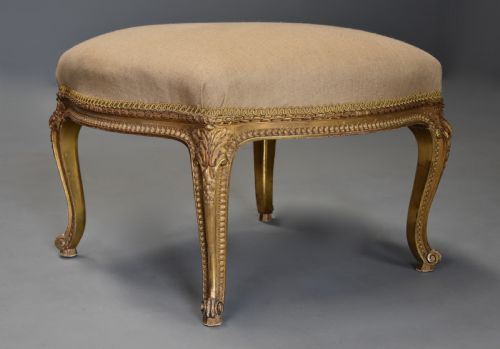


Carved Giltwood Stool
A carved giltwood stool brings theatrical French or Italian style to a room, offering low seating or a handsome footrest finished in lustrous gold leaf.
Carved Giltwood Stool
When you search for a carved giltwood stool, you enter a field dominated by nineteenth-century French and Italian pieces built as window seats, footstools, or long benches. These items draw heavily on historical revivals such as Louis XIV, Louis XVI, Rococo, and Neoclassical styles, with occasional X-frame curule shapes appearing among them.
The assortment spans simple low footstools to grand scale parcel gilt designs and duet stools upholstered in silk, velvet, or linen. Makers often turned to classic architectural motifs, applying elaborate hand carving to timber before finishing the surfaces in gold leaf or gesso.
Materials and construction
Cabinetmakers shaped these frames from dense timbers such as wood and giltwood, applying a layer of gesso to prepare carved surfaces for gilding. This meticulous preparation allowed artisans to achieve crisp relief work on acanthus leaves, fluting, and scrollwork.
Upholstery completed the piece, with workshops employing traditional textile coverings like silk, linen, and velvet fastened over padding. Surviving examples demonstrate how structural timber supports ornate surface gilding and soft fabric seating.
Listings feature eighteenth-century roots extending through nineteenth-century revivals into early twentieth-century interpretations.
Distinguishing quality
The distinction between ordinary and exceptional pieces lies in the depth and sharpness of the hand carving on the wooden frame. Crisp, deep relief work indicates skilled workmanship, whereas shallow or mechanically smoothed carving points to lesser production.
Quality also rests on the integrity of the original gilt surface and the harmony of the upholstery proportions. Pieces that retain their historic gilding without excessive modern over-painting hold greater character.
LOIDRAULT FRERES PARIS·Miles & Edwards·A.M.E. Fournier
The Carved Giltwood Stool Glossary
- Giltwood
- Timber that has been coated with gold leaf or gold paint over a prepared ground. This technique gives furniture a brilliant metallic finish.
- Curule stool
- An ancient Roman magistrate's seat design featuring concave X-shaped legs. Nineteenth-century makers revived this form for formal seating.
- Parcel gilt
- Woodwork where only specific carved details are gilded, leaving other portions of the timber exposed or painted. This creates a striking contrast between the wood grain and the gold leaf.
- Gesso
- A plaster mixture applied to wooden furniture frames to create a smooth, absorbent base for gilding. It allows carvers to achieve fine detail before applying gold leaf.
Carved Giltwood Stool: Frequently Asked Questions
Where should I place a carved giltwood stool?
These pieces suit positions at the foot of a bed, beneath a large window as a low seat, or beside a fireplace as an accent footrest.
Because of their decorative presence, they also function well in dressing rooms or hallways where a touch of period elegance is desired.
How do I care for giltwood surfaces?
Dust the carved wooden frame gently with a dry, soft brush to protect the delicate gold leaf layer from abrasion.
Keep the stool away from direct sunlight and moisture to prevent the gesso and gilding from flaking over time.
Are these stools comfortable to sit on?
Many examples are designed primarily for short periods of sitting or for resting feet, featuring firm period padding.
Larger window seats and duet stools offer more substantial seating areas upholstered in traditional textiles like velvet or silk.
How do I distinguish French and Italian styles?
French nineteenth-century pieces often follow courtly Louis styles with refined cabriole legs, floral carvings, and elaborate window seat proportions.
Italian pieces frequently display bolder neoclassical architectural lines, curule X-frames, and crisp gesso ornamentation.