
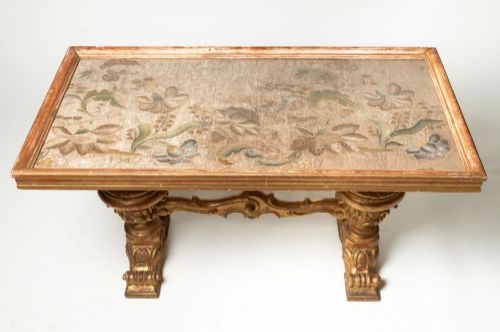
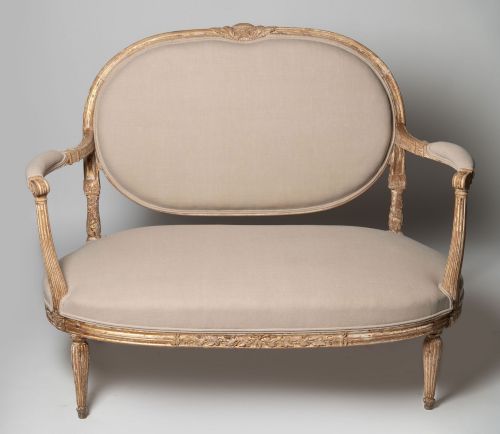
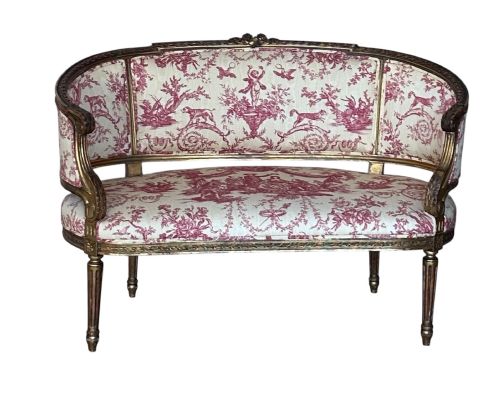
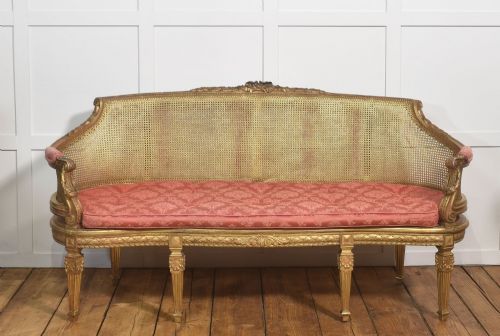



Carved Giltwood Sofa
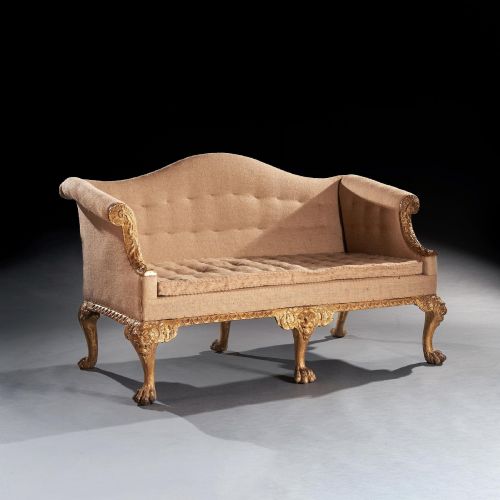
A carved giltwood sofa brings theatrical scale and glittering warmth to a room, offering seats designed for grand reception rooms.
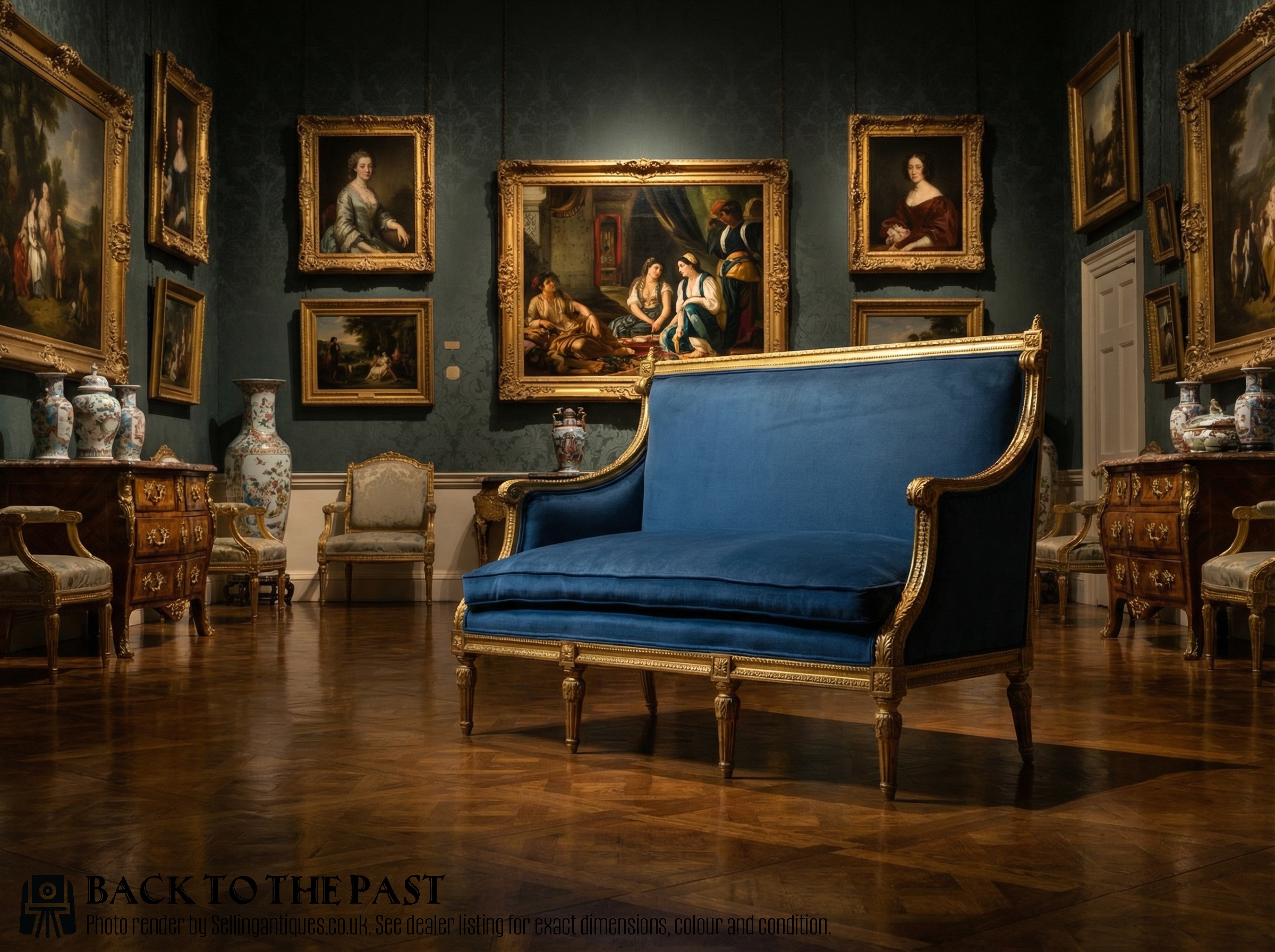
Carved Giltwood Sofa
A carved giltwood sofa is a formal seat built with a wooden frame coated in thin metallic leaf, appearing across European drawing rooms from the eighteenth century onwards. The pieces gathered here span the nineteenth and early twentieth centuries, drawing heavily on French court tastes.
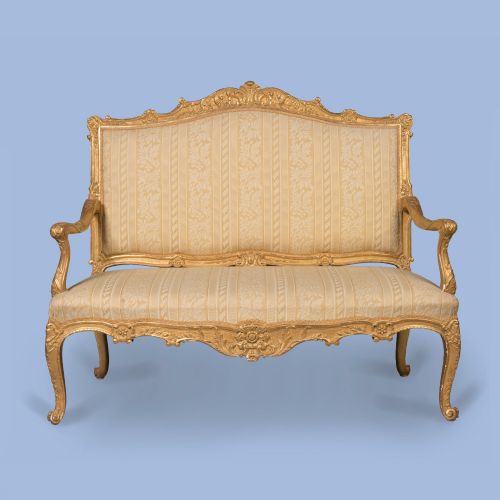
French designs dominate the selection, particularly in the Louis XV and Louis XVI styles, alongside nineteenth-century Victorian interpretations. These range from compact two-seat canapés and window sofas to large country house settees.
Makers adapted these forms across England, Italy, Germany, and France, producing variations with exposed carved wooden frames, cane panels, or upholstered backs. Buyers meet pieces intended for formal reception spaces rather than everyday lounging.
What varies in quality
The crispness and depth of the hand-carved wooden ornament separate ordinary joinery from exceptional work, where floral garlands and scrolls retain sharp definition beneath the metallic leaf. Deep relief carving requires skilled hand labour rather than mechanical shaping.
The application and survival of the gold leaf influence visual richness, as older surfaces show subtle wear that reveals the warm red or yellow bole underneath. Smooth, unbroken gilding sits at one end of the scale, while distressed patination shows the history of the piece.
The inventory spans eighteenth-century origins, nineteenth-century revival pieces, and early twentieth-century interpretations.
Giles Grendey·Holland + Son
The Carved Giltwood Sofa Glossary
- Giltwood
- Wood that has been decorated with thin sheets of gold leaf. This surface treatment provides a bright metallic sheen that reflects candlelight and daylight.
- Canapé
- A traditional French term for an upholstered sofa or settee. These seating forms often feature exposed wooden frames and padded backs.
- Louis XV Style
- A decorative design movement characterised by asymmetrical curves, cabriole legs, and naturalistic floral carvings. Pieces from this tradition avoid straight lines in favour of flowing contours.
- Louis XVI Style
- A neoclassical design aesthetic defined by geometric symmetry, straight fluted legs, and classical motifs like urns and ribands. This style reacts against the earlier curved Rococo forms.
- Cane
- Material woven from stripped rattan used for seat panels and backrests. This technique creates a lightweight, resilient surface common on period chairs and settees.
Carved Giltwood Sofa: Frequently Asked Questions
Where did people place these sofas historically?
These seats belonged in formal reception rooms, salons, and withdrawing rooms where hosts entertained visitors. Their decorative backs meant they could stand away from walls to punctuate large spaces.
Today, they function well in drawing rooms, large hallways, or bedrooms as statement seating rather than daily lounging furniture.
How do I distinguish Louis XV from Louis XVI style?
Louis XV pieces rely on asymmetrical curves, cabriole legs, and flowing floral carvings without straight lines. The overall impression leans toward organic movement.
Louis XVI furniture introduces strict symmetry, straight fluted legs, and classical motifs such as columns and square frames, reflecting a neoclassical revival.
Can I use everyday cleaning products on giltwood?
Harsh chemical cleaners and excessive water will damage the delicate gold leaf surface and strip the underlying bole. Dusting requires only a soft, dry brush or cloth.
Professional conservators should handle repairs to the gilded frame to prevent flaking or loss of the metallic finish.
What textiles match original upholstery choices?
Period pieces frequently used silks, damasks, brocades, and fine linens that suited formal interior schemes. Choosing traditional weaves maintains the historical character of the furniture.
Plain neutral fabrics also work well to let the carved and gilded wooden frame remain the visual focal point of the piece.