
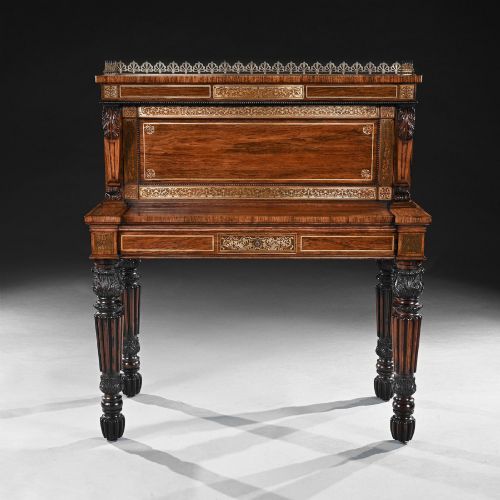
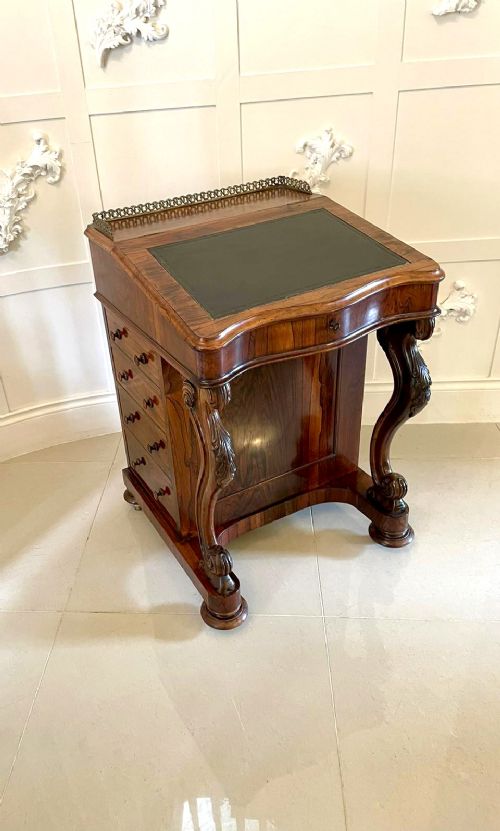
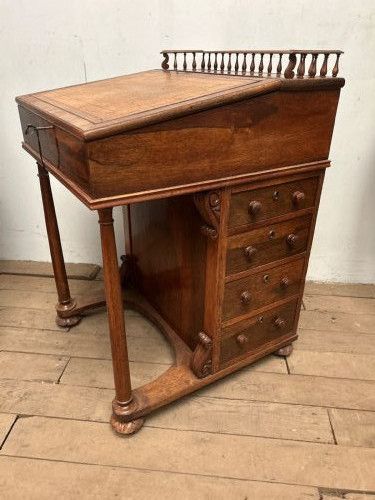
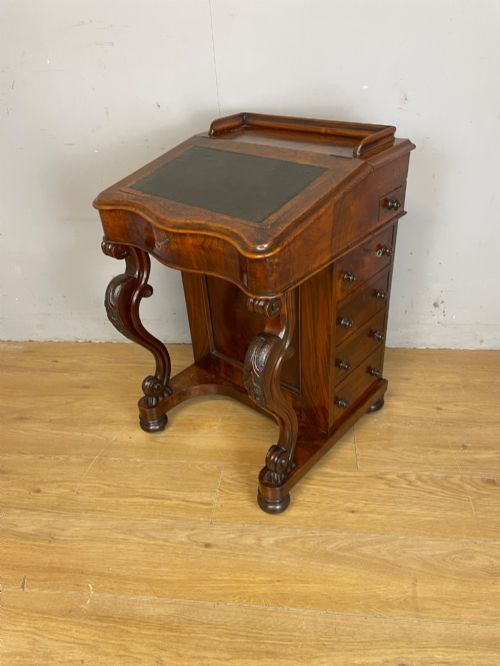



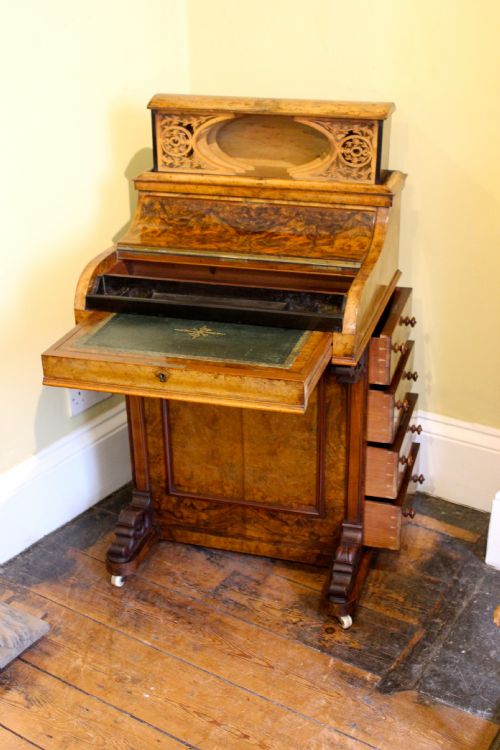
Carved Davenport Desk
A carved davenport desk brings compact Victorian workspace to a room, offering a sloping lid and neat side drawers that combine utility with decorative carving.

Carved Davenport Desk
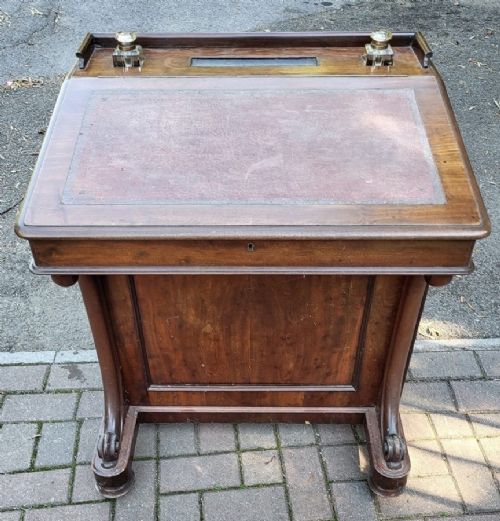
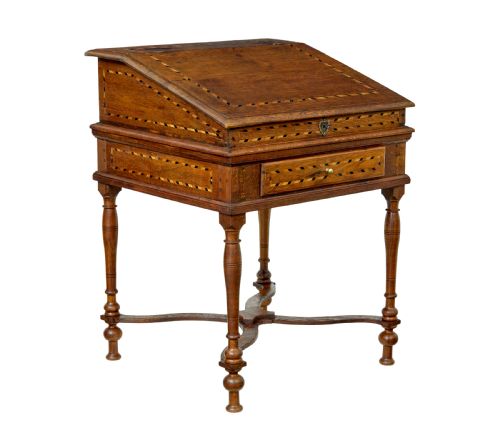
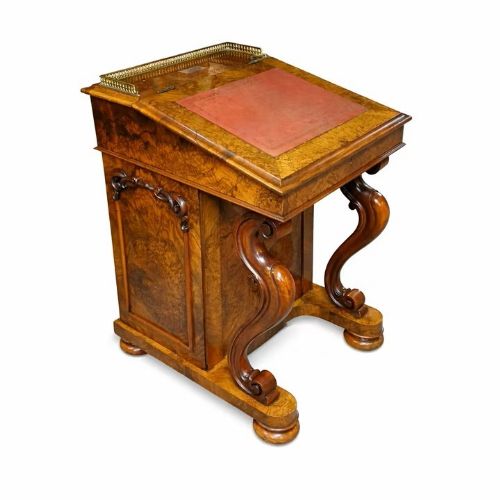
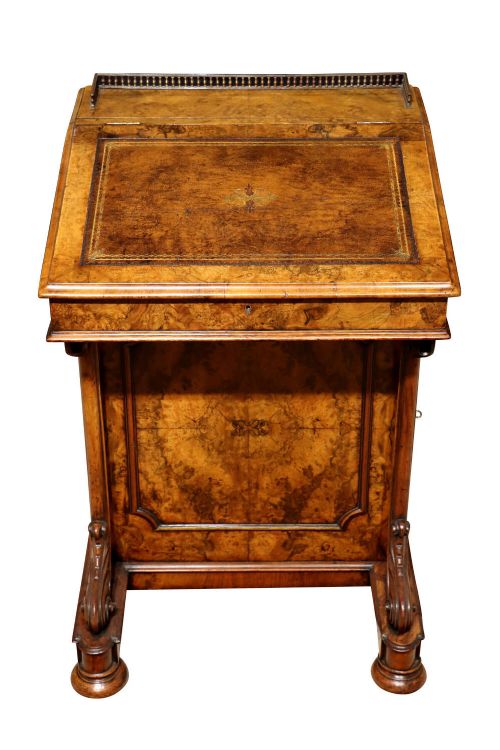
A carved davenport desk is a compact writing cabinet that places a sloping desk surface above a bank of drawers. These pieces emerge predominantly from the Victorian period, though earlier Regency examples and later interpretations appear.
Buyers encounter walnut, burr walnut, and oak frequently, often embellished with carved details such as Green Man motifs, lion heads, or floral marquetry. The form balances practical writing space with ornamental presence.
The layout typically incorporates side drawers accessed from a seated position, sometimes paired with stationary boxes or pop-up mechanisms on top. Such configuration makes the form suitable for smaller studies or drawing rooms.
Materials and construction
Cabinet makers built these desks using dense hardwoods like mahogany, rosewood, oak, and walnut, often applying highly figured burr walnut veneers to external surfaces. Satinwood frequently appears in the fitted interior compartments.
Carving was executed by hand directly into the solid timber or applied mouldings, displaying deep relief work on supports and panels. Brass hardware, leather writing inserts, and occasionally glass elements completed the assembly.
Carved Davenport Desk Retail Price Guide 2026
Typical asking prices for carved davenport desk among the pieces listed under this phrase on Sellingantiques today, from the lower quarter to the upper quarter. They describe what is for sale here now, not the wider market.
Listings demonstrate that burr walnut is the dominant timber for these desks, accompanied by rosewood, mahogany, and carved oak.
Distinctions in craftsmanship
Quality rests in the selection of timber figure, particularly the richness of the burr walnut veneer and the crispness of the hand carving on oak or walnut structures. Superior pieces display seamless drawer construction and well-matched grain patterns across the fall front.
Internal fittings also differentiate tiers of making, where secondary drawers in satinwood and sophisticated pop-up superstructure mechanisms indicate higher workshop standards than standard stationary compartments.
Gillows Oxford Street Workshop·Gillows of Lancaster
The Carved Davenport Desk Glossary
- Davenport
- A small pedestal desk featuring a sloping writing surface and drawers opening to the side. The design dates back to the late eighteenth century and remained popular through the Victorian era.
- Burr walnut
- A veneer taken from the warted growths on walnut trees, prized for its swirling, highly figured patterns. It was extensively utilised on high-end Victorian cabinet furniture.
- Pop-up
- A desk superstructure that raises an interior tier of pigeonholes and small drawers when the top is unlocked. This mechanism hides additional storage within the desk body.
- Green Man
- A sculptural architectural ornament depicting a human face disgorging foliage, found carved into oak and walnut furniture. It symbolises rebirth and spring in traditional decoration.
Carved Davenport Desk: Frequently Asked Questions
What is a davenport desk?
A davenport desk is a compact piece of nineteenth-century furniture designed for correspondence, combining a sloping leather-lined writing surface with a set of drawers built into the pedestal underneath.
The user sits beside the pedestal rather than facing it directly, accessing drawers that pull out to the side while papers store securely inside the sloped top compartment.
How do pop-up davenports work?
Pop-up versions conceal a nest of small stationery drawers and pigeonholes inside a compartment at the back of the writing slope. Opening the mechanism raises this interior section vertically using internal springs or weights.
This clever engineering allowed Victorian writers to keep their papers organised and out of sight when the desk was not in use.
Where were davenport desks placed?
Because many examples feature finished panelling on all four sides, they were designed to stand free in the middle of a room rather than push flat against a wall. This freestanding capability made them popular in larger drawing rooms and libraries.
Smaller iterations fit easily into corners or beside fireplaces where full-sized partners desks would take up too much floor space.
How do I identify a Victorian davenport?
Victorian examples typically date between eighteen-fifty and eighteen-eighty, utilising woods like burr walnut, mahogany, and carved oak. Look for hand-cut dovetail joints in the drawers and traditional timber framing.
Stylistic markers range from simple mahogany frames to heavily carved oak panels featuring lion masks or floral marquetry typical of mid-to-late Victorian taste.