
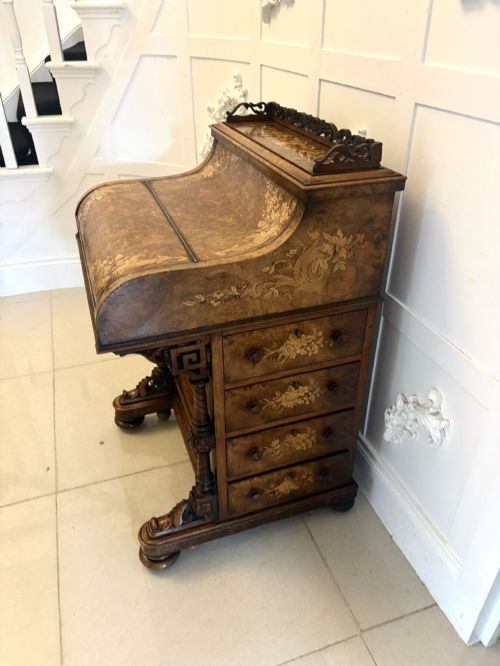


Piano Top Davenport Desk
A piano top davenport desk is a clever Victorian writing cabinet housing hidden pop-up compartments, perfectly built for compact study.
Piano Top Davenport Desk
A piano top davenport desk combines a compact writing compartment with a sliding lid mechanism reminiscent of a keyboard cover. These pieces belong firmly to the Victorian period, appearing across the middle decades of the nineteenth century from roughly eighteen-fifty to eighteen-seventy.
The format provides a practical writing surface alongside internal stationery storage that rises when the top rolls back. Most examples found on this page display the distinctive burr walnut timber characteristic of mid-Victorian craftsmanship.
Materials and Construction
Makers utilised rich burr walnut veneers over solid secondary timbers to create the striking figured surfaces seen on these desks. Brass hardware and leather writing inserts provide durable functional contrast against the polished wood.
Intricate boxwood inlay and floral marquetry frequently decorate the exterior panels of these cabinets. The complex internal pop-up mechanism requires precise joinery to ensure smooth movement of the writing slope and rising compartments.
Every single piece currently listed and recorded in the archive hails from the Victorian era, utilising burr walnut and brass.
Judging Quality
The standard of timber selection largely dictates the visual appeal of each desk, with dense, highly figured burr walnut commanding attention. The smoothness of the pop-up mechanism reflects the original skill of the cabinet maker.
Fine decorative additions such as precise boxwood inlay and floral marquetry distinguish superior examples from plain utilitarian versions. The integrity of the internal fittings and the crispness of the secondary wood joinery complete the picture.
The Piano Top Davenport Desk Glossary
- Davenport
- A compact writing desk featuring a sloping writing surface above a pedestal of drawers. This form became popular during the nineteenth century for use in smaller rooms or ladies' boudoirs.
- Piano Top
- A cylinder or tambour style rolling lid that opens by sliding backward, resembling the fallboard of a keyboard instrument. It conceals the writing surface and internal stationery compartments.
- Pop-Up
- A mechanical arrangement where interior storage wells rise automatically when the main desk lid is retracted. This clever feature maximises usable space within a small cabinet footprint.
- Burr Walnut
- Timber taken from a tree growth or burl, yielding swirling, highly decorative grain patterns. It was heavily favoured by Victorian cabinet makers for high-end furniture.
Piano Top Davenport Desk: Frequently Asked Questions
How do piano top davenports work?
These desks operate via a sliding top that rolls backward like a piano keyboard cover. As this lid retracts, internal mechanisms cause hidden stationery compartments and pen trays to rise upward for easy access.
When pushed shut, the entire interior storage safely lowers out of sight, protecting the contents and presenting a tidy cabinet exterior.
What era do these desks come from?
The available evidence shows these pieces originate exclusively from the Victorian period during the mid-nineteenth century. Dates span from around eighteen-fifty through to eighteen-seventy.
Stylistic markers and construction methods consistently place them within this specific nineteenth-century window.
How were these desks used?
Owners used them for personal correspondence and household record-keeping in nineteenth-century sitting rooms or studies. The compact footprint suited domestic spaces where a full-sized partner desk proved too large.
Secret compartments and rising stationery wells provided secure storage for letters and valuable papers.
What wood is most common?
Burr walnut dominates the surviving examples from this period, celebrated for its rich, swirling grain patterns. Makers often enhanced these surfaces with contrasting boxwood inlay and floral marquetry.
Secondary materials like brass hardware and fitted leather writing panels frequently accompany the walnut construction.