


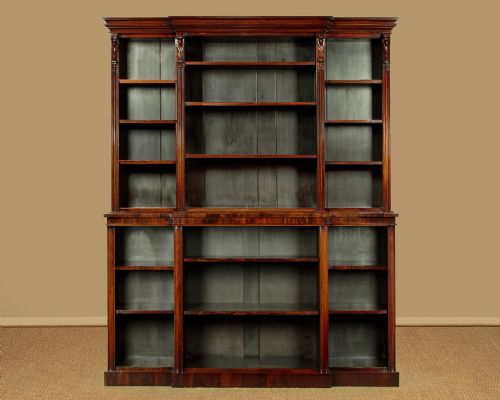
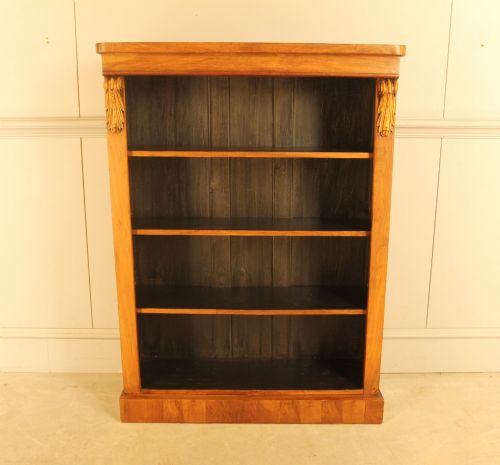
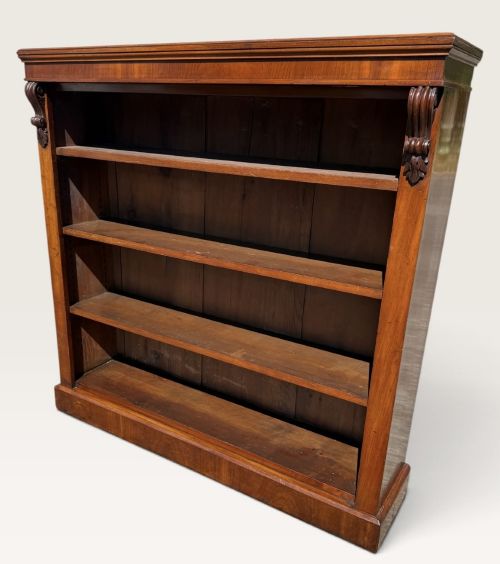

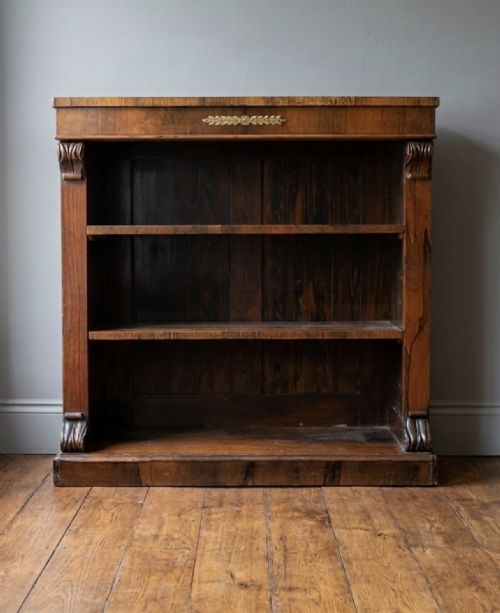


Carved Corbel Bookcase
These carved corbel bookcase examples bring architectural presence to a room, offering sturdy open shelving paired with distinct carved timber supports.
Carved Corbel Bookcase
When you search for a carved corbel bookcase, you are looking at substantial library and display furniture designed to hold substantial volumes while anchoring a room with heavy architectural detailing. These pieces typically feature open shelving flanked or punctuated by prominent corbels, giving them a monumental character distinct from plain shelving units.
On this page, you are most likely to meet Victorian and 19th-century examples in rich timbers like rosewood, mahogany, and walnut. The forms range from low dwarf bookcases to large breakfront configurations, alongside occasional oak library pieces dating from the Regency and William IV periods.
How they were made
Cabinet makers constructed these bookcases using dense timbers such as rosewood, mahogany, walnut, and oak, often applying fine rosewood veneer over secondary woods. The structural carcass houses fixed or adjustable shelving, while the signature corbels are carved directly from solid timber blocks or applied as architectural ornaments.
Surface finishing relies on traditional French polishing to bring out the deep grain of the mahogany and rosewood. Brass hardware sometimes appears on associated cupboards and cabinets, while glass doors feature in two-part library variants.
Carved Corbel Bookcase Retail Price Guide 2026
Typical asking prices for carved corbel bookcase among the pieces listed under this phrase on Sellingantiques today, from the lower quarter to the upper quarter. They describe what is for sale here now, not the wider market.
Listings feature periods from the Regency era through to the late Victorian period, spanning the mid-19th century.
What varies in quality
The distinction between standard and top-quality pieces rests upon the crispness of the timber carving and the selection of the primary wood. Fine examples display deeply chiselled acanthus or scrollwork on the corbels, executed in richly figured rosewood, goncalo alves, or dense oak rather than plain pine or secondary timber.
Proportion and architectural harmony also dictate the upper tier of the range. Superior bookcases integrate their carved corbels logically into the pilasters and cornice, whereas lesser examples can appear heavy-handed or lack refinement in their joinery and backing boards.
The Carved Corbel Bookcase Glossary
- Corbel
- A projecting bracket of timber supporting a weight above it. In these bookcases, they form the decorative and structural shoulder beneath the cornice.
- Breakfront
- A piece of furniture whose central section projects forward from the flanking wings. This layout adds architectural depth to larger library bookcases.
- Rosewood veneer
- A thin layer of highly figured tropical timber applied over a stable secondary wood carcass. It provides a luxurious surface figure without the structural instability of solid heavy planks.
- Dwarf bookcase
- A low open shelving unit designed to sit beneath dado height. These pieces keep books accessible while leaving wall space free above.
- Library bookcase
- A large, robust shelving cabinet built to house extensive collections of heavy volumes. They frequently incorporate lower cupboards or glazed upper sections.
Carved Corbel Bookcase: Frequently Asked Questions
What is a carved corbel bookcase used for?
These bookcases were originally built for institutional and grand domestic libraries to house heavy leather-bound volumes. Today, they serve the same function in living spaces, holding book collections while adding historic character to an interior.
The open shelving design also makes them practical for displaying ceramics, collections, and decorative objects alongside books.
How do I identify a Victorian bookcase?
Victorian pieces often feature dense timbers like rosewood, mahogany, and walnut, frequently combined with heavy architectural carving. They span from the 1830s through to the end of the nineteenth century, showing shifts from late Regency heaviness to high Victorian ornamentation.
Construction methods during this era included machine-assisted timber preparation alongside traditional hand-finishing and French polish.
Where should I place a large library bookcase?
Large library bookcases require stable wall space away from direct heat sources and strong sunlight, which can dry out rosewood and mahogany veneers. Placing them against a flat, load-bearing wall ensures the substantial weight of the timber and books is safely supported.
Allowing sufficient clearance around breakfront or two-part models preserves their architectural proportions within the room.
What is the difference between open and closed bookcases?
Open bookcases provide immediate access to volumes without doors, a format common in nineteenth-century library and parlour pieces. Closed bookcases incorporate wooden or glass doors, offering dust protection and security for more delicate or valuable collections.
Some larger library forms combine both styles, featuring open shelves above and enclosed cupboards below.