

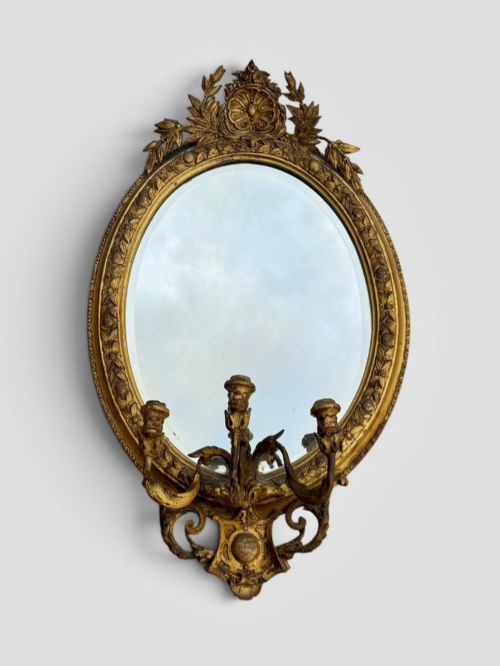
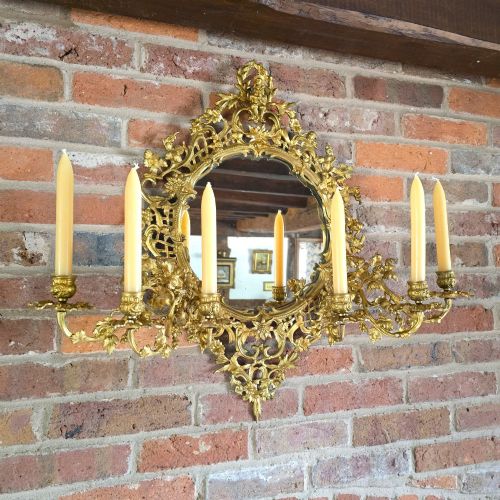


Candle Branch Wall Mirror
These candle branch wall mirrors bring genuine period character and functional candle light to a room, hung simply to reflect both flame and space.
Candle Branch Wall Mirror
A candle branch wall mirror combines reflective glass with integrated candle arms, forming a fixture designed to catch and multiply candlelight across a room. These pieces appear across several distinct historical periods, stretching from the late 18th century through the Victorian era and into the early 20th century.
The selection ranges from grand giltwood girandoles to French ormolu candelabra mirrors and carved Italian polychrome twin arm examples. Buyers frequently encounter wall sconces and girandoles originating from French, Italian, and British workshops, often featuring single or multiple candle branches.
Styles span the elaborate curves of French Rococo revival and Italian rococo, the classical symmetry of neoclassical designs, and the exotic motifs of chinoiserie. Surviving pieces demonstrate considerable variety in scale, from single wall mirrors to matched pairs intended for placement flanking a fireplace or architectural feature.
How they were made
Maker's workshops utilised traditional carving and moulding techniques to shape timber bases before applying layers of gesso in preparation for gilding. Giltwood and gilt gesso surfaces received thin applications of gold leaf, while metal versions utilised cast brass, bronze, and ormolu for the structural frames and candle arms.
Mirror glass was shaped to fit the frames, often incorporating bevelling or convex forms depending on the period and style. Polychrome painted finishes on Italian examples involved the application of pigments over prepared grounds to create decorative surface patterns.
Candle Branch Wall Mirror Retail Price Guide 2026
Typical asking prices for candle branch wall mirror among the pieces listed under this phrase on Sellingantiques today, from the lower quarter to the upper quarter. They describe what is for sale here now, not the wider market.
Several mirrors arrive with multiple candle branches ready to test whether candlelight still flatters a modern hallway.
What varies in quality
The sophistication of the carved detail and the depth of the gilding set the finer examples apart from standard production. Artisans who invested time in crisp relief work and balanced proportions achieved pieces with superior visual presence.
The quality of the cast metal branches, whether bronze, brass or ormolu, dictates the refinement of the arm attachments and the overall structural integrity of the piece. Original mirror glass and well-preserved surface finishes distinguish the most desirable survivals.
The Candle Branch Wall Mirror Glossary
- Girandole
- A decorative wall mirror featuring attached candle branches or sconces designed to reflect the flame. These fixtures served both practical lighting and decorative purposes in period interiors.
- Ormolu
- Finely chased and gilt bronze used for decorative mounts and metalwork. The technique involves applying a gold amalgam to a bronze base.
- Gesso
- A plaster mixture applied to wood frames to provide a smooth base for gilding or painting. It allowed craftsmen to achieve sharp, intricate relief ornament.
- Chinoiserie
- European decorative style reflecting Chinese artistic influences. This aesthetic appears on frames featuring oriental motifs and figures.
Candle Branch Wall Mirror: Frequently Asked Questions
How were candle branch wall mirrors used?
These mirrors were positioned on walls to amplify the illumination from candles before the advent of electric lighting. Placed strategically opposite windows or fireplaces, they maximised ambient light.
In contemporary spaces, they function as striking decorative wall focal points that retain their historic utility.
What periods do these mirrors come from?
The available pieces span multiple eras, including the 18th century, the 19th century with its Victorian and Regency periods, and early 20th century examples.
Stylistic markers such as neoclassical symmetry or rococo curves help indicate the specific era of manufacture.
How do I identify a girandole mirror?
A girandole is specifically defined by the integration of candle branches directly onto or beside the mirror frame. This distinguishes them from standard wall mirrors lacking lighting attachments.
They frequently appear as single statement pieces or matched pairs.
What materials were used to make the frames?
Frames were constructed from wood finished with gesso and giltwood, or cast from metals such as brass, bronze, and ormolu. Some regional pieces incorporate polychrome painted finishes.
Mirror glass forms the central reflective element across all types.