




Button Back Dining Chairs
Button back dining chairs are practical seats built for long dining room conversations, bringing upholstered comfort and period character to the table.
Button Back Dining Chairs
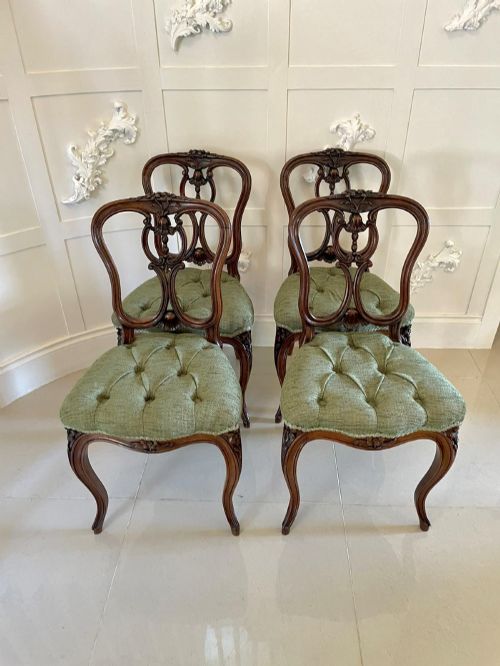
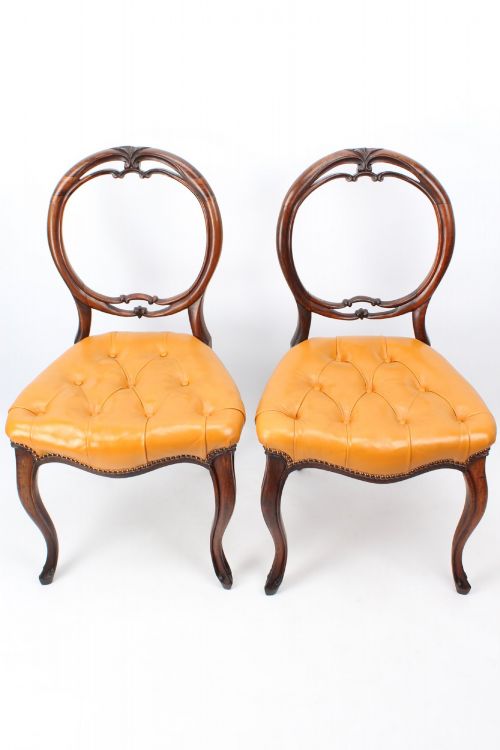
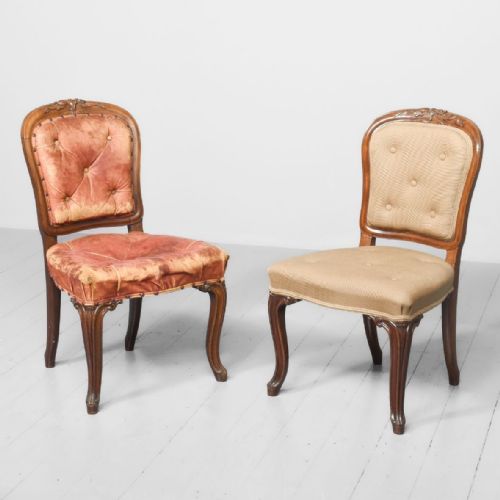
Button back dining chairs are traditional seating options designed for formal dining rooms, appearing primarily in Victorian and nineteenth-century forms. These pieces range from substantial sets of mahogany dining chairs to matched groups in walnut and rosewood.
Buyers will most frequently encounter Victorian examples featuring deep buttoning, scroll backs, and balloon shapes. The selection spans single pairs up to large matched sets suitable for bigger dining tables.
How They Were Made
Cabinetmakers constructed the frames of button back dining chairs from dense timbers like mahogany, walnut, and rosewood, often shaping the wood with hand-carved details or turned forelegs. These strong hardwoods provided the necessary structural integrity to withstand daily use around the dining table.
Upholsterers secured the padding by pulling thread through the fabric to create the signature buttoned pattern, then finished the edges with brass tacking. Caning also appears on specific revival styles, demonstrating varied handcraft techniques across the periods.
Button Back Dining Chairs Retail Price Guide 2026
Typical asking prices for button back dining chairs among the pieces listed under this phrase on Sellingantiques today, from the lower quarter to the upper quarter. They describe what is for sale here now, not the wider market.
What Varies in Quality
The distinction between standard seating and superior examples lies in the crispness of the timber carving and the symmetry of the wood grain. Richly figured walnut and rosewood elevate a set well beyond plain mahogany frames.
Attention to structural detail distinguishes the finest makers, from finely reeded legs to the depth and regularity of the button tufting. Complete larger sets maintain a greater consistency in timber selection and joinery than smaller assembled groups.
Gillows·Blyth & Sons·H. Samuel
The Button Back Dining Chairs Glossary
- Balloon back
- A chair back curved in the shape of a balloon, characteristic of nineteenth-century seating. This profile provides comfortable lumbar support during long meals.
- Button upholstered
- A technique where upholstery is secured with recessed buttons to create a tufted surface. It adds firm tension and textural depth to the backrest.
- Reeded
- A decorative moulding consisting of parallel convex strips carved into wood. It is commonly found on the front legs of dining chairs.
- Rococo Revival
- A nineteenth-century style drawing on eighteenth-century French motifs, featuring asymmetrical curves and naturalistic carving. This aesthetic appears frequently on walnut parlor and dining suites.
Button Back Dining Chairs: Frequently Asked Questions
How do I care for antique button back chairs?
Keep wooden frames nourished with appropriate furniture wax and protect leather or fabric upholstery from direct sunlight. Avoid placing them near heat sources to prevent the timber from drying out.
Regularly check the stability of the frame joints and handle the buttoned upholstery with care during cleaning.
Can these chairs be used daily?
These dining chairs were originally built for heavy daily use by nineteenth-century households using robust hardwoods. Their sturdy construction makes them well-suited for modern dining rooms.
Ensure the frame and upholstery webbing remain secure before putting large sets into regular service.
How do I distinguish Victorian from later revival styles?
Victorian pieces typically display the heavier timbers and specific hand-carving techniques native to the mid-to-late nineteenth century. Look at the construction joints and timber patination for period authenticity.
Later revival styles often imitate these earlier forms but can be identified by differences in wood finish and manufacturing tools.
What table shape suits a set of balloon back chairs?
Balloon back chairs pair naturally with rectangular or extending dining tables from the Victorian and nineteenth-century periods. Their curved profiles soften the straight lines of a large table.
Ensure there is adequate leg clearance beneath the table skirt for the chair frames.